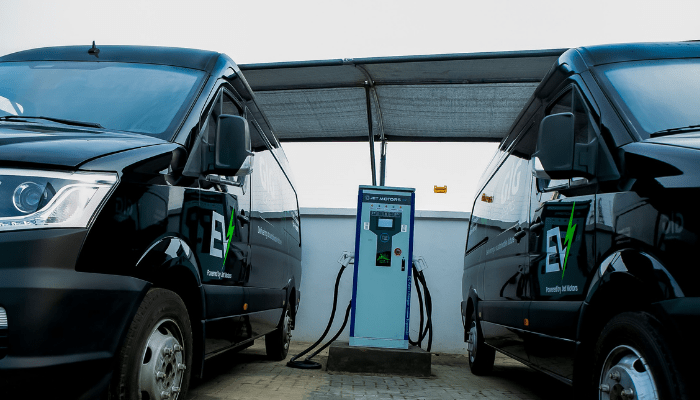
While the rest of the world is steadily moving away from fossil fuel vehicles and ramping up investment in electric vehicles (EVs) Nigeria’s poor electricity generation has held her back from fully participating despite its potential.
But one company is making a big bet on the market in Nigeria. Jet Motors recently launched a fleet of electric vehicles assembled in Nigeria.
As an entry strategy, the company focused on making commercial EVs because the market in Nigeria has yet to gain traction. There is no data yet to clearly measure what it would cost an individual to maintain a private electric vehicle in a country like Nigeria with all peculiar infrastructural challenges.
Apart from poor availability of electricity, individual owners of EVs would need a charging facility to ensure optimal charge of the vehicles. When maximally charged, an EV from Jet Motors can cover a distance of about 240KM.

Read also: Articulated vehicles and road carnage
Jet Motor said it has already delivered four electric vans to GIG Logistics. The partnership with GIGL was sealed two years ago when the logistics company, a subsidiary of GIG, reached out to Jet Motors to help push its carbon-free initiative.
“By carbon-free, I mean we are looking at having total electric vehicles do our deliveries all around Nigeria,” Ocholi Etu, Director of Operations Services and Hubs at GIG Logistics, said.
The vans which are 100 percent electric are built to be resilient on the Nigerian roads.
“People have asked me, what if you spend 10 hours in traffic? My reply was that the battery will not discharge at that same rate when the vehicle is stationary. So it means even if you spend 10 hours in traffic the rate of discharge will be like 2 percent. So you can easily cover 240 kilometres if the battery is fully charged,” Oluwemimo Joseph, the strategy and projects head and chief financial officer of JET Motor Company.

Joseph adds that under normal circumstances – without the heavy Lagos traffic – the van travels about 300km before needing a recharge.
In terms of charging infrastructure, GIGL has built a charging facility within GIG logistic digital hub in Gbagada which can charge the van to full charge in 2 hours.
GIGL plans to phase out the internal combustion engine vehicles and make the entire fleet completely electric in the future.