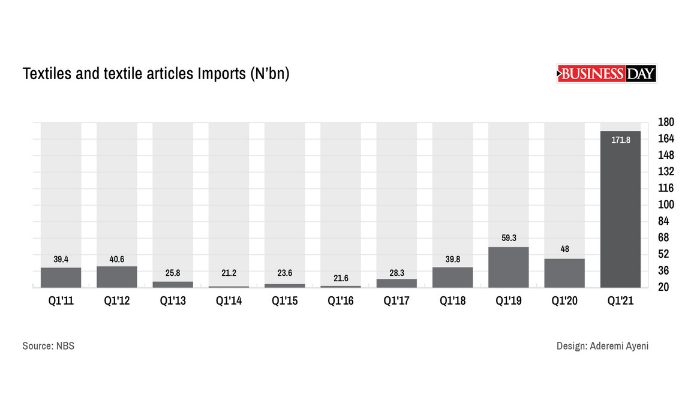
Despite the Central Bank of Nigeria’s (CBN) restriction of Foreign Exchange (FX) for textile products imports since 2019, its import has skyrocketed.
According to the National Bureau of Statistics (NBS) trade report, importation of textile and textile articles rose year-on-year by 257.9 percent in the first three months of 2021 to N171.8 billion from N48 billion in the same period of last year.
This shows that importers found other means to source for FX where the price has increased by 31 percent to N479/$ within the reviewed period.
This situation does not augur well for the once-thriving local industry as it limits its ability to take advantage of the African Continental Free Trade Area agreement (AfCFTA) where most locally manufactured goods exported among other African countries enjoy free tariff.

“With this surge in imports, how do we prepare to reap the benefits of the (AfCFTA) because people are still importing even more than before. Currently, we have 24 textile companies but they are just operating skeletal services not up to full capacity,” Hamma Kwajaffa, director-general, Nigerian Textile Manufacturers Association, says.
The textile industry plays an important role in the economy as it is believed to create huge employment for both skilled and unskilled labour, export earnings, foreign direct investment, and poverty reduction.
In the early 1980s, Africa’s biggest economy had over 180 textile mills that employed more than one million Nigerians. Some of the mills were United Nigerian Textile Limited (UNTL), Aswani Textile, Afprint, Asaba Textile Mills, and Edo Textile Mills. These firms disappeared in the 1990s as they were unable to compete in an atmosphere of smuggling and unbridled importation.
Read Also: CBN’s N220bn MSMED fund creates more opportunities for borrowers
This is not the first time that a ban has been placed on textile products. In 2008, Nigeria banned the importation of textiles and other fabrics but in 2015, the ban was lifted but a 35 percent import duty was placed on it.

However, the CBN’s N50 billion Textile Sector Intervention Facility set up in 2019 has increased capacity utilization of ginneries from 30 percent to nearly 90 percent.
According to data from the United States Department of Agriculture (USDA), Nigeria’s cotton production rose to 1.6 million metric tons in 2020 from 920,000 metric tons in 2019.
Although stakeholders in the industry have said that while the funding interventions by the CBN is welcome, funding alone does not account for the inability of the industry to compete, but the lack of enabling infrastructure, especially steady power supply.
This leads to lower outputs of finished textile products creating a domestic demand gap that is filled by imported products from China.
Nigeria is among the top cotton-producing countries in West Africa. In order to improve local production and competitiveness, a new report on the textile industry in West Africa written by the Oxford Business Group (OBG), recommends building the capacities of Small and Medium-sized Enterprises (SMEs).
This can be done through training programmes in priority areas (including supply, quality control and marketing of textiles), preparing investment profiles to attract foreign direct investment in the textile sector and providing information for micro-enterprises and SMEs in the region and buyers outside of Africa.
“With its access to an abundance of raw material, competitive wages, strategic location, West Africa is well placed to develop its textile industry,” Karine Loehman, OBG’s managing director for Africa, states.
Other recommendations highlighted are providing SMEs and trade and investment support institutions (TISIs) with the necessary expertise to benefit from other support programmes and initiatives in the regional textile value chain.
It also recommended strengthening the type of support provided by TISIs to SMEs, particularly in organising networking events, training TISIs in accessing the necessary financial resources for a networking and sharing platform for SMEs in the textile sector and providing commercial online monitoring tool for all textile operators in the region.
Loehman also notes that introducing value-added steps into the supply chain, such as spinning, weaving, dyeing, printing, finishing and garments, will provide local economies with a significant boost, while also helping to reduce imports from the Asian markets.
Other African countries like Ethiopia have begun to see the importance of the textile industry as its government has shifted their focus from agriculture to the fashion and textile industry as a priority for poverty reduction and economic development.
The industry employs over 95,000 people. The Ethiopian government has also set itself an ambitious goal to create additional 350,000 jobs by 2022.
“If these recommendations are implemented it will surely give the industry a boost. But emphasis has to be based on import substitution in that industry,” Damilola Adewale, a Lagos-based economic analyst, advises.