



As the prospect of having a West and Central Africa maritime shipping operating company continues to grow, investors have also been taking advantage of the Sealink placement offer, which they expect will turn in huge returns after two years.
The private placement is currently taking place by way of offer for subscription of 89,036,956 ordinary shares at $0.70 per share, all of which are worth $62.3 million.
Already, 10 million ordinary shares have been issued and fully paid as local investors’ appetite in the project continues to rise. This initiative is championed by the Nigerian Export-Import (NEXIM) Bank, the Federation of West African Chambers of Commerce and Industry (FEWACCI), Sealink Promotional Company Limited and Transimex, while FBN Capital Limited is the financial adviser and issuing house.
According to the promoters, the purpose of the ongoing offer is to raise funds needed to acquire sea-going vessels for conveying people and cargo across the West and Central Africa coast. Information available to BusinessDay shows that the project to be undertaken include vessels which will cost $47 million; spares $2.35 million; other equipment $6.37 million; and a three-month working capital of $4.3 million.

“The Sealink project is worth investing in. We need to be interested in investing in the project because it would facilitate the realisation of enormous trade-related benefits, such as reduction of non-tariff barriers to trade, elimination of transit corridor issues, reduction of transaction costs to economic operators, as well as enhance fiscal benefits to various governments through formal and documented trade,” said Roberts Orya, managing director/CEO, NEXIM Bank, in Lagos.
Sealink is an initiative to create a West and Central Africa maritime shipping operation that will facilitate trade and eliminate bottlenecks encountered via land transportation. This will become the first serious collaboration between the Central and West Africans to prop the now $1 trillion combined Gross Domestic Product (GDP) and widen the market of 460 million people in a stake some analysts say could turn in $5 billion.
The first proposed passenger-cargo route will interconnect eight cities, from Cape Verde to Abidjan, while the second one will join six cities across the two regions. Route III, which will centre on only freight, will interconnect 10 cities, including Lagos, Nigeria’s economic capital.
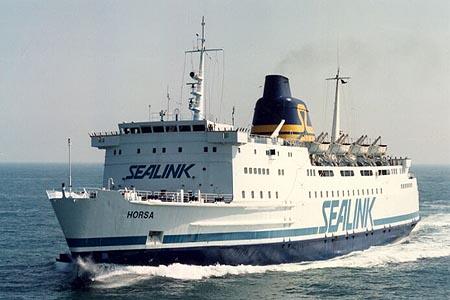
Afolabi Olorode, associate director and head, Financial Advisory, FBN Capital, said the investment was worth making as all estimates showed that it would break even in two years. According to him, there was potential opportunity for Sealink to capture the pent-up demand for fast, reliable, safe, cheap and barrier-free means to transport people and goods.

The world’s second-most populous continent is blighted by high transport/logistics cost. Findings have shown that shipping of goods from Japan to Abidjan, capital of Cote d’Ivoire, which costs $1,500 could go for as high as $5,000 just from Addis Ababa to Abidjan.
Apart from this, the movement is often characterised by exploitation by corrupt regional government officials, delays and internal bottlenecks. The Manufacturers Association of Nigeria Export Group (MANEG) has been lamenting the gridlocks members encounter in these markets, which basically involve transport bottlenecks and cloning, among others.
Though Nigeria’s export market seems to be booming, many manufacturers are yet to fully tap into the thriving opportunity provided by Africa’s 1.11 billion population. Exploiting Africa’s markets has become necessary at a point where Europe is just recovering from recession. It has even become more imperative in a situation where return on domestic investment goes between 30 and 35 percent. Incidentally, most of the export movements done by the country’s businessmen are done by road.
With logistics costs and other disturbances, including other charges, the products of these exporters eventually become very expensive and thus uncompetitive.
“We did a study and found that the easiest way for our people to travel is by sea. Every businessman who wants to expand must look at the bigger market and just like the BRICS countries, we can do it ourselves coming together,” said Wilson Attah Krofah, Sealink’s board chairman.
ODINAKA ANUDU




