Penultimate Friday when the news broke that there had been a plane crash in Kaduna involving Ibrahim Attahiru, a former Chief of Army Staff and other top military officers, many Nigerians had screamed, “Ahhhh…Again!”
The astonishment stemmed from the fact that in a space of months, Nigeria had witnessed three air mishaps involving military planes.
Recall that on Sunday, February 21, 2021, seven NAF officers died onboard a Beechcraft KingAir B350i aircraft when the jet crashed in Abuja.
The jet en route Minna in Niger State crashed close to the runway of the Abuja Airport after reporting engine failure.

Also, on Wednesday, March 31, 2021, NAF spokesman, Air Commodore Edward Gabkwet, said an Alpha-Jet aircraft involved in the anti-terror war against Boko Haram and Islamic State West Africa Province lost radar contact in Borno State.
Stakeholders raise concerns that two of the crashes occurred close to the runways of airports – Abuja and Kaduna, they say it tells something about the landing techniques of NAF officers, adding that NAF needs serious help, and the earlier the better.
But an expert said that the increased activities of the aircrafts in the war against insurgency in the North East may have exposed them to frequent accidents.
An expert was quoted as saying that, “During this period due to the war in the North East and the opening of other theatres of operations due to insurgency and banditry, there is a great increase in combat, patrol, surveillance and contingency missions conducted by NAF aircraft. There is something we conduct in the Airforce flying training school that civilian pilots don’t go through. For example, when instructor pilot and his student suffer an accident in training, the following day, the student is flown by another instructor or his own instructor if he is alive. We call it regaining confidence flight.”
It was said that the pilot of the Beechcraft plane that crash-landed penultimate Friday had wanted to land at an airstrip in Kaduna, but for bad weather went ahead trying to land at Kaduna Airport.

“The NAF Beechcraft 350 that crashed on Friday, May 21, 2021, the pilot was scheduled to land at NAF Airfield in Kaduna but just before landing, weather had dramatically changed and he had to divert to the civil, but we all witnessed visually how suddenly it rained cats and dogs (heavy downpour) at exactly 6pm the time of this expected landing at the civil airport Kaduna. He (pilot) told the tower it was almost zero visibility,” the expert further said.
Group Captain Sadeeq Shehu, a retired senior officer of the Nigerian Air Force, said on a television programme that there have been speculations and rumours because the aircraft was carrying important personalities, explaining that the accident could have been as a result of human error, weather or simply an act of God.
According to Shehu, who also is a security consultant, “There are many causes of air accidents; 80 percent is human error- (could be the pilot, air traffic control engineers- many people are involved in that chain. No aircraft in questionable condition is allowed to fly. They are always certified fit before they are approved to fly). 20 percent is weather and Act of God (where so many things can come into play).”
With the frequency in the air crashes on the Kaduna-Abuja route, many Nigerians are wondering if Kaduna is turning into another Bermuda Triangle, where stories have it that mysterious things happen, such as disappearance of aeroplanes, ships, among others.
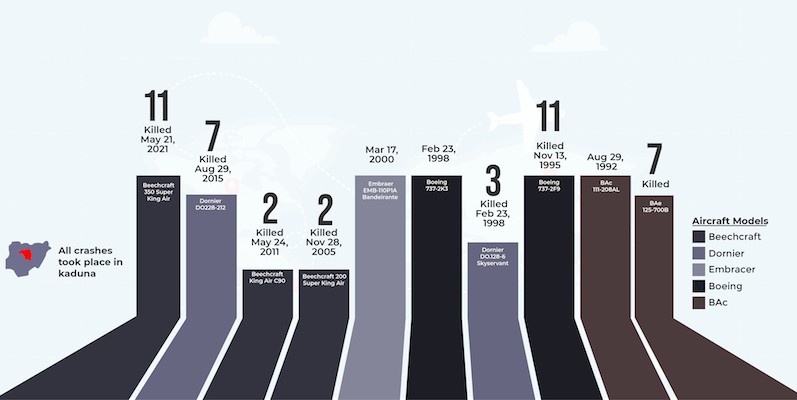
Records show that from 1985 till date, there have been about 10 air mishaps in Kaduna.
Beechcraft 350 Super King Air crashed on May 21, 2021, killing 11 people; crash of Dornier DO228-212 on August 29, 2015 claimed seven people; crash of a Beechcraft King Air C90 on May 24, 2011; left two persons dead, and crash of a Beechcraft 200 Super King Air on November 28, 2005, killed two.
There was also crash of Embraer EMB-110P1A Bandeirante on March 17, 2000. On February 23, 1998, there was a ground fire of a Boeing 737-2K3; Dornier DO.128-6 Skyservant crashed on February 24,1997 killing three people, and on November 13, 1995, a Boeing 737-2F9 crashed; three persons were killed.
Boeing 737-2F9 also crashed in Kaduna on November 13, 1995, killing 11 people. There was also a crash of a BAc 111-208AL on August 29, 1992, and the crash of a BAe 125-700B on December 31, 1985 claimed seven lives.
A source told BusinessDaySunday that the Kaduna-Abuja route had become so scary that even some Army chiefs loath flying the route.
“Air mishaps have become frequent in this country. As you well know, there have been about three in the last few months. I can tell you for free that some people have already grown weary of flying the Kaduna-Abuja route nowadays. I can’t confirm it, but I was told of one of the top Army officers that insisted he would not fly the route. Again, I don’t know how true that information is. But the truth is that whatever needs to be done should be done to check such occurrences,” the source said.
According to Wikipedia, Bermuda Triangle, also known as the Devil’s Triangle, is a loosely defined region in the western part of the North Atlantic Ocean where a number of aircraft and ships are said to have disappeared under mysterious circumstances.
“The vicinity of the Bermuda Triangle is amongst the most heavily travelled shipping lanes in the world, with ships frequently crossing through it for ports in the Americas, Europe and the Caribbean islands. Cruise ships and pleasure craft regularly sail through the region, and commercial and private aircraft routinely fly over it,” it says.
Wikipedia notes that the earliest suggestion of unusual disappearances in the Bermuda area appeared in a September 17, 1950, article published in The Miami Herald (Associated Press) by Edward Van Winkle Jones. Two years later, Fate magazine published “Sea Mystery at Our Back Door”, a short article by George Sand covering the loss of several planes and ships, including the loss of Flight 19, a group of five US Navy Grumman TBM Avenger torpedo bombers on a training mission. Sand’s article was the first to lay out the now-familiar triangular area where the losses took place, as well as the first to suggest a supernatural element to the Flight 19 incident. Flight 19 alone would be covered again in the April 1962 issue of American Legion magazine. In it, author Allan W. Eckert wrote that the flight leader had been heard saying, “We are entering white water, nothing seems right. We don’t know where we are, the water is green, no white.” He also wrote that officials at the Navy board of inquiry stated that the planes “flew off to Mars.”
In February 1964, Vincent Gaddis wrote an article called “The Deadly Bermuda Triangle” in the pulp magazine Argosy saying Flight 19 and other disappearances were part of a pattern of strange events in the region. The next year, Gaddis expanded this article into a book, Invisible Horizons. Many other books have been written about the area, all keeping to some of the same supernatural elements supposedly at work there.
On that fateful Friday, May 21, Nigerians were jolted with the news that the aircraft, on final approach to Kaduna Airport in poor weather conditions, the twin engine aircraft crashed, bursting into flames.
The aircraft was totally destroyed by impact forces and a post crash fire. All 11 occupants were killed, among them General Attahiru. He was returning to Kaduna with a delegation of six other Army officers, among them three Brigadier-Generals.