Before the assumption of office of Governor Udom Emmanuel, Akwa Ibom State health statistics were frightening and discouraging, and called for a state of emergency.
The state ranked sixth out of Nigeria’s 36 states, including Abuja, for the highest number of people living with HIV, according to PEPFAR/USAID-funded Programme to Build Leadership and Accountability in Nigeria’s Health System (PLAN-Health), managed by Management Sciences for Health (MSH), in its five-year project (2010 – 2015).
Also, the 2012 National AIDS and Reproductive Health Survey showed the state had a prevalence rate of 6.5 percent, which was higher than the national prevalence rate of 3.4 percent.

The maternal mortality rate was 77 per 100,000 live births and infant mortality was 72 per 1,000 live births. This was as a result of minimal use of antenatal care (ANC) services by pregnant women and deliveries outside the formal sector. Available statistics then showed that 57.2 percent of pregnant women attended four or more ANC sessions, while only 39.7 percent deliveries were attended by skilled birth attendants.
Then, nearly 60 percent of the women surveyed did not deliver in a health facility. Traditional birth attendants (TBAs) were reportedly the preferred service providers in the communities because of their availability, accessibility, and affordability.
Read Also: Water: Ogun assures residents of quality health care
Why? The financial risk of paying out-of-pocket for health services, poor attitude and unavailability of health workers, and inhibiting religious and traditional beliefs discouraged pregnant women from accessing health services.
Providing equitable services and interventions to address the HIV burden in Akwa Ibom State was a health management emergency then. Sadly, the 2012 Nigeria Health Workforce Profile for Akwa Ibom showed there was one doctor per every 24,000 people and one nurse per every 1,500 people.

Interventions to strengthen the leadership, management, and service provision of the state’s health system were seriously needed. Adequate skills, strengthened management, and an enabling environment for service provision were also critical to reducing the burden of HIV, and other forms of diseases like tuberculosis.
Things are now different
With his corporate background, knowing that enthusiastic employees are the backbone of any successful company, and a belief that a healthy workforce will make a vibrant economy, Governor Udom Emmanuel has done everything possible in revamping the health sector for effective healthcare delivery for the people of Akwa Ibom State.
Firstly, and in addition to the free healthcare policy for children within the age bracket (0-5) years, pregnant women and the aged, the Governor has put in place institutional frameworks to coordinate and supervise effective healthcare services in the state, including: the Primary Healthcare Development Agency, the State Hospitals Management Board, and the Ministry of Health, all with proven health professionals and administrators to head health matters.
This was made manifest within his first 100 days in office, when he undertook the rehabilitation of a foremost missionary health institution in the state capital – St. Luke’s hospital, Anua, for improved healthcare service for residents of the Uyo metropolis and its environs.
The refurbishment of the facility did not only give the hospital an aesthetic face-lift but provided the institution with state-of-the-art equipment and remodelled wards, in honour of the renowned Irish Missionary who worked selflessly for the hospital, Dr. Ann Ward.
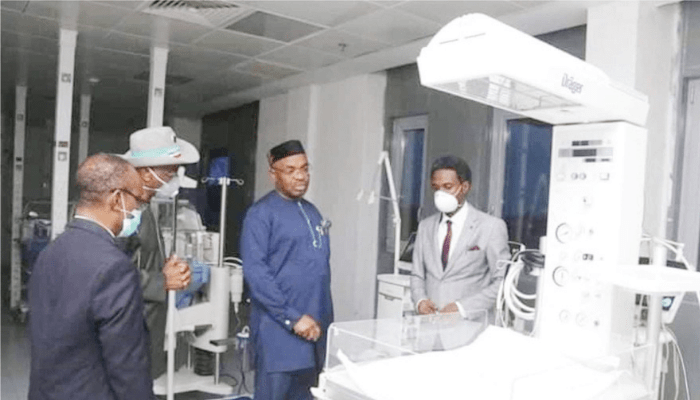
As matter of urgency, and with the determination to ensure that at least one state-of-the-art health facility was reached within a driving distance of an hour in each of the 10 Federal Constituencies of the state, the Governor urgently engaged on the remodelling, upgrading, and re-equipping of secondary heath institutions across the state for efficiency and accessibility.
To this end, he undertook the upgrading, computerisation and digitisation of hospitals in the state towards effective healthcare delivery and ease of tracing of medical records of patients, as the government was gearing towards networking all General Hospitals in the state. So far, over seven General Hospitals have benefitted from the ongoing refurbishment in the health sector namely: General Hospital, Etinan, General Hospital, Ikot Okoro, General Hospital, Ikono, General Hospital, Ituk Mbang, General Hospital, Iquita, Oron, General Hospital, Awa and Immanuel General Hospital, Eket.
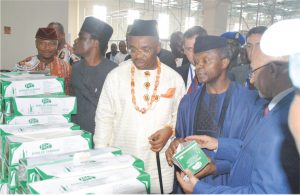
Vice President Yemi Osinbajo, while commissioning the refurbished General Hospital, Etinan, on September 23, 2017, and in appreciation of the feat recorded by Governor Emmanuel in the health sector, said, “This is an extremely useful project, it is the type of project, I believe touches the lives of the people directly.”
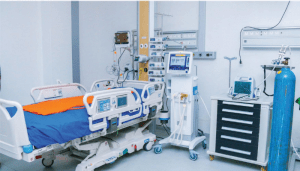
Amazingly, the Governor, so far, had procured 100 containers of state-of-the-art medical equipment for health institutions across the state, with over half of the containers so far delivered. Among the procured medical equipment include: Electrocardiograph 3 Channels, colonoscopy (with halogen light), x-ray film processor, x-ray film viewer, gastroscope, operating theatre light (5-Spot light), operating table and anastasia trolley with ventilators.
Others are: monitor, syringe pump, electro surgical units, monopolar-bipolar operating instruments, suction pump, CT scanners, as well as surgical microscope for the eyes.
In addition to changing the fortunes of secondary health institutions across the state, he also took steps to salvage the quaternary health institution in the state – the Ibom Multi-Specialty Hospital, which did not only suffer from mismanagement but needed some level of completion work. The Governor did not only engage the services of expert for the management of the health facility but also equipped the institution with world-class medical facilities as well as employed professionals in various specialised healthcare fields, who have worked assiduously in providing health care for patients on referrals and have also proved their mettle in containing the ongoing fight against the global ravaging COVID-19 pandemic, and other health challenges in the state.
Before the insurgence of the COVID-19 pandemic, the Governor had constructed the Emergency Operations Centre at the Infectious Disease Hospital, Ikot Ekpene, as well as procured the Oxygen Plant, which have complemented the Ibom Multi-Specialty Hospital in the care for COVID-19 cases.
Despite the unprecedented occurrence of the coronavirus pandemic, Akwa Ibom managed to have 14 deaths despite 1,780 confirmed cases while 1,603 people were discharged.
Another big feat towards this was the construction of the record breaking 300-bed International Isolation Centre with inbuilt Molecular Virology Laboratory that has received global applause and commendation. The Laboratory with a Category 3 PCR Machine has since commenced the testing of COVID-19 cases, a feat that has been hailed by the World Health Organization and the Nigeria Centre for Disease Control.
To further boost the health sector and enhance healthcare delivery, the Governor approved the recruitment of over 250 medical doctors, 400 nurses and 100 consultants organise training for health workers with payments of handsome incentives. There has also been series of specialised training and certification for 100 health workers in Basic Lives Support and Advanced Cardiac Lives Support by Medical Energy Experts from the USA; Training of 20 Biomedical Engineers as well as approval for the payment of the Consolidated Medical Salary Structure (CONMESS) and CONHESS to medical and dental practitioners and nurses respectively.
With all these in place, it was therefore not surprising when Governor Udom Emmanuel came out convincingly to announce publicly that, COVID-19 did not meet Akwa Ibom State unprepared. And with the heights so far attained in containing the COVID-19 pandemic so far, including: scoring 99% in Contact tracing, recording only two deaths and being placed among the top three states in Nigeria in quick recovery rate of COVID-19 cases, then it is very clear that the Governor is scoring very high in healthcare delivery for the people, at least with 48 hospitals and allied health institutions, according to its website.
Notably, the import of his efficient healthcare delivery in the state is manifested in the reduction in child and maternal mortality, and most importantly, making the state a reference point in healthcare delivery and medical tourism.
Today, Akwa Ibom can boast of a health sector that is not only encouraging medical tourism but also effective enough to increase the life expectancy of the people.
Generally, the Governor has through the health sector demonstrated an understanding of corporate governance, which considers the people as central and salient to all other facets. After all, no other facet of governance is operational without the people. His prioritisation of the health sector therefore is equally proportional to the high premium he places on the lives of his people.
Jubile Syringe Manufacturing Company
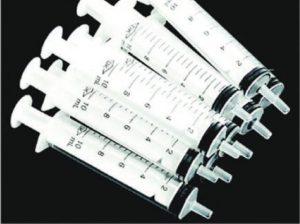
In the Governor’s avowed zest to continually increase the state’s industrial landmark in general, and improve the health sector in particular, the Jubilee Syringe Manufacturing Company (JSM) Limited was established in 2017 for the purpose of producing disposable syringes in Nigeria.
The JSM is the largest syringe factory in Africa with an annual production capacity of 350 million and is set to be the leader in the syringe manufacturing sector in the continent.
JSM, also in Awa, Onna LGA industrial zone, syringes are made from the highest quality, medical grade raw materials with state-of-the-art technology, according to Farukh Shahzad, production manager of the company, saying, our 2-part Luer slip type syringes come in three sizes (2mL, 5mL, 10mL).
With a mission of ensuring its customers are provided with the highest quality disposable syringes, thereby helping people of Africa live healthy lives, JSM aims to deliver superior growth and profitability to its shareholders by continuously improving productivity and lowering costs.
“We envision an Africa where our products improve healthcare services and patient safety. We will earn our customers’ trust and strive to exceed their expectations by never compromising from our quality and our integrity. We aim to be an African leader in the production of disposable syringes,” according to the vision statement of the company.
Just last month, the syringe firm recorded another milestone by bagging International Organisation for Standardisation (ISO) certification for industrial quality, less than two months after it secured the endorsement of the Nigerian Medical Association (NMA) for the quality of its products.
The ISO certification is also for conformity with industrial quality and for the production of single use hypodermic, sterile disposable syringes.
It product was adjudged to have conformed with the requirements of ISO 9001:2015 and ISO 13485:2016 International Standards.
Olumicle Ajibawo, managing director, Professional Evaluation and Certification Board (PECB), who made the presentation of the certificate to the company, noted the international body was satisfied with the management and quality of products from the company.
According to Ajibawo, “By achieving the ISO 9001 and ISO 13485 certification, the company will benefit from the opportunity of improving efficiency and customer relationships, team’s cohesion and cost containment.
“By holding a PECB certificate, you will demonstrate that you have the necessary capabilities to improve overall businesses performance, and shield yourself and your organisation against persistent, changing and undefined threats in a moderately challenging environment over a short period of time.”
He lauded the board of directors, management and staff of the company for their commitment to achieving compliance with the international standard through their Management System Certification Services. On his part, Akin Oyediran, managing director of the company, when receiving the award, attributed the success recorded by the firm to the hard work of the staff he described as the best.
With the certification the company would be seen as an international competitor and would continue to work harder and better to be so recognised at the international market, Oyediran said.
One of the challenges the company would face in the international market is that it would be seen as a Nigeria company, he said, but noted that a world-class product in Nigeria is not impossible.
The next part of the certification would be to go for what would allow it to send its product to Europe, he noted, adding, “We are not resting on what we have achieved.”
Ukpong Akpabio, the state commissioner for trade and investment, in his remarks, said the Ministry would be ready to partner the company towards the actualisation of the industrialisation policy of the government. “As you continue to break new grounds and set standards in the area of medical services industrialisation, revenue generation and employment generation, may you sustain this tempo and remain a value partner.”
It was gathered that the company has concluded a plan to diversify into the production of other medical devices including hand gloves and nose masks. All these are made possible through the determination of the state Governor to see the state is best to none at this trying time in the world economy.