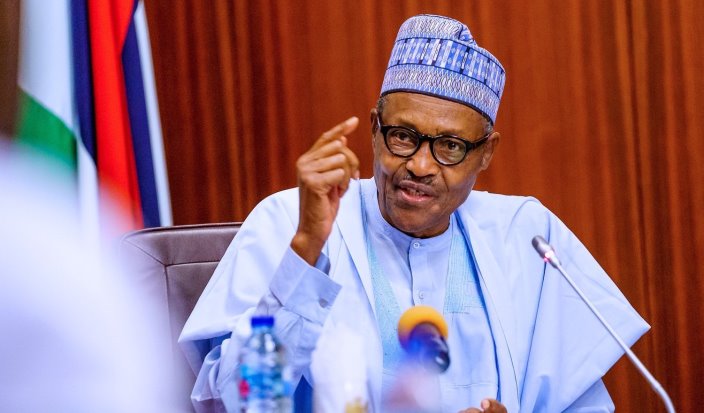
Nigeria is planning a return to the Eurobond market as President Muhammadu Buhari on Tuesday sought Senate approval to borrow fresh $6.18 billion external loan to partly fund the N13.58 trillion 2021 budget.
This is coming barely a month after the Senate approved $1.5 billion and €995 million external borrowings for the Federal Government.
However, some Nigerians on Tuesday raised concerns over the terms of the borrowing and the utilisation of the fund.
Reacting to the development, Taiwo Oyedele, head of Tax and Corporate Advisory Services at PwC, said the 2021 budget of the Federal Government has a deficit of N5.2 trillion. By implication, it means that government has to borrow N5.2 trillion to finance the budget. This is expected to be a mix of domestic and foreign borrowings.

According to Oyedele, the real issues of concern should be the terms of the borrowing and the utilisation of the funds. If applied productively, borrowing can have a positive impact on the economy.
“Also, it is critical to expand Nigeria’s revenue base to reduce the debt service cost to revenue ratio, otherwise the country’s debt profile is becoming unsustainable,” Oyedele said.
The loans were part of the $5.5 billion and €995 million external borrowings Buhari had, in May 2020, asked the Senate to approve to finance various priority projects of the government and to support state governments facing fiscal challenges.
Read Also: COVID -19: Buhari seeks stronger economic, military ties with France
The borrowing was contained in a letter addressed to the Senate president, Ahmad Lawan, and read at plenary.

According to Ayodeji Ebo, head, retail investment, Chapel Hill Denham, there is need to raise finance but it should be channelled to the productive sector so that it can generate activities that will pay back in the future. “It should not be used for recurrent expenditure,” he said.
In the letter titled: ‘Request for the resolution of the National Assembly for the implementation of the new external borrowing of N2.343 trillion about $6.183 billion in the 2021 Appropriation Act,” Buhari said that the proposed loan, equivalent of N2.34 trillion, would be used to finance the 2021 budget deficit of N5.6 trillion.
The president also explained that the loan would enable the government to fund critical infrastructural projects in transportation, health and education, among others.
He said the request was in line with the Provisions of Sections 21(1) and 27(1) of the Debt Management Office (Establishment) Act, 2003 (DMO Act).
Section 21(1) of the DMO states: “No external loan shall be approved or obtained by the Minister unless its terms and conditions shall have been laid before the National Assembly and approved by its resolution,” while Section 27(1) states: “The National Assembly may by a resolution approve, from time to time, standard terms and conditions for the negotiation and acceptance of external loans and issuance of guarantees”.
The President recalled that the 2021 Appropriation Act provides for N4,686,775,885,696.00 as New Borrowings (Item No. 328) to part-finance the 2021 Fiscal Deficit, of which 50 percent or $2,343,387,942,848.00 (about $6,183,081,643.40 at the Budget Exchange Rate of $1.00/N379) is specified as New External Borrowing.
He said the allocation of N2.343 trillion to New External Borrowing in the 2021 Appropriation Act was consistent with the Nigeria’s Debt Management Strategy, which seeks among other objectives, to moderate debt service costs by accessing relatively cheaper external funds, and to free-up space in the domestic market for other borrowers.
With respect to the Terms and Conditions of the proposed External Borrowings, the president disclosed that the multilateral and bilateral institutions operate on standard Terms and Conditions.
As regards the Eurobonds, the president noted that the Final Terms and Conditions (Interest Rate and Tenors) could only be determined at the point of Issuance of the Bonds in the ICM, and would be subject to market conditions prevailing at that time.
In the president’s second letter titled: ‘Request for the Senate’s concurrent approval of donor fund projects under the 2018-2020 Federal Government External Borrowing Rolling Plan,” he explained that the projects listed under the 2018-2020 External Borrowing Plan would be financed through sovereign loans from the World Bank, African Development Bank (AfDB), French Development Agency (AFD), Islamic Development Bank, China EXIMBank, China Development Bank, European Investment Bank and European ECA.
Others are: KfW, IPEX, AFC, India EximBank and International Fund for Agricultural Development (IFAD) at a total sum of $36,837,281,256 plus Euro 910,000,000 and Grant Component of $10,000,000.
Meanwhile, the opposition People’s Democratic Party (PDP) has reacted to the current borrowing plan of President Buhari as mortgaging the future of the country.
The party’s national publicity secretary, Kola Olagbondiyan, said the painful part was that there was no single project you could point to as to where these funds were used.
Before now, Nigeria’s total debt profile is at N33 trillion.