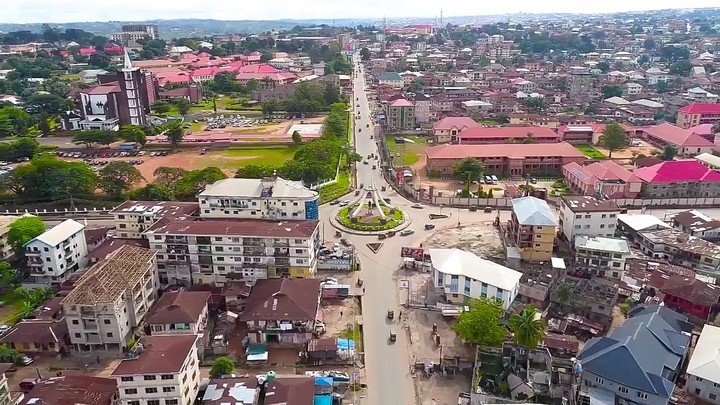
The first thing that struck me was how difficult this was going to be. Getting to Abakaliki was going to be a bit of a struggle because the Akanu Ibiam International Airport at Enugu was closed indefinitely for one reason or the other. With flights to Asaba costing in excess of N70,000 each way, my only option at the time was to fly to Sam Mbakwe Airport 160KM away in Owerri. Well I say “Owerri,” but I should point out that this airport is in “Owerri” the same way Mowe is in “Lagos.”
Don’t believe me? Here’s a snapshot from Google Maps showing the distance from airport to city.
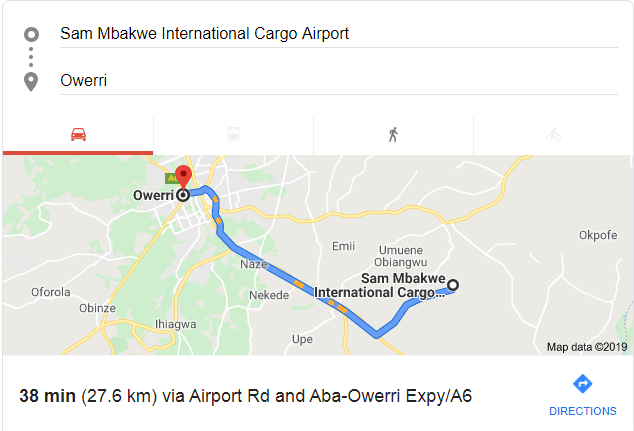
In case you’re thinking “27KM isn’t so bad,” bear in mind that this Google Maps route is the scenic airport road, generally free of traffic and potholes. It does not account for the route that I took, dotted with sections of road that had completely failed and disappeared under horrible brown water, like life-sized bomb craters. From “Owerri Airport” to Owerri took close to an hour. From there, I was directed to the premises of the Imo State Transport Company, where I could get a vehicle going to Abakaliki.

Roughly two and a half hours after boarding my flight at MM2 in Lagos, my real journey was about to begin.
Moving through Abia’s countryside, I did not see poor, hopeless and destitute Africans engaged in the grip of societal unravelling
A surprising realisation
On paper, the 189KM drive from Owerri to Abakaliki via Okigwe, a section of Abia state and Afikpo in Ebonyi State, should not take particularly long. 189KM is the same as the distance between Kaduna and Abuja, and nobody ever accused that journey of being a tortuously long one. The difference though, is the state of the roads in Imo State. Getting out of Owerri alone took the best part of an hour again, followed by a truly, unbelievably hellish drive through Okigwe. I saw a tipper truck make its way through a flooded section of bomb crater-cum-road, with the water getting up to the doors of the cabin. I watched in horrified fascination as the expected catastrophe somehow did not materialise and it emerged from the brown liquid.
The other passengers in the vehicle did not seem overly interested in the spectacle. Presumably, they had seen this many times. This repeated itself over and over, as we crawled through Imo State – never particularly far from our destination, but also hours away from it at the same time, which was a new level of frustration for me. Eventually we got out of Imo State and the roads got better as we crossed into Abia, and this was where I made a stunning realisation – Abia State is beautiful.
You did not misread that. I said Abia State is beautiful. Well, rural Abia, anyway. I have to qualify this by mentioning that we got nowhere near Umuahia or Aba, the two notoriously filthy and polluted cities, so this assessment was based solely on a roadtrip through the countryside. Abia was everything I would never have put in a sentence with it. It was green. It was scenic. It was (relatively) smooth. It was gloriously hilly with some amazing near-sunset views. Best of all, it was quiet. In the hour or so we spent driving through Abia’s countryside, I felt like I was in a Discovery Channel documentary about a scenic road trip somewhere in East Africa. It was lovely. And that was where I had a mini-epiphany about Abia and Nigeria at large – this could all be so much more.

The tourism potential in Abia if it was led by people that knew what tourism is. The volume of business and trade opportunities if a 100KM/hr rail service existed along the Onitsha-Enugu-Abia-Imo corridor. The internal and international trade opportunities if Port Harcourt could do what its name suggests and become an import-export hub located less than 60KM from Aba. The chance for increased regional and national cohesion if fast, high quality transport links existed to make it easy for anyone to travel through Abia and have their assumptions and prejudices shattered. The opportunity to spark double digit economic growth by creating Nigeria’s second urban cluster in the Southeast – a cluster which could conceivably end up being more prosperous than the Lagos-Abeokuta-Ibadan cluster.
So near, yet so far
The drive through Abia rammed the point home to me that Nigeria – for all its 10,001 problems – is actually still such a promising place. This is what makes its sustained failure all the more painful. Moving through Abia’s countryside, I did not see poor, hopeless and destitute Africans engaged in the grip of societal unravelling. I saw factories and industrial clusters, kids going to school, grand countryside mansions, beautiful, untouched scenery and ordinary people just going about their business trying to make a living. For someone who spends so much time poring over figures that scream “NIGERIA IS A FAILING STATE!” it was a humbling experience to realise that Nigeria outside of Lagos is not a giant IDP camp. It is actually a place of great promise and potential.
Potential that will unfortunately suffer devastating non-utilisation. The gorgeous scenery will eventually be ruined by illegal logging and unplanned urban sprawl as the state government looks the other way. The rail lines to boost regional and national trade acceleration and integration will not get built. Enugu Airport will remain shut for months, losing Nigeria’s economy billions in lost productivity. The repair work on it will be shoddy, condemning it to another closure 5 years down the line.
The roads in Okigwe and around Owerri will remain civil war re-enactments with political campaign billboards next to the bomb craters. The southeastern urban cluster that should become the industrial engine of Nigeria’s economy will not be enabled. The opportunity to promote national cohesion will be spurned. My sad, pessimistic figures from the BusinessDay columns will continue to be borne out by Nigeria’s economic and social indices.
In another 20 years, another young, enterprising Lagosian will make similar journey through the southeastern countryside, and he or she will see the signs of a beauty and a hope that once existed. Like me, all they will have is a melancholy feeling in their hearts while driving through, because history will have confirmed to them as I suspect now, that no matter how much hope and potential Nigeria offers, it cannot help but to disappoint you.
Like Google Maps telling us that our destination is just after an impassable stretch of cratered-out road just ahead, we are tantalisingly near, but at the same time, hopelessly far from greatness.