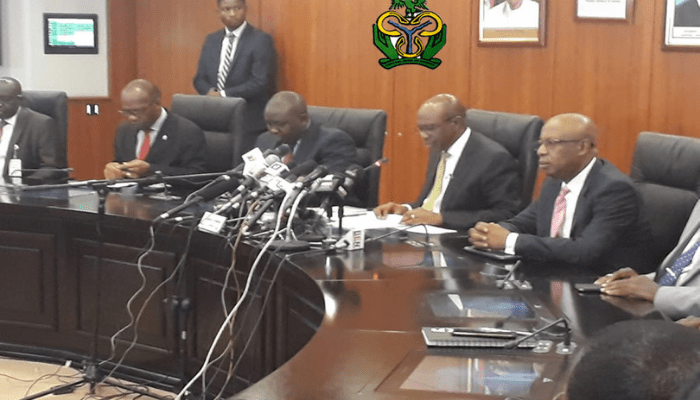
MPC decides
Analysts are tipping Nigeria’s Monetary Policy Committee to announce a hold in benchmark interest rate as the committee’s two-day meeting ends today.
The need to balance stimulating economic growth with taming stubborn inflation is seen as the major deciding factor.
Boost for cash-strapped Nigeria as FG to adopt I&E rate
In what is a potential boost for the finances of state governments and the federal government, Nigeria says it will now adopt the exchange rate that applies to investors and exporters for government transactions.

This was disclosed by Zainab Ahmed at a press briefing in Abuja yesterday.
The I&E rate, which closed at N410/$ Monday is weaker than the CBN official rate of N380/$ at which government transactions were done. With the adoption of the I&E rate, the federal government and the states will get more naira for each petrodollar.
Since the beginning of the year, the Nafex rate has hovered around N410 to the dollar, as against the average of N379 last year.
On Monday, the currency fell slightly against the U.S. dollar at the I&E window, data posted on the FMDQ Security Exchange where forex is officially traded showed.
The naira also weakened to N485 per dollar at the parallel market.
Nigeria gets $168.5m USAID fund for healthcare, education lift
The U.S. Agency for International Development (USAID) has announced an additional $168.5 million in development assistance to Nigeria for goals outlined in a 2015 bilateral agreement between both governments.
Most of the new funding, more than $115 million, will finance new and existing activities to improve public health in Nigeria, including $40 million for maternal and child health, $28 million to control malaria, as well as significant boosts in family planning, tuberculosis control, nutrition, and pandemic relief.

Another $32 million will go to economic growth, including $19 million to help Nigeria increase agricultural productivity and access to nutritious foods, $10.5 million for cleaner water, and two million to facilitate trade and investment.
An additional $15.5 million in basic education funds will expand states’ abilities to provide early grade reading programs and alternative education opportunities for out-of-school children and youth. It will also tackle the marginalization and educational needs of Nigeria’s hearing-impaired community.
Read Also: Five things to know to start your day
The last part of the fund, $6 million will go towards new activities to strengthen human rights, civil society organizations, political competition and consensus-building, and reducing trafficking in persons.
This funding raises the total U.S. assistance to Nigeria to $2.16 billion under the five-year Development Objectives Assistance Agreement (DOAG) signed between USAID and the Ministry of Finance.
FG to End Electricity Subsidies by December 2021
The federal government intends to end the current subsidy being paid on electricity by the end of the year, Special Adviser to President Muhammadu Buhari on Infrastructure, Ahmad Zakari, has said.
He also said that following the recent intervention by the Central Bank of Nigeria (CBN), the government was expecting collections on electricity tariffs to hit N100 billion in the short to medium term, adding that the amount it pays monthly to subsidise the sector was gradually reducing.
Speaking during a recent webinar organised by the Abuja Chamber of Commerce and Industry (AICC), Zakari, explained that the collection efficiency of the Distribution Companies (Discos), has significantly improved since the CBN started warehousing the funds.
Zakari stated that the Buhari-led administration was focused on moving from the traditional way of funding subsidies or using the liquidity in the sector to fund consumption, rather than using it to provide the infrastructure that will ultimately lead to growth.
Third Covid wave hits Europe
More than a year after the coronavirus outbreak was declared a pandemic, Europe is continuing to struggle with the virus amid a third wave of infections and ramping up of lockdown measures.
At the same time, the bloc’s vaccination rollout remains sluggish, hit by manufacturing issues and supply snags, to the extent that European Union leaders are meeting this week to discuss — once again — the introduction of possible vaccine export bans.
It comes as a handful of countries re-introduce lockdowns to curb a third wave of infections, with France, Poland and Ukraine all implementing stricter measures at the weekend that are set to last several weeks at least.
A month-long partial lockdown was reintroduced in Paris Saturday, as well as in 15 other regions in France, in an effort to get on top of rising case numbers, largely attributed to new, more infectious Covid variants.
The latest partial lockdown is less stringent than previous ones, however, prompting some to question the point of such a move, while others have said that the new measures are confusing. A curfew is still in place and inter-regional travel remains effectively banned.
Meanwhile, Europe’s largest economy Germany could be set to extend a national lockdown into April as the country also battles a third wave of Covid-19 cases.
As much of the EU experiences rising coronavirus cases, the bloc’s vaccine rollout remains sluggish and contentious.
EU leaders are set to meet virtually on Thursday to discuss whether to block vaccine exports while supplies within the region remain in short supply, and its vaccination program lags behind those in other developed nations.