Increasingly, many Nigerians may have lost interest in participating in the electoral process in the country. Perhaps, the low turnout of eligible voters in the December 5 Lagos East Senatorial by-elections vividly underscored the problem and threat that voter apathy poses to the nation’s democracy.
By 2pm on Election Day at a polling unit in Ikosi/isheri LGA, only 20 out of 458 registered voters in the polling unit had cast their votes.
Similar low turnout of voters was recorded in several polling units across the constituency with less than 50 per cent of eligible voters casting their votes after the end of the voting.
When interviewed the residents of the constituency blamed the candidates for not campaigning, others simply appeared disillusioned about the state of affairs in the country and did not want to waste their vote, saying their votes may not make any difference.

“Well I only heard yesterday that there was an election in this area for the senate and House of Assembly, but i don’t know the candidates that are part of the reasons I am not voting.
“Another reason is because my vote may not count; what is the assurance that if I vote it would count just like in the past? The parties here think they can win even without our vote,” Tunde Olomade, A Lagos resident, said.
Read Also: FG’s SIM registration drive risks dealing weak economy another blow
Nigeria’s election is often ridden with the challenges of violence, vote-buying militarisation of the process, ballot box snatching, thuggery with politicians desperate to win at all cost which make the environment unsafe for voters.
However, in recent times the trend has assumed an alarming proportion and is a major concern to the country’s fledgling democracy.

Democracy is said to be the government of the people by the people and for the people. Meaning the people, the electorates, have to take part in electing those who govern them; anything short of that would not give such government legitimacy.
Therefore, it can be argued that citizen’s involvement in their governance and decision-making at all levels is a necessary tool to sustain a democracy. But, this is not the case in Nigeria.
Despite efforts to check the trend; little progress appears to be made while the situation has worsened. Since 1999 general election, a year that Nigeria returned to civil rule and attained the Fourth Republic, there has been considerable drop in the number of eligible voters who cast their votes.
Voter turnout for a general election reached its lowest ebb in 2015 when 43.65 percent of the 68.8 million registered voters turned out to vote.
In 2011, the percentage turnout was 53.7 percent, 57.7percent in 2007 and a peak of 69.1percent in 2003.
However, despite the 84,004,084 (Eighty Four Million, Four Thousand, and Eighty Four) eligible registered voters for the 2019 general elections, only 28.6 million voted in the elections. A mere 35percent of the registered voters voted in the election.
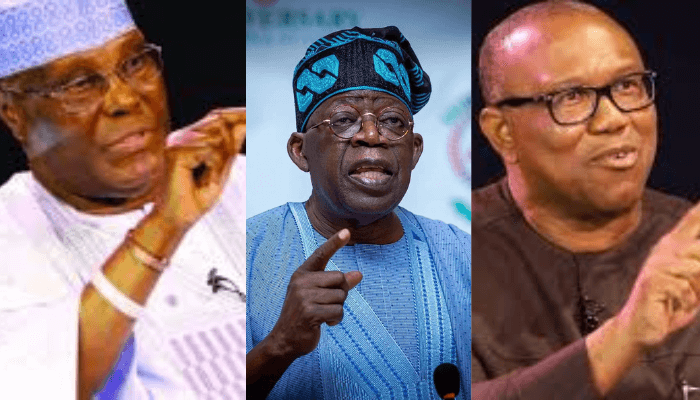
The voter apathy situation becomes serious when you consider the number that voted for the top two presidential candidates Muhammadu Buhari and Atiku Abubakar in the 2019 presidential election.
Of the 28.6 million that voted, President Muhammadu Buhari of the ruling All Progressives Congress (APC), who was declared winner got 15,191,847 votes to beat his closest rival, Atiku Abubakar of the People’s Democratic Party (PDP) who polled 11,262,978 votes.
Going by percentage of the registered voters, Buhari and Atiku got a paltry 18.5percent and 13.7percent, respectively of the votes of the total registered voters.
This trend of voter apathy was also reflected in the voting pattern in the presidential elections of 2015 and 2019.
For example, Lagos State had 6.570,291 registered voters according to the Independent National Electoral Commission (INEC), but Muhammadu Buhari polled a paltry 792,460 votes to win the state ahead of the then incumbent Goodluck Jonathan who scored 632,327 votes in 2015.
In 2019 incumbent, President Buhari also won Lagos State with only 580,825 votes, while Atiku Abubakar, his closest rival, polled 448,015 votes across the state.
Similar situation was witnessed in the just concluded Edo State gubernatorial election and in Ondo State.
In the Edo State gubernatorial election despite 2,210,534 being the registered voters in the state, in the election that happened from the 18 local government areas, 192 wards, and 2,627 polling units, only 1,726,738, collected their permanent voters’ cards (PVC) and were eligible to vote in the election.
According to the INEC, the voter turnout was terribly low at 25 percent, amid the tension of impending violence and rift.
The figure was below the 32 percent recorded in 2016, the last time a governorship election was held in the state.
Lamenting the continuous dwindling of number of voters in Lagos State, Abdul-azeez Olajide Adediran, initiator of the Lagos4lagos movement and leader of Team Jandor, said: ‘If you look at the election result from 1999, the voting number has continued to dwindle. You see that people are dropping off. People are no longer interested in voting. Registered number of voters has continued to shrink.”
According to him, “In the last governorship election in Lagos, there are over 2 million registered APC members; over 6 million registered voters, but Babajide SanwoOlu won with only 739, 000 votes. It shows you that even members of the party are losing interest.”
“Is the same total population figures they are quoting correct? I doubt that, I think it is exaggerated. In 1960, I think we had the same population with Britain today; they said we are about 200million way ahead of Britain.
“And the same thing happens when we do voter card registration that is why you see someone in Imo State but fines his name in Lagos State”, Funsho Ologunde the vice chairman of the APC in Lagos State said.
Ologunde, however, said part of the problem of voter’s apathy in Nigeria was attitudinal, adding that it was a further reflection of the failure of the Nigeria system.
“How many of these people even come out to collect their voter’s card? It is more in our attitude. We load the number when registering people and you don’t see them it is more about our attitudinal for me and ways of doing things. If you go to your local government you would collect a card to vote”.
But Inebehe Effiong, convener of the Coalition of Human Rights, blamed voter’s apathy on Nigeria’s electoral system and poor governance among the ruling class.
According to him, “Voter apathy is an indication of lack of confidence in the electoral process. “Another reason is that so much power is imbued in the Nigerian Presidency. The President is expected to be patronising. We need to devolve more constitutional powers to the states to make the centre less attractive.”
Effiong called for more involvement of the youths in the political process, saying that the government and other stakeholders can do more to educate the citizenry on their role in the electoral process.
“I believe that the voting population in Nigeria is not sufficiently enlightened. We need to continue to educate voters on why they should participate in the electoral process”.
Also speaking, Auwal Ibrahim Rafsanjani, Executive Director, Civil Society Legislative Advocacy Centre, CISLAC blamed voter apathy on what he called pessimism on the part of some Nigerians that their votes were not going to count.
“Voters in large numbers did not believe there were sufficient reasons to come out and vote in the election. Some of them see the governors or politicians as not doing enough and so coming out to vote was a big challenge.
“Again, the militarisation of the elections has added to the activities of political thugs as witnessed in the last Presidential election made some people lose interest in the entire process. This was the experience in Rivers, Lagos, Imo and Akwa Ibom where violence almost marred the polls,” Rafsanjani stated.
Meanwhile political watchers have argued that there is the need for a holistic approach in tackling trends.
They say the government and stakeholders must map out plans to educate the voters on the need for their increased participation in the electoral process ahead of the 2023 general elections.
“I think the government should do more, though people are not happy with governance in Nigeria, considering past disappointments they have had. But I think the numbers of voters can increase, we just need to educate them,” analyst Tinu Adebayo said.