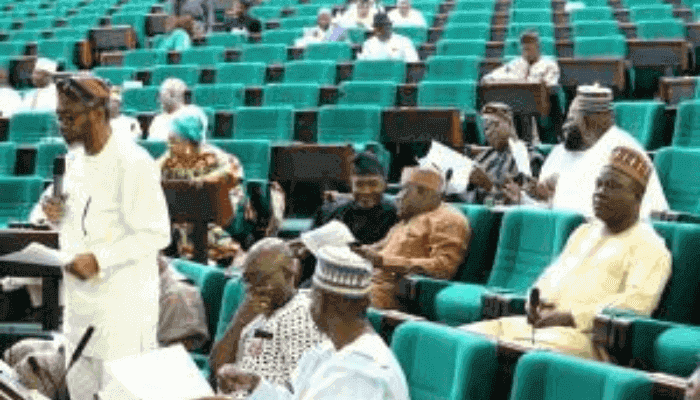
The House of Representatives on Wednesday passed for second reading, a bill to alter the constitution to stipulate a timeline within which to file and determine election petitions and appeals.
Titled; ‘A Bill for an Act to Alter the Constitution of the Federal Republic of Nigeria, 1999 to make further Provisions Relating to the time within which to file and determine Election Petitions and Appeals; and for Related Matters,’ is sponsored by Olajide Olatubosun (APC, Oyo).
Leading the debate on the Bill, Olatubosun said the emergence of the COVID-19 pandemic, which has continued to ravage most countries of the world, unveils the imperative of amending laws to accommodate force majeure in the computation of time where statutes provide time within which certain things are to be done.
He argued that it has become obvious that computation time in election petitions should take into account natural occurrences (force majeure) that would render it impracticable to meet the stipulated timelines provided.

Read Also: Bill to recover bank loans passes second reading in Senate
The lawmaker made reference to the case of Ngige v. 0bi& Ors (2006), where it took three years for the matter to be determined from commencement at the Tribunal to its conclusion at the Court of Appeal, adding that delayed cases like this, delays justice with adverse effect on governance.
Olatubosun emphasized that if the alteration is not carried out, the country will have a situation where parties to election petitions are punished for a situation they are not responsible for, and that would be most unfair, unjust, and immoral in a civilised and democratic society.
He said: ”As part of the COVID-19 lockdown, the courts were also shut except for a few criminal cases. The question that agitates our minds is whether parties to election petitions would not be thrown into a state of helplessness under such circumstances, in the absence of a provision in the constitution reckoning with force majeure in the computation of time.
”The Supreme Court has repeatedly emphasized that the various timelines provided in section 285 of the Constitution relating to election petitions are meant to operate as limitation laws so that election matters which are sui generis and time is of essence are not affected by the endemic delays in the prosecution of cases.

“Ordinarily where the law prescribes a period within which a matter should be brought, heard, or disposed of, legal proceedings cannot be properly or validly instituted or heard after the expiration of the prescribed period. An action instituted after the expiration of the prescribed period has no legal effect whatsoever, as it has become extinguished by effluxion of time. Furthermore, where the limitation of time is imposed in a statute unless the statute makes provision for extension of time, expansion, or elongation, the Courts cannot extend the time.
”Consequently, this seeks to amend section 285 of the Constitution by inserting immediately a new subsection (9) to the effect that where there is a force majeure, whether at national or state level, that prevents the filing of petition or sitting of an Election Petition Tribunal or an appellate court, the period of the force majeure shall not be reckoned with in the computation of time under subsections(5), (6) and (7) of the section. This is to prevent the hands of the parties to a petition and the court from being tied in the face of force majeure.”