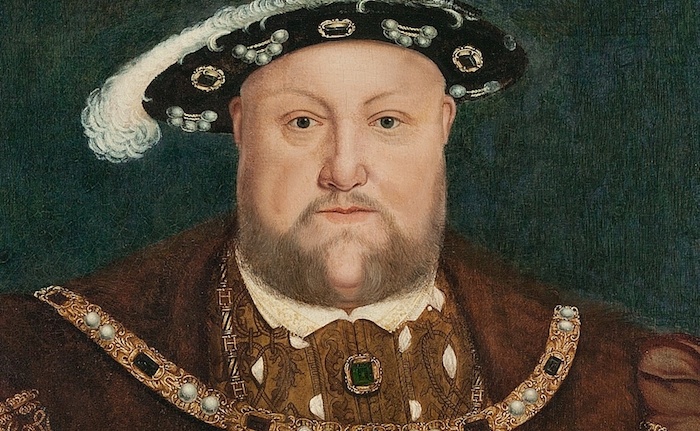
When Tudor King Henry VIII (1491 – 1547) became desperate to divorce his legitimate wife – Catherine of Aragon – over what he perceived as her inability to give him a male heir to the throne, and following the repeated refusal of the Pope to sanction a divorce, some officials and individuals – motivated in part by their desires to further their political and personal interests – took it upon themselves to help the King achieve his goal by all means possible. Those – such as Thomas Cromwell, Thomas Cranmer (who was to be appointed Archbishop of Canterbury), and Anne Boleyn (Henry’s mistress who hoped to replace Catherine as Queen) – urged Henry VIII on, making him realise and put to use his latent and untrammelled powers and advancing biblical and theological arguments to enable Henry to circumvent the difficult Catholic guidelines for annulment of marriages.
They – together with Anne Boleyn’s family – facilitated the appointment of a relatively unknown Cranmer as the Archbishop of Canterbury when the seat became vacant. Cranmer helped build the case for and sat as head of the tribunal that annulled Henry’s marriage to Catherine of Aragon. To do this, they championed the separation of the English Church from papal authority and union with the Holy See, establishing the principle of Royal Supremacy, in which the king was considered sovereign over the Church within his realm and was the Supreme Head of the Church of England.
READ ALSO: Nigeria could need $16bn for Pfizer’s COVID-19 vaccine, nearly half of 2021 budget
Crucially, however, all those who helped Henry VIII realise and put to use his awesome and absolute powers – including the Chief Minister, Thomas Cromwell and Queen Anne Boleyn – ended up on the King’s execution table, just like the officials they displaced. Even Thomas Cranmer, the Archbishop of Canterbury met his fate subsequently in the hands of Queen Mary I in 1556.

When the army is unleashed against peaceful civilian agitators, rather than condemn the mindless massacres and crimes against humanity they perpetrate, we rather condemn the victims for having the effrontery to raise their voices or even protest
But what is the use of this excursion into English history? It is simply to drive home the point in the metaphor made popular by John F. Kennedy in 1961 that “those who foolishly sought power [influence and favours] by riding the back of the tiger ended up inside.” History is replete with individuals, societies and countries trying to ride on the back of tyrannical leaders, systems or countries only to end up being victims of that same system. But Nigeria is a country that totally despises history. A former President even listed History as one of the “useless” courses of study in the university. Consequently, the subject has almost abrogated from the school curriculum. But like George Santayana argues long ago, “those who cannot learn from history are doomed to repeat it”, Nigeria has been going in circles reinventing the wheels of history and never able to learn any lessons from their or other nations’ histories.
If we could, we would have long known that the abridgement of human rights by the government under any guise is unacceptable and should be unanimously condemned by all citizens. But no! There are fanatical supporters of governments in power that urge the government on; even question why the victims and those accused should enjoy any right at all and call on the government to circumvent the law, go harder and to even handle some accused politicians and public officials with more brutality.
But if history and experience is anything to go by, we know that in Nigeria most of the cases of corruption that go to the courts do not end up in convictions. One of the reasons, among others, for this, is because the government isn’t really interested in really prosecuting the accused or is sometimes incapable of diligently investigating and prosecuting such cases. Most times, its aim is to try and convict the accused in the courts of public opinion and once that is done, the government itself loses interest in the case. Hence, since 1999, Nigeria’s anti-corruption consists of using the media to demonise, to persecute, to destroy people’s integrity knowing that most Nigerians believe that every accused person is guilty.
When the army is unleashed against peaceful civilian agitators, rather than condemn the mindless massacres and crimes against humanity they perpetrate, we rather condemn the victims for having the effrontery to raise their voices or even protest.
Haven urged the government or pushed it to become fully authoritarian or tyrannical, those fanatical supporters soon discover they have created a monster that would also consume them once they step out of line. Abubakar Sidiqu Usman learnt that the hard way in 2016. Abubakar Idris Dadiyata, a lecturer at the Federal University Dutsinma, Katsina State and a fierce defender and later, a critic of the Buhari administration may have learnt or is still learning that lesson today. More than a year ago, precisely on August 1, 2019, he was forcefully abducted from his home by men suspected to be security agents. Till date, there has been no news of him or his whereabouts. Rather than finding Dadiyata, Nigerian security agencies are absolving themselves from any form of guilt or blame for his disappearance.

Before becoming disenchanted with the government, the majority of middle-class Nigerian youth, especially in Lagos, will rationalise the tyrannical tendencies of the Buhari administration on the need to ruthlessly fight corruption. Not a few of them will insist that the government cannot successfully fight the systemic corruption in the Nigerian system entirely through lawful means. Well, the moment they also stepped out of line, they realised what the government critics have been saying all along. Not only was the genocidal army sent to massacre some of them peacefully protesting police brutality at the Lekki toll gate, the government and the army, like they always do, are trying hard to deny what was captured live on camera. But if we think the Lekki massacre will now make them more circumspect in the use of the military to target civilians, we are mistaken. The army has simply moved on to Rivers state to continue their massacre away from the watching eyes of the world.
What is more, the government has now borne it ugly fangs on the Lekki protesters and all those associated with the #EndSARS movement, arresting, restricting bank accounts and impounding passports of some of the prominent members of the movement.
I hope by the time this is over and we survive it, we would have fully learnt the lesson involved and never take a ride on the back of the tiger.