Nigeria’s government handling of the EndSARS protest has widened the trust deficit between Nigerians and the present administration, and this could cost the economy.
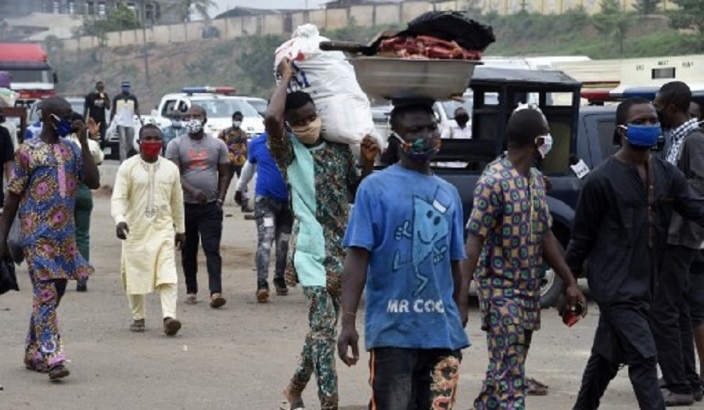
It will be harder for the government to convince the people to make the sacrifices required for economic reforms when it has demonstrated a lack of regard for the citizens. It is been two weeks since peaceful protesters were killed after the Nigerian Army opened fire on them at the Lagos Lekki Tollgate and the perpetrators look far from being brought to book.
The discovery of food items stashed away in warehouses when they should have been distributed to Nigerians who lost their means of income to the Covid-19 pandemic has also done the government’s image little favours.
“It is hard to convince people to make sacrifices for a government that is distant and cannot empathise with them, and that could block the route to economic reforms,” a senior source close to the government who does not want to be quoted, said.

READ ALSO: Sanwo-Olu presents 2021 Appropriation Bill to Lagos Assembly
“In Nigeria, it is important that the government gets the support of the people in implementing tough economic reforms that bring short-term pain but long-term gains,” he said.
Nigeria still has a host of economic reforms on the table from enthroning a fully market-reflective electricity tariff and complete deregulation of the downstream petroleum sector.
Cash-strapped Nigeria also needs to grow its tax revenues, which will require a mix of better collection rates and raising the rate people pay altogether.
Nigeria’s tax to GDP ratio of 7 percent is one of the lowest globally and compares with the African average of 15 percent.

However, growing tax revenues in a country like Nigeria will require sacrifice from businesses and individuals who point at decrepit infrastructure to make the case that tax revenues are not efficiently utilised.
With the government’s latest show of insensitivity to Nigerians with the violent turn of the End SARS protest, getting Nigerians to make sacrifices required for reform will be harder, especially if the government is not leading from the front.
Government critics say Nigerian politicians are not adopting the austerity measures being forced on the people.
From a combination of unfulfilled campaign promises, unimplemented policy reforms, corruption to bad governance, most Nigerians have long believed the government only exists for a privileged few and not for a population of over 200 million people many of whom are struggling to afford the most basic standard of living.
With a growing culture of mistrust built over decades, most Nigerians are still puzzled about why the government will fire gunshots at its own citizens or why the dreaded Special Anti-Robbery Squad (SARS) continued to operate with impunity despite being previously disbanded in 2017, 2018 and 2019.
“Definitely, the attack, the shootings and the killings have portrayed the government as being lawless, and it shows that we are not in a society governed by the rule of law,” a labour activist and human rights lawyer, Femi Aborisade, said, adding, “Citizens can’t be happy in a country where their fundamental rights are not guaranteed.”
Ordinarily, most experts believed the intervention of President Muhammadu Buhari ought to have attracted a positive response from the band of youthful protesters. However, widening trust deficit means many Nigerians took the President’s speech with a pinch of salt.
A Lagos-based senior advocate who pleaded anonymity said the thin bridge of trust between the government and Nigerians had been further shattered by the recent issues around the Lekki massacre.
“The EndSARS protest was one of the golden opportunities presented to this government to make history but instead of making good use of it, they mishandled it,” the lawyer said.
For many, they do not understand why the government only exists as a burden when it comes to demanding economic sacrifices from its tax-paying citizens rather than creating a conducive environment for business to strive or provide basic infrastructure facilities.
Most people do not understand why Nigerian legislators are among the highest paid in the world and the president controls a huge oil-money fuelled patronage system that can transform anyone into a billionaire overnight while the country is still faced with several economic maladies, including epileptic power supply, weak infrastructure and institutions, among others.
“Nigeria cannot be seen as secure and free until the people’s human rights are respected and protected by the government,” Vincent Thom-Otuya, head, Department of Management, Rivers State University of Science and Technology, said in a journal.
According to Thom-Otuya, radical approach to policy-making in a trust deficit environment is not likely to be successful. “Good governance, transparency, accountability and the rule of law are the keys to tackling corruption in our society and effectively managing government business in Nigeria,” he said.
Since Nigeria returned to civilian rule, it has not made any headway in seeing through well-thought-out policies, while public trust in government appears to be in decline alongside a growing perception of lacking political inclusion.
This is hardened by a sense of undelivered political promises, which has hastened frustration and discontent among the populace who have already been negatively impacted by the adverse economic consequences of the Covid-19 pandemic.
High unemployed labour force and rising insecurity have compounded the unsolved challenge of Boko Haram insurgency in the Northeast, contrary to Buhari’s promise of solving it within the first six months of assuming office.
Although, the government is quick to showcase their achievements on infrastructure, especially in some road and railways sectors, while promising to complete the second bridge across the River Niger in the Eastern part of the country. However, the larger populace doubts their sincerity and might have lost confidence in a government that was voted in under the mantra of “Change”.
Despite President Buhari, driving a major crusade in African Union’s corruption awareness campaign in 2018, Nigeria is now ranked 146 out of 180 countries in Transparency International’s Corruption Perceptions Index, slipping from 136 places when he was first inaugurated.
“Under Buhari’s “watchful eye,” corruption runs rampant,” Professor Steve Hanke tweeted.
In his election manifesto, President Buhari also promised to ensure equitable distribution of the nation’s wealth, close the gap between different classes and also lift 100 million Nigerians out of poverty in the next 10 years.
He also formulated an Economic Recovery and Growth Plan (ERGP) in 2017, which forecasted that by 2020, Nigeria’s economy would grow at an average of 4.6 percent annually, unemployment rate projected at 11.23 percent by 2020 while inflation was projected at a single digit.
In reality, over 95.9 million people are now living in extreme poverty, growth is at -6percent, and inflation is nowhere near the country’s single-digit target while unemployment has almost doubled to an all-time high of 27 percent.
Aside from failing to implement policies drafted in its development plans, another major issue widening distrust is Nigeria’s penchant for killing policies, however good, so long as they were drafted by a previous government.
Before the formulation of Vision 2020 in 2009, Nigeria had an economic development plan known as Vision 2010 that was drawn up under the then military government of General Sani Abacha.
The Vision 2010 plan, which was crafted in 1996, was articulated by over 300 Nigerian stakeholders from all walks of life, including expatriates. It had a workable document to put Nigeria on an economic growth trajectory by 2010.
“For us in Nigeria, the need to do this visioning has never been more compelling given our relatively weak position in the world in many areas of human endeavour,” the chairman of Vision 2010 Committee, Ernest Shonekan, said then.
The Vision 2010 was abandoned by subsequent governments: Abdusalami Abubakar, Olusegun Obasanjo, Musa Ya’Adua, Goodluck Jonathan and Mohammadu Buhari. And Nigeria has either stagnated or receded economically.
“Nigerians can still reduce the trust deficit index in governance by emphasising the accountability of public officeholders. Policies should be reviewed periodically to close any loophole and to catch-up with events in the society,” Thom-Otuya suggested.