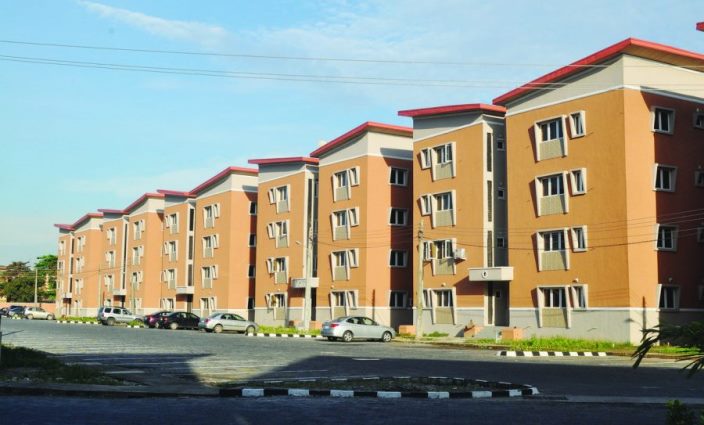
Perhaps, it will take great energy and effort to sustain an argument that Nigeria’s housing sector has not seen any change and growth in the past 60 years of the country’s independence. If anything, many of the houses that were built in the country at independence have given way to modern, architecturally sophisticated structures, especially in the cities.
But, given the tremendous change in demographics and the startling housing and homeownership situations in the country today, it could be safely said that housing development in this part of the world has remained very slow, even as demand continues to grow in multiples, outstripping supply.
Though there were great strides in housing development within the first three decades after independence, the slack that followed the period is amply reflected in the home ownership level in the country today with all the sounds and fury from private initiatives.
As against 72 percent home ownership level in the US, 78 percent in UK, 60 percent in China; 54 percent in South Korea and 92 percent in Singapore, homeownership level in Nigeria, 60 years after independence, is estimated at 25 percent.

Arguably, Nigeria started out well after independence with forward-looking national development plans that had ambitious housing development components. A few samplers may suffice here.
The first National Development Plan of 1962 – 1968 saw ‘young’ Nigeria establishing state-owned housing corporation which was for the provision of urban infrastructure and industrial estates in three key areas— Lagos in South West, Port-Harcourt in South East and Kaduna in the North.
The second National Development Plan from 1970 to 1974 saw the establishment of National Council on Housing and the creation of Federal Housing Authority (FHA) in charge of housing Nigerians and the establishment of National Housing Programme (NHP) to construct about 59,000 housing projects. That was when the Staff Housing Loans Board was established.
The third National Development Plan from 1975 to 1980 saw activities of federal government’s direct intervention in housing when about 220,000 dwelling units were proposed. 50,000 units in Lagos, then 8,000 units in each of the then 19 states. At the end, only 15 percent of the projection was achieved.
There were other housing programmes such as the establishment of committee on standardization on housing types and policies in 1975. There was also an anti-inflation task force in 1976. There was also a Rental Panel in 1976, and then the Land Use Panel in 1977. The Nigeria building society was also converted to Federal Mortgage Bank of Nigeria (FMBN) in 1976 with a special capital base of about N20million, then increased to about N150million later on in 1979.

The last of these government housing programmes seemingly ended with the second civilian administration from 1979 to 1983 during which period there was an elaborate national housing programme based on the concept of affordability and citizens’ participation. This was the period of low cost housing by the President Shehu Shagari at the federal level and Lateef Jakande in Lagos.
The return of the military junta to governance (led by the present President Muhammadu Buhari) marked the beginning of where Nigeria finds itself today in the housing sector. Things have gone so bad that the statistics send chilling waves down the spine.
With a growing population of 200 million and high urbanization growth rate estimated at 4-5 percent per annum, housing stock in Nigeria is said to be between 12 million and 15 million units while an unconfirmed record shows that about 25 million households with six members each don’t have homes of their own.
A report by BusinessDay Research and Intelligence Unit (BRIU) on Nigerian Real Estate says that out of 200 million Nigerians, only 8 million people qualify for the luxury property market, adding that while there is more than enough for the latter, hardly any thought is spared for the remaining 192 million citizens.
According to the report, over 80 percent of Nigerians are living in ‘unplanned residences’ and those in the urban centres are living in rented accommodation that takes away almost 40 percent of their income with no adequate facilities for water or electricity.
Even though the federal government is in denial of this fact, housing deficit in the country today is over 20 million units. This deficit, according to experts, requires building over 700,000 housing units yearly for the next 20 years and spending about N56 trillion to close, meaning that, to effectively house its citizens, Nigeria needs to spend its annual budgets for over five years on housing development alone.
Views are mixed on why Nigeria’s housing sector is in this sorry state. While Terver Gemade, former managing director of Federal Housing Authority (FHA), blames it on policy summersault, and Femi Akintunde, GMD of Alpha Mead Group, blames it on infrastructure, others say it is about the country’s undeveloped mortgage industry.
Experts worry that, six decades after independence, Nigeria’s mortgage industry has remained underdeveloped owing to the same challenges that have stunted the sector’s growth since the Nigerian Building Society, the first mortgage institution that was set up pre-independence.
According to Omozokpia, Nigeria would have to learn from how the US, UK and some Africa countries were able to grow their mortgage industry because “the sector is huge and has a lot of potential for Nigeria’s economy.”
Nigeria’s mortgage to Gross Domestic Product (GDP) rate at about 0.6 percent is one of the lowest in not just Africa but in the world. While neighbouring Ghana has 2 percent mortgage to GDP rate, South Africa with 30 percent is coming behind the US and UK with 60 percent and 70 percent respectively.
“The underdevelopment of Nigeria Mortgage sector in driving homeownership is worrisome as more than 90 percent of new homes utilise funds from personal savings,” the Association of Housing Corporation of Nigeria (AHCN), a real estate body said.
“In Nigeria, the housing finance market has not fared any better,” a report titled ‘Housing Market Dynamics in Africa’ said.
According to the report, mortgage loans account for less than 1 percent of the loan portfolio of commercial banks, and only about 5 percent, or 685,000 of the housing units in Nigeria are financed using mortgages, “because Nigeria’s Federal Mortgage Bank (FMBN) has failed to meet expectations.”
For these and more reasons, despite its large population size, Nigeria is crawling behind its peers in terms of homeownership level. While the level is 84 percent in Indonesia, 75 percent in Kenya and 56 percent in South Africa, Nigeria, Africa’s most populous nation, has only 25 percent.
Funke Okubadejo, Director, real estate at Actis, advises that to address its housing challenges, Nigeria needs to have a functional mortgage industry that has to be at an affordable interest rate.
On his part, Deji Alli of Mixta Africa, says the country needs clearly articulated targets, need-based resource allocation, reviewing of existing development guidelines, development of integrated infrastructure and encouragement of PPP as a viable development initiative.
CHUKA UROKO & ENDURANCE OKAFOR