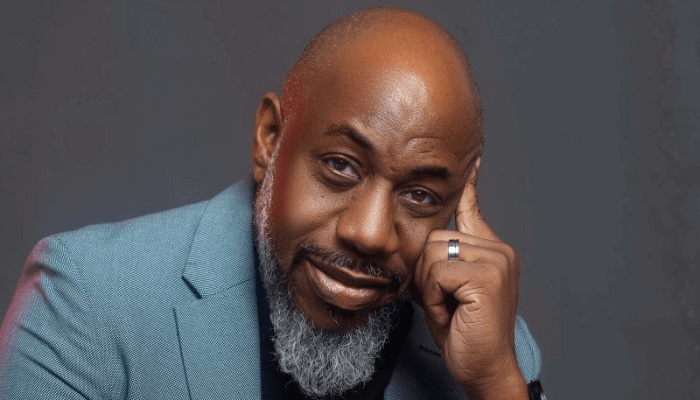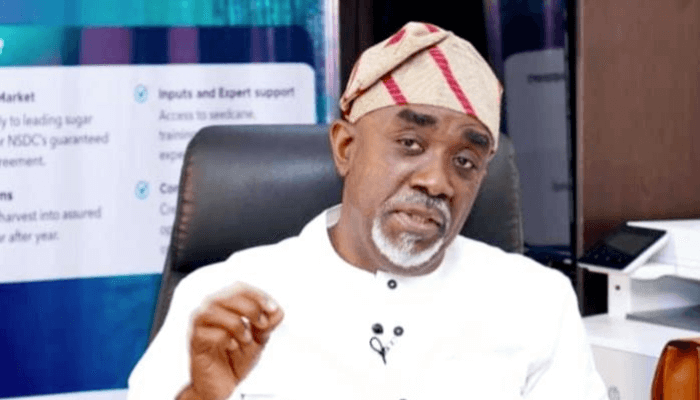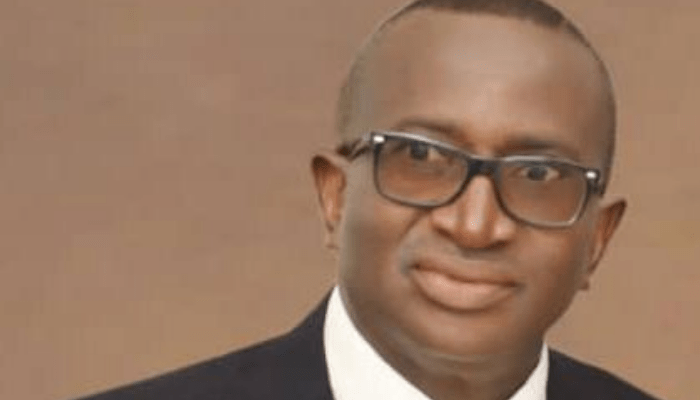
Senator Victor Ndoma-Egba, SAN, is a lawyer and politician. Son of a former Justice of the Court of Appeal, former Commissioner for works in Cross River State and third term Senator, he was Deputy Leader of the 6th Senate (2007-2011) and Leader of the 7th Senate (2011-2015) as well as the immediate past Chairman of the Board of the Niger Delta Development Commission (NDDC).in this interview with Assistant Editor/Member Editorial Board, Obinna. F. Nwachukwu in Abuja, the senior advocate explained issues around the controversial NDDC contracts, the bogus salaries and allowances enjoyed by members of the National Assembly and other matters. Excerpts:
Distinguished Senator, you have been in politics for over 3 decades. But popular thinking is that politics is a dirty game. Why did you choose politics over law which is your profession? What actually was the attraction?
I was born and I grew up in a political environment. My mother, Regina Achi Nentui who recently passed on was the first elected female County (now Local Government) Council Chairman in the defunct Eastern Region, and the entire country presumably. She was elected Chairman, Ikom (now Ikom, Boki and Etung Local Governments of Cross River State) County Council in 1960 and served to 1963. She had previously been elected as Councilor for Ikom Urban ward. My father, on the other hand was the first lawyer, first High Court Judge and first Justice of the Court of Appeal from my part of the world. Many joke that I took politics from my mother and law from my father in equal proportions more or less. While both professions are critical to society, politics however gives you a wider platform and audience and an opportunity to serve the greater good. As a student I was in politics either through the University of Lagos Law Society, the Students Parliament or the National Association of Nigerian Law Students where I first met people like the late Senator Haruna Abubakar who was to become Deputy Senate President in 1999, the late Yahaya Mahmud Zaria SAN, Justice Chrisanthus Senlong, OCJ Okocha SAN, Awa Kalu SAN and Rotimi Akeredolu SAN who is currently Governor of Ondo State. Social scientists have postulated that there is a direct correlation between democracy and development, economic, social, political and human development. Having, in all humility, proven myself in the legal profession, I was Chairman of Calabar Branch of the Nigerian Bar Association for an unusual three terms, a Bencher and now a Life Bencher and a Senior Advocate of Nigeria, I had to move to serving a greater number of people. My politics is to deepen democracy in context and content, enhance debate, elevate the intellectual and moral inputs into our politics which is not dirty if you had already set for yourself clear moral boundaries like I believe I have.
You were a Catholic Church seminarian but were not ordained a priest. What happened?
I went to a famous Catholic School, Mary Knoll College, Okuku which served as holding ground for those aspiring to the Catholic priesthood during the Nigerian Civil war as there was no access then to the seminaries for those from my part of the world. I had gone there in the first place because of my aspiration to be a priest. Again because of the civil war I had to change schools. By the time I returned to Mary Knoll after the war a lot had changed. My colleagues were already in seminaries. One irreverent young lawyer in my firm told me in jest that it took God and a civil war to stop me from being His priest and wondered what kind of Priest I would have become. I keep wondering about that.
By October 1st this year, Nigeria will be marking 60 years of independence. What would you say are our key achievements and setbacks as a nation?
Our key achievements are that we survived the Nigerian civil war of 1967 -1970 and that we are still a country. Beyond these every index in terms of physical and social parameters shows that we have declined. Up to the early 1980’s you most likely contemplated going abroad to study only if you did not find a place in a Nigerian university. Our universities compared with the best in the world as did our primary and secondary schools. Our medical facilities, largely public or owned by religious missions were first rate. It is said that up to 1965 the King of Saudi Arabia went to University College Hospital (UCH) Ibadan for his medicals. Today, our social and physical infrastructures are in shambles. The textile factories in Kano and Kaduna and many other industries all over the country have shut down.

We have one of the highest, if not the highest, number out of school children in the world, the unemployment and poverty rates are scandalous. I did my NYSC in Bauchi (now Bauchi and Gombe) States. The safest time to travel then was at night. Crime was very low especially in the North. That has changed for the worst. Nigeria’s judiciary was rated amongst the best in the world. Today, in every sector it is a tale of woes. By 1971, United Arab Emirates was complete desert with no infrastructure. We were miles ahead. Today UAE compares with the best in the world and has sent people to space while we now grapple with nineteenth century issues. Religious tolerance in this country is a policy, it is practiced and strictly enforced.2019 was proclaimed as ‘Year of Tolerance”. Churches and Mosques exist side by side. In Abu Dhabi there is the Mary, Mother of Jesus mosque next to the St. Joseph’s Catholic Cathedral. In Nigeria rather than preach tolerance where we should have strength, the political elite, in agbada and military uniform, have rather exploited these differences to promote disunity and hate. You can find neither peace nor strength in disunity and hate`. We need a different strategy to deal with our differences to promote tolerance, understanding and unity.
You were the immediate past Chairman of the Board of the Niger Delta Development Commission (NDDC). How do you feel about the allegations of corruption and other infractions made at the national assembly investigations?
The allegations of corruption in the NDDC must worry every Nigerian of conscience and especially the long suffering people of the Niger Delta Region who are face to face with the squandering of their opportunity for development. More worrying is the fact that the sleaze is not peculiar to the NDDC. It is an open secret that corruption has become endemic especially in the public sphere. If we are to open up every public institution to scrutiny we will suffocate from the bad odor of corruption. With the kind of resources that have gone into the Niger Delta Region in the last twenty years if the region could not look like Dubai it should at least look like Bahrain.
Read also: NDDC to shift to regional projects in master plan
But some of the NDDC contracts were alleged awarded during your tenure as Chairman of the Board. Did the contracts go through due process? And why were they not executed?
My Board inherited very many contracts. It did not award any contract, not even one. I am categorical on this. Check the records. The threshold for the Board to award contracts was withdrawn by the Secretary to the Government of the Federation when there was no Board. That was before we were appointed and it was never restored while I was chairman. Moreover I believed then, and still believe, that part of the problems of the NDDC is that contracts have become a bazaar with no method to them and too many to be realistically managed. We rather, as part of the strategy to restructure the books of the Commission terminated about three hundred billion Naira worth of contracts and were going to cancel many more when the board was prematurely dissolved for reasons that I still cannot fathom.
One issue that has emanated from the ongoing NDDC probe and other probes by the NASS is the fact that legislatures compromise on their oversight functions. Is this proper?
The Legislature, in the discharge of its power of oversight, exposing corruption and minimizing waste regarding funds appropriated by it must be like Caesar’s wife, beyond suspicion. It is constitutionally and morally wrong for the Legislature or its members to be complicit. In any matter that is or likely to be within its purview. The various Houses have their committees on Ethics and Public Petitions whose mandates include ethical and conflict of interest situations like this. Just like the legislature oversights the Executive the public oversights the Legislature. In this public oversight of the legislature the media and civil society have a critical role to play in ensuring ethical compliance by legislators and the legislature as an institution. Democracy is not an event, it is not a milestone, it is an endless journey, it is a process and all citizens have a responsibility to it.

In view of what you just said, what should happen to legislatures found guilty of abusing oversight functions?
Each chamber of the National Assembly that is the Senate and the House of Representatives has its Committee on Ethics and Public Petitions to handle allegations of ethical breaches among others their members. Where the infractions are essentially ethical, depending on the gravity, the sanction could range from a reprimand to a suspension using its own laws, that is the laws of the legislature. Where however a crime is committed parliamentary privilege will not apply and it will be subject to the laws of the land and not the laws of the parliament as members do not enjoy general constitutional immunity like the President, Vice President, Governors and their deputies and except where there is immunity no one is above the law. The public must therefore hold the parliament or legislature to a minimum standard of conduct.
Do you think scrapping legislative oversight function is the way out?
I don’t think so. Appropriation and oversight are at the soul of any parliament. Remove these two functions the legislature becomes useless and needless.
Since the exit of your Board, the Federal government has been using Interim Management Committee to run the NDDC; does this contravene the NDDC act?
The Interim Management Committee was not contemplated howsoever by the NDDC Act. It is an illegal contraption. Its actions can be successfully challenged in court by anyone affected by them. I believe that if the decisions or actions of the Interim Management Committee are challenged in a Court of competent jurisdiction they will be declared unlawful. Government must resort to the Act setting up the NDDC and comply strictly with the law by setting up a Board for the Commission as envisaged and provided for by its Act.
With the way Nigeria is being ruled, would you say we are practicing true federalism?
I cannot say we are practicing true federalism. We are practicing what my friend and brother Senator Ike Ekweremadu called “feeding bottle” federalism where the State’s apart from perhaps Lagos State and one or two other States are completely dependent on statutory allocation. We have sixty eight items on the exclusive legislative list and thirty on the concurrent list with only sixteen actively for the States. You have a centralized police and correctional (prisons) system creating an anomalous situation where for instance, a person commits a state offence; he is arrested by a federal police, is tried by a state court and sentenced to a federal correctional facility. Our federalism is clearly abnormal. Its content suggests a unitary system.
How would you justify the humongous salaries and allowances being enjoyed by members of the National Assembly in the light of the following : first, the work they do as legislatures, second, In relation to the state of the Nigerian economy and thirdly, In relation to the N30,000 per month minimum wage earned by an average Nigerian worker?
To the best of my knowledge the salaries of public officers, including members of the National Assembly, are fixed by the Revenue Mobilization and Fiscal Allocation Commission. I believe that their running costs are misrepresented as allowances. Every public office has running costs and until these running costs are compared with those of other public offices you cannot reach a fair judgment. The budget of National Assembly including the National Assembly Service Commission, Nigerian Institute of Legislative Studies and their capital and recurrent expenditure is less than three percent of the national budget and less than what is paid as oil subsidies and lost as customs and other waivers. If you scrapp the National Assembly you will be saving less than three percent of the National budget. If we must interrogate the cost of governance therefore, which we must, it should be holistic and global. Scapegoating an arm of government, simply because through military rule we had learnt to live without it will be most unhelpful. We might unwittingly be browbeating the Legislature into timidity.
The current 9th National Assembly by their words and actions has become a stooge to the executive arm to the detriment of the electorates that put them there. Does this not negate the principle of check and Balance?
The three arms of government, the Legislature, the Executive and Judiciary are intended to be independent but that independence in reality is not and cannot be absolute. The Legislature is meant to check and oversight the executive but there are times both must work together as they are part of the same government without mortgaging their independence.There are also times the National Assembly must rise to stabilize the polity like it did with “ the doctrine of necessity “. I also believe it is precipitate to tag an Assembly which is not even midway into its term. Any objective assessment can only be at the end of its term as we cannot foresee tomorrow.
How do you feel about the state of insecurity in Nigeria today and what actions would you advise President Buhari to take?
The state of insecurity in the country is a matter of grave concern to everyone. I am very worried. The causes of our insecurity and the architecture to tackle it must be addressed. There is no silver bullet for solving the security problems of the country which are multidimensional. The root causes are social, economic, political and environmental. Discussing our security problems will require a treatise but I will attempt to make it as short as I possibly can because of space and time. Our social institutions especially in education and health have totally collapsed. Today we produce graduates who cannot justify their paper qualifications. Our moral and social values are so badly eroded that there is a complete loss of shame in the public and private spheres. Youths have role models in people who ordinarily should be in jail. We celebrate people who in other climes should be an embarrassment to society. Every activity, whether public or private has become transactional. Youth unemployment has reached alarming proportions and therefore the greater opportunity for criminality. Businesses are folding up daily especially in the North. Add the consequences of desertification and the drying up of Lake Chad and the attendant pressure on land, and of course our porous borders and proliferation of small and other arms. Add the endemic corruption everywhere and the sense of injustice by sections of the country, the poor conditions of the armed forces and the police. I could go on and on. All of these are as a result of serial failure of political leadership by the political elite, both military and civilian over the years. In the last few years the same strategy and security architecture have been deployed to address the symptoms rather than the causes with very limited success. We cannot do the same way and expect different outcomes. The solution to our security challenge must be global and holistic. It will require political will and consistency.
For 12 years you were in the Senate and rose to the position of Senate leader. What would you say were your major contributions?
It is for the public and history to judge my achievements in the Senate. However I like to be judged by the simple promise I made to my constituents when I was soliciting their mandate to represent them. The promise was that I was going to give them a voice. In all humility I believe I gave them that voice. I introduced thirty eight bills during my time in the Senate two of which, the Freedom of Information and the Nigerian Correctional Services Bills are now Acts of the National Assembly. I introduced many topical motions including the ones on the implications of the tsunami of years back on us and the fate of Nigerian sailors captured by Somali pirates off the coast of Somalia precipitating events that led to their eventual release. I offered undergraduate and post graduate scholarships to over seven hundred of my constituents, secured employments for about four hundred of them in federal ministries, departments and agencies, attracted ninety seven projects from the minor to the mega, sponsored small and medium businesses for constituents, facilitated medical treatment locally and abroad for many of them, provided laptop computers for many of my students sponsored many for the Central Bank of Nigeria entrepreneurship programme and provided them with startup capital, gave out over two hundred cars , sponsored both Christians and Muslims on pilgrimages, among many other things. My free computer training programme is still running and we now have over ten thousand graduates. Like I said earlier it is for the public and history to judge and I pray that the judgment is merciful.
But it was alleged that your failure to return to the Senate in Cross River state was because of disagreements with former Governor Liyel Imoke. Could you please explain what actually happened?
I had desired to return to the Senate. As to what happened and why, only Senator Liyel Imoke who was Governor at the time can tell as I still do not know what the issues were. Whatever the reasons they are now in the past and I have moved on trusting as always that my destiny is God’s hands always and not men.