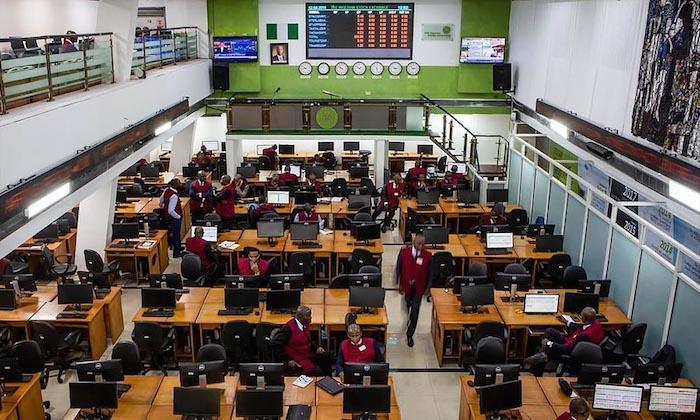
Equity investors on the Nigerian Stock Exchange (NSE) exchanged only 17.16 billion units of listed stocks in the second quarter (Q2) to June 30, 2020, which represents 32.7 percent decline from 25.52 billion units exchanged in Q2’ 2019, the NSE Fact Sheet shows.
Also, average daily volume of traded stocks on the Nigerian Bourse in Q2’20 decreased by 33.92 percent to 290.77 million as against 440.03 million recorded in Q2’19.
Likewise, the average daily value traded across all products on the NSE saw a year-on-year (yoy) decline of 43.57 percent, from N5.70 billion ($15.70m) in Q2 2019 to N3.22 billion ($8.33m) in the period under review, the Fact Sheet further reveals.
While international participation in the Nigerian equity space has been understandably weak, as foreign investors seek safer investments in more stable economies and commodities such as Gold, this supposedly creates an entry opportunity for local investors with long-term views.

“From time to time we notice equity markets taking a pause, trading sideways for a month, before launching again upwards or downwards. One of the ways to measure the health of an equity market is its turnover. The Nigerian equity market’s turnover has been trending downwards recently, prompting the question: ‘where is the institutional investor?” The answer might be: “presumably, buying long-dated bonds, rather than equities,” Lagos-based research analysts at Coronation Asset Management, say.
The NSE services the largest economy in Africa and is championing the development of Africa’s financial markets. What could have been a flourishing year for the Nigerian economy was caught in the web of a global public health crisis, which grounded domestic and external economic activities. This is evident in record growth decline in domestic economy by -6.1 percent in Q2.
Following gradual easing of local and national lockdown measures in Nigeria and resumption of economic activities, stock market activity on the NSE in Q2 2020 waned slightly from Q1, but was characterised by comparatively lower sell pressures and a reduction in net outflows from the previous quarter.
The NSE All Share Index gained 14.92 percent to close the quarter at 24,479.22 points, from an opening level of 21,300.47 points. Despite this, the equity market returns did not preserved capital for many investors over the long term, even when adding back the generous dividends paid to investors. Consumer goods stocks were worst hit in Q2 as evidenced in the NSE Consumer Goods Index, which printed low at 441.71 points, a decline of 29.02 percent from 611.68 points in Q2’19.
It was followed by NSE Banking Index at 281.96 points at the end of Q2, down 21.26 percent from 358.09 points in Q2’19, and NSE Oil/Gas Index, which decreased by 22.44 percent to 196.47 points from 253.33 points in Q2’19.

At the end of the review quarter, the average price-to-earnings (PE) ratio of The Exchange’s listed equities stood at 14.50, compared to 8.49 in the corresponding period of the previous year. The P/E ratio helps investors determine the market value of a stock as compared to the company’s earnings. In Q2’ 2020, the equity market turnover velocity declined to 5.69 percent, from 10 percent in Q2 2019.
The total value of stocks traded in Q2’ 20 at N189.93 billion ($491.43m) represents 42.59 percent decline from N329.95 billion ($907.9m) recorded in Q2’19. The dollar value was derived from exchange rate $1/N386.50 – NAFEX as of Jun 30, 2020.
“Despite the early optimism of the first month of 2020, a steep decline in crude prices caused by the spread of the coronavirus led to a generally bearish half-year (H1). The sell-offs from international and local investors dragged the bourse to a low of -23 percent on April 7, before bargain hunting from mainly local investors pushed the ASI to single-digit losses by May. While we expected a more attractive market for investors in 2020, the poor macro environment, currency devaluation and general uncertainty over crude prices have dampened investors’ view of the Nigerian market,” research analysts at Lagos-based Vetiva Capital, note.
In this second half of the year, they expect the recovery in equity prices seen in Q2 to continue – albeit at a slower pace with local investors continuing to drive majority of the activity on the bourse. “We expect the market to close the year in mildly negative territory (-5%), driven by the current economic outlook,” the Vetiva analysts say.
Average daily transactions of 4,593.32 in Q2 represents an increase of 19.64 percent as against average daily transactions of 3,839.34 in Q2’19. The market’s snapshot at the end of Q2’20 shows the NSE closed the quarter with total market capitalisation of N28.62 trillion ($74.05bn), representing 11.23 percent increase from Q2’19 level of N25.73 trillion ($70.79bn).
Equities market capitalisation of N12.78 trillion ($33.07bn) in Q2’20 implies a decline of 3.08 percent from N13.19 trillion ($36.28bn) in Q2’19. Exchange Traded Fund (ETF) market capitalisation increased to N14.07 billion ($36.40m), up by 157.20 percent from N5.47 billion ($15.05m) in Q2’19. The bonds market capitalisation increased by 17.96 percent to N14.75 trillion ($38.17bn) from Q2’19 low of N12.51 trillion ($34.41bn).
Following the steep decline in crude oil price, foreign portfolio investors (FPIs) who feared an economic crash began exiting the Nigerian stock market, but domestic investors helped sustain the market. From January to June 2020, domestic investors accounted for 60.48 percent of the trading activities compared to 51.11 percent in 2019 and 49.30 percent in 2018.
In the same 6 months period (January to June), their foreign counterparts accounted for just 39.52 percent of the trading activities as against 48.88 percent in 2019 and 50.70 percent in 2018. The total foreign transactions (January to June) stood at N396.63 billion ($1.03bn). It was N942.55 billion ($2.59bn) in 2019 and N1.219 trillion ($3.35bn) in 2018.
“The spread of the COVID-19 disease across the world triggered unanticipated global financial market volatility and Nigeria was not left out. Foreign Portfolio Investors (FPIs) and local investors flew to safety amid the collapse in oil prices and currency adjustments. Investors repriced the risk on naira assets,” research analysts at United Capital plc, say.
They believe the path remains gloomy for equities market, amid pressure on corporate earnings, concerns about the exchange rate, among others. As a result, the analysts expect the market to remain highly volatile and ‘short-term gain’ driven.