|
Getting your Trinity Audio player ready...
|
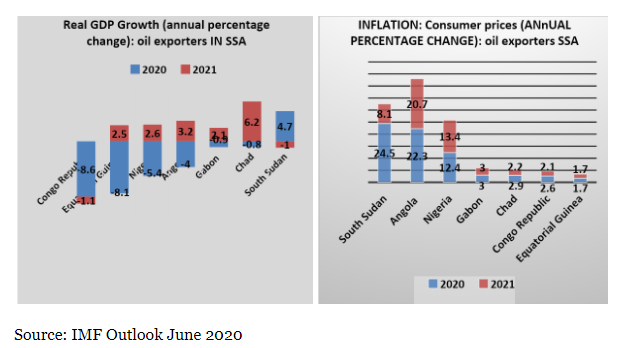
According to the International Monetary Fund (IMF), Sub-Saharan Africa has been projected to contract by 3.2 percent in 2020, with oil exporting and tourism dependent economies dipping the most.
Net oil-exporting and tourism dependent economies in SSA experienced an unprecedented twin shock in 2020.
The Net oil-exporting countries had to deal with the global economic contraction effect of the coronavirus pandemic as well the biggest oil price shock in modern history.
Tourism dependent economies, on the other hand, were faced with the spiralling effects of the pandemic as well as restrictions on international flights which reduced the arrival of tourists to a single digit.

On the 2020 contraction projection ranking for oil exporting countries in SSA, Congo Republic is expected to contract the most at 8.6 percent and closely following this rate is Equatorial Guinea which will contract by 8.1 percent.
Nigeria and Angola are expected to contract 3rd and 4th place in the contraction projection ranking for SSA at 5.4 and 4 percent respectively.
Nonetheless, South Sudan is projected to experience a slower growth rate of 4.7 percent in 2020 as against other contracting oil exporting SSA countries.
Surprisingly, South Sudan has the highest inflation projection of 24.5 percent whereas Equatorial Guinea which was ranked second on the list of SSA oil exporting countries to suffer the most contraction is projected to have the least inflation level at 1.7 percent in 2020.
Overall, inflation in the oil exporting SSA countries has been projected to skyrocket from 11.7 percent in 2019 to 13.3 percent in 2020.

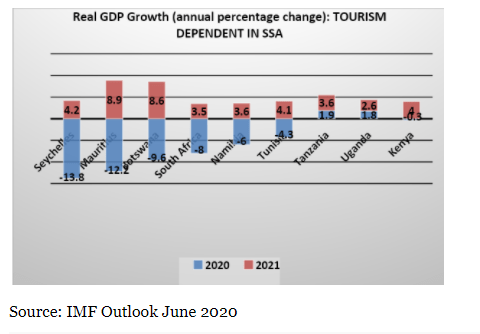
The contraction projection for tourism dependent economies revealed that Seychelles will contract the most at 13.8 percent followed closely by Mauritius, Botswana, and South Africa at 12.2, 9.2, and 8 percent respectively.
Meanwhile, according to CEIC data, Mauritius’s Tourism Receipts was about US$562.9 million (at exchange rate of 39.80 MUR) in March 2020.
This records a decrease from the previous number of US$ 716.5 million ((at exchange rate of 39.80 MUR) for December 2019.
Also, CEIC data records that Mauritius had a drastic decline in tourist arrivals from 55,863 in March 2020 to an average of 13 persons between April and June 2020.
Similarly, Kenya’s tourist arrival dropped from 47,296 in March 2020 to 12 in April 2020, according to CEIC data.
Overall, within the first quarter of 2020, international tourist arrivals worldwide dropped by 22% due to the coronavirus pandemic, the United Nations World Tourism Organization (UNWTO) reported.
UNWTO proceeds to forecast that international tourist numbers could decline by 60-80% in the year 2020. This resulted in a decrease of 67 million in international arrivals and about $80 billion loss in exports.
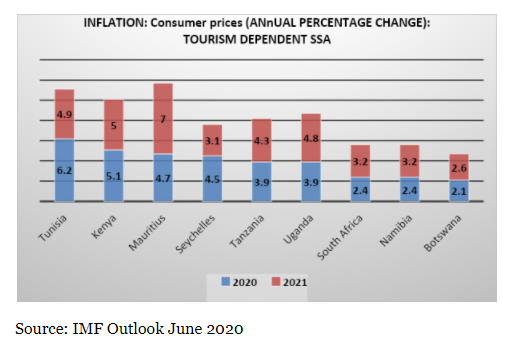
In retrospect, unlike the double-digit inflation projection for oil exporters in SSA, IMFs 2020 projected inflation for tourism dependent economies is single digit.
While Tunisia takes the lead on the highest inflation projection at 6.2 percent, Botswana is estimated to have the least inflation rate at 2.1 percent among tourism dependent economies in the SSA region.
Abebe Aemro Selassie, Director, IMF African Department in a press briefing on the Regional Economic Outlook for sub-Saharan Africa said “tourist-dependent economies have been hit very hard; also quite a number of the oil exporting countries will be hit very significantly, because oil prices have declined. So, it’s been a double whammy for them – the impact of the COVID pandemic within the country, as well as losing quite a significant share of oil-generating income”.
“At the moment we’ve seen disruption to many of those supportive factors (investment in health, education and infrastructure), capital markets have turned, you know, capital is flowing out of the region rather than towards the region in most cases. Commodity prices are of course low, global environment is weak”.
“So, I think it’s important that countries rethink their development models, reconsider what’s going to be important sources of growth going forward, and develop new development plans”.