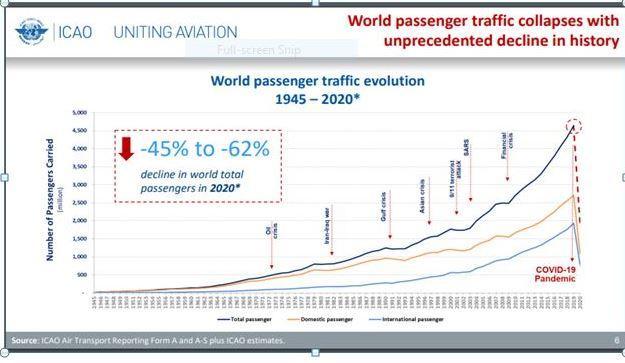
Commercial aviation has always been dealt with shock owing to acts of terrorism and economic downturns, but in the wake of the coronavirus pandemic, airlines are facing unprecedented crisis, both regionally and internationally. According to McKinsey & Company, during one of their briefings on COVID-19, it was noted that out of 30 key industries, air and travel, and commercial aerospace would be most severely affected for the duration of the pandemic and its effects. Generation of revenue for airports is directly proportional to traffic travels, save for cargo flights handling essential services, many airlines have been grounded at 90 percent of their flight capacity.
By February 2020, commercial flights were connecting more than 20,000 cities, a situation that rapidly dropped to 6,500 by end of March. This follows the bans and cancellations on flights, as countries continued to close their boundaries, one after another. Unfortunately for airports, while employees may take pay cuts or be sent on unpaid leaves, little can be done to save the operational costs of airport infrastructure, given terminals and runways cannot be closed or relocated. Even for essential services aircraft, the normal landing and taking off is interdependent on many other aviation players, including equipment and firefighters on site. Global communications, tourism and trade, are all compromised by the absence of air travel. And while the health crisis is purely limited to COVID-19, thousands of people are not able to travel for specialised medical care for other ailments.
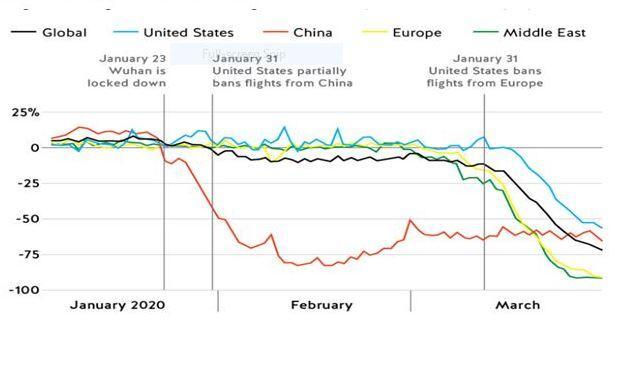
Comparative change in the number of flights tracked for same date, exactly a year before

With grounded fleets, airlines are quickly running down their cash reserves. Technically, airlines are being driven into bankruptcy, many of them substantially positioned to breach debt covenants. According to IATA, more than 25 million jobs have been jeopardised around the world, both in aviation and related sectors. By end of April, this figure was distributed in the following estimates: 11.2 million (Asia-Pacific), 5.6 million (Europe), 2.9 million (Latin America), 2.0 million (North America), 2.0 million (Africa), and 0.9 million (Middle East).
At this point, it is difficult for anyone to confidently project the timelines for resumption of international aviation. This impact will largely be mitigated depending on how long the pandemic persists, the intensity of the outbreak in various jurisdictions, the measure put in place to contain the crisis, the prevailing economic conditions of both individuals and institutions, as well as the confidence level of consumers on air travel. With increased operational costs and reduced demand, the general path to recovery may be slow.
In solidarity with airlines and their staff, urgent intervention measures are necessary, not only for the short-term, but also medium-long-term. This is because aviation and viruses are like oil and water – they don’t mix well. An ordinary day at an airport is characterised with queues of people, close contact, going through security checks, buying foodstuffs and drinks, duty free shopping, clearing at the customs, boarding and alighting from planes. The virus is also said to live on hard surfaces, including wood and metal, which are very common sites in airports. All this is bound to change when operations resume, and will definitely come at a cost. Consequently, it is inevitable that airlines must be bailed out, to reposition them to the crucial role they play in both national and global economy.
With limited bank support, government intervention as a last resort lender, insurer and owner, will definitely be the way to go. For instance, the Chinese airlines are mainly funded by government, something that has seen their share prices only drop as slightly above 10 percent, compared to majority of other international airlines, which have seen a drop in share prices by 50 percent.

Reasonably so, many airline unions are lobbying for government subsidies and massive bailouts. Already, the US has extended a $2 trillion package to assist the aviation, $78 billion of which is meant for loans and payroll support for workers and airlines. Others include EURO 300 million for British Airways from the UK government, NOK 3 billion loan guarantee for Norwegian Air by the state, the South African Airways looking for ZAR21 billion, a $70 million funding for Kenya Airways, and N500 billion for Nigerian Airlines by the Central Bank.
While there are many ways in which various stakeholders can save the aviation industry from the wrath of this pandemic, the following creative solutions could save the day: Loans be extended at preferential rates; Governments to offer grants and subsidies; Airports and Airlines to access secured financing; Loan repayments be deferred on mutual agreement; Banks to offer guarantees; Governments to offer guarantee on loans between airlines and foreign lending agencies; Governments to offer cheaper federal loans; Tax relief; Measures to support corporate bond market.
The role of airlines in the post COVID-19 economic recovery cannot be overemphasised. As they continue to coordinate repatriation of thousands of various nationalities and move essential goods like medical supplies, the earlier governments and financial institutions come on board to rescue the industry, the faster tourism and manufacturing hubs will be connected, boosting trade in virtually all aspects. It is a win-win situation for airports, airlines and the government.