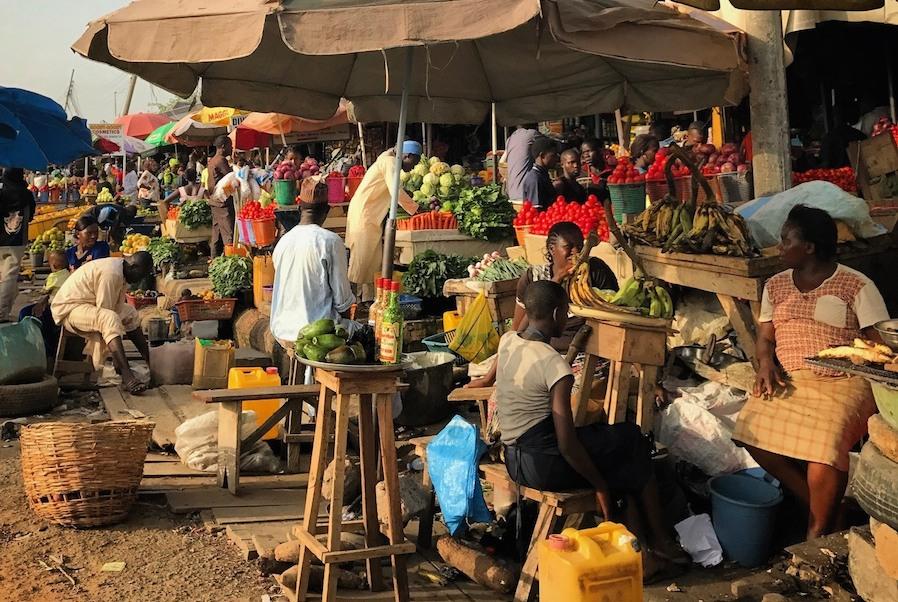
In a plethora of sessions over the last few weeks, experts in different parts of the agricultural value chain have expressed fears over food security in Nigeria due to the coronavirus pandemic. In a webinar session by the Guild of Nigerian Agriculture Journalists (GNAJ) on the “ The Imperative for Strategic Policy Direction” in limiting negative impacts of COVID-19 in Nigeria, panellists highlighted areas the country should give more attention.
These included Alhassan Cisse, FAO representative ad interim in Nigeria; Andrew Nevin, chief economist, PwC West Africa; Manzo Maigari, director general, Nigeria Agribusiness Group (NABG) and; Samuel Ogallah, senior climate specialist for Africa, Solidaridad.
Nigeria is not short of policies, but mostly falls short in implementation, they noted, highlighting areas that should get priority and those that may be evolved into other forms. There are also policy gaps, even with those currently existing, thereby limiting their effectiveness.
Andrew Nevin, chief economist, PwC West Africa

There have been concerns on the complexity of the Federal Government’s agricultural policies, and what we would like to see in the medium term is a simplification of the role the FG plays. States need to take a leading role in charting agricultural policies and development, rather than a central led approach with limited impacts.
Nigeria needs to have a program that has small-scale farmers, extension, and outgrower programs, feeding into agricultural processing or export in every commodity. But, who is currently building those systems?
The only investment that is available for Nigeria has to come from the private sector and for this to happen, the private sector has to be confident they are operating in an environment that is going to work for everyone in the chain. And, of course, in agriculture, what is grown, the conditions of growing things and harvesting, processing vary very much by state. Therefore, we would like to see it much more driven at the state level.
There is a need to see State governors talking directly to large international investors, bringing them into the states and getting them to work with the farmers to get the food production system going. If that is going to happen then there is a need to rethink the federal government’s role and I think in many ways the complexity of the federal government’s involvement is a barrier to what has to happen.
What do we need from the federal government? From the federal government we’ve all heard of Anchor Borrowers Program, etc. But the truth is that the total quantum of money they have is so small. It is not nearly sufficient for what we require in agriculture. I think that the federal government would be better, focusing on a few things. One of them is the overall enabling environment for business. Second one is a particular issue around the ports, import and export of goods because for most of the imports of things like machinery for agricultural processing and then the export of commodities like the cashews and cocoa, we need a well-functioning port system, well-functioning physical infrastructure to do that. That is the role of the Federal Government.

The other thing I think that’s critical to all of this is agricultural technology. We need to have more agtech and more farmers enabled so that they can take advantage of the opportunities available, such as ensuring they are growing the right crops, applying the right inputs at the right time, and have the required off takers.
It is essential that this next planting season works. I do not have words for my concern if we do not get the inputs in time into the hands of the farmers dealing with rain fed agricultural crops. If the seeds and the fertilizers are not there on time it is the recipe for catastrophe in Nigeria.
Alhassan Cisse, FAO representative ad interim
Putting agriculture information and early warning systems in place is key in informing decision-making when it comes to agriculture. At FAO, we are exploring (more) ways that smallholder farmers can be supported. We are thinking of taking some fiscal models to support the private business people in the agricultural sector.
All these require having regular, systematic and reliable data and information to support the decision-making. Another thing that we do not know yet is the impact, but if you look at the statistic over the last few years you’ll see that Nigeria has made tremendous effort.
However, the effects of COVID-19 could make things worse if Nigeria does not pay attention to the disruption to the food system, including the transport, input supply, and hiring of seasonal works. If we don’t pay attention, we could have a decrease of production meaning that the balance will increase the deficit of import and export and it can have a huge impact in the economy of the country. We have to make sure that in terms of policy recommendation, Nigeria endeavours to keep international trade open in West Africa. Nigeria can play a great role in making sure that there is intra-trade in agriculture.
While intra trade in West Africa is 10 to 12 percent, in Europe and Asia, it is about more than 70 percent. Therefore, this is one opportunity that we can we can leverage on. Nigeria has potentials, with soil and climate that are suitable for the great deal of the food the county and even West Africa need.
Keeping the domestic food supply chain alive and functioning is key. Focus on the needs of the most vulnerable and scale social protection programs.
Manzo Maigari, director general, Nigeria Agribusiness Group (NABG)
We are advocates that Nigeria as a country should create a business in agriculture. Any policy that does not agree with this is only going to be an effort in futility. The simple reason why nobody takes farming serious (in Nigeria) is because it remains a black hole; no standards, no regulation. No serious businessperson would put their funds in an uncertain venture.
We have advocated the issue of clusterization that is based on the understanding that over 70 percent of the agricultural landscape is dominated by smallholder farmers who on their own cannot do anything, and not even viable. Therefore, if a farmer has been clustered with an offtaker it becomes easy to direct funds and channel them into productive ventures for them.
While there have been developments such as the Anchor Borrowers program and NIRSAL Agro geo cooperatives, there should be a deliberate policy to back this and in crafting a policy like that, we expect the government takes a critical look at the status of agriculture as being in the concurrent list of the constitution. What that simply means is that local governments, state governments and the federal government can each pursue their own agricultural agenda independently. The current approach has so far proven counterproductive.
If we find it inconvenient to drop agriculture from the concurrent list, then we should make it in such a manner that efforts are concerted. If for instance, a region has soil and climatic conditions that are best for a kind of crop, the federal government should take the States along and take the local governments along so that they work together, pull resources together to achieve that.
There is also the need for a National Agricultural Development Corporation akin to the Nigerian National Petroleum Corporation (NNPC) because agriculture is even bigger than the oil economy. We must approach agriculture from that perspective in a manner that we have a national development company, to which states can zone certain percentages of their land mass and we give them seed money to clear these lands, develop these lands and then go into joint ventures. JVs with multinationals, JVs with Sovereigns because we are aware that there are a lot of countries that are looking for land to produce food and we can develop this with an integrated approach with percentage derivation paid back to host communities. With this, Nigeria will see agriculture developing in no time to drive the economy of this country.
Samuel Ogallah, senior climate specialist for Africa, Solidaridad
There is an urgent need for institutional review of policies and realignment. In the wake of covid-19, it has exposed how our policies are not aligned at the federal down to the state level to the local government level. Some of the policies are made at the federal level, but where are the farmers based? The farmers are based in the grassroots at the local government level so the trickling down of those policies has become a challenge. And so there is urgent need, in the wake of covid-19, for policy realignment.
Ministries, departments and agencies need to begin to speak to each other. Let policies begin to speak to each other and become practical. There is also need for digitalization of Nigerian agriculture. The covid-19 has exposed how vulnerable we are in terms of digital agriculture. So what do we do to move forward? We need to digitalize the agricultural sector.
Can we make a technology that will locate where the farmers are? Do we have a database where you click on the farmer, where when you click on the farmers, you will know the number of hectares of land, type of crops, the type of facility the farmer needs in operating if you want to provide those services.
We also need to go forward to see if in terms of a lockdown like this, where do we find what and how do farmers access required inputs? These are some of the things that we need to do moving forward, especially digitalization. Can we use drones to distribute some of the input we are talking about? Do we know what a particular crop needs in Nigeria at a particular time especially in the light of climate change that the farmers are being faced with? Are we giving overdose of fertilizer or we are giving less?
The aspect of research and development is key for innovations and technologies. We have various agricultural research institutions but are they bringing out technology that are in sync with the local need? This is important because we cannot be importing technology from abroad that will not suit what our farmers need in Nigeria. Therefore, there is the need for indigenous research and development that suits the context and terrain our farmers are operating.
The policies we have cannot stand the test of time during crisis such as the one we have found ourselves in. And, God forbid, what if we have COVID 20 or 21? We don’t pray for that and that will not happen. But the lessons that we have learned from COVID-19 should make us to become proactive in addressing our policy gaps and everybody must be on board. The way to go is by prioritising implementation, because we have some of these policies in place and they are lacking implementation. New ones that need to come on board also need to be implemented.