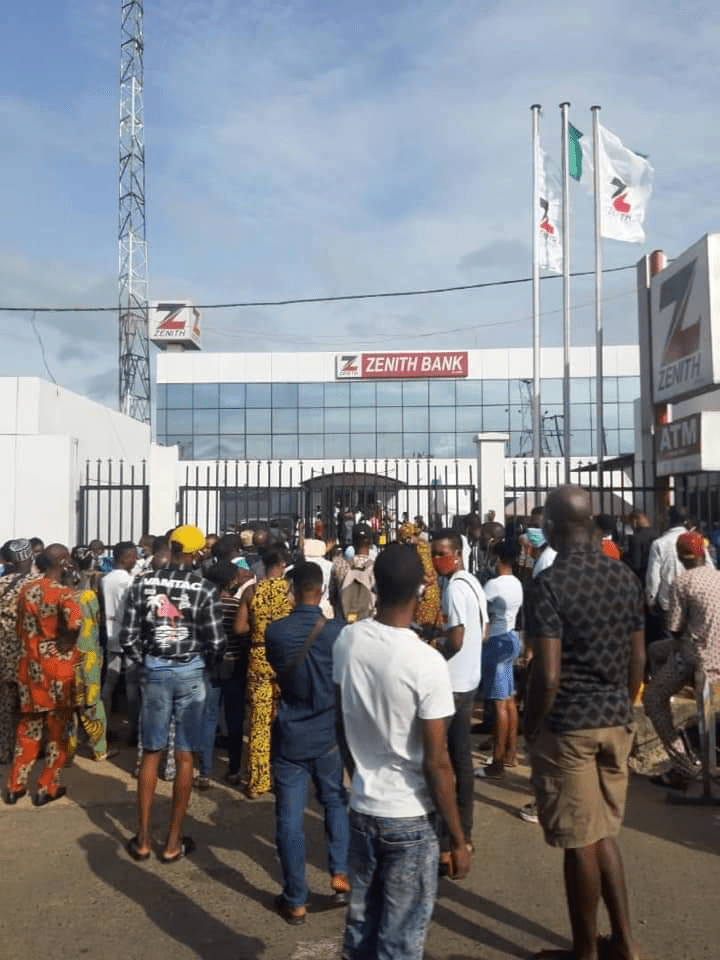
On the first day of the partial easing of the month-long lockdown, Lagosians on Monday besieged the banks in their numbers, abandoning social distancing. Some of them wore their facemasks.
Consequently, commercial banks had onerous task managing surging crowds of customers who thronged their branches for different transactions as the controlled easing of the lockdown imposed on Lagos, Abuja and Ogun State began.
Checks around Lagos on day one of the gradual relaxation of the lockdown also showed poor level of compliance with the guidelines reeled out by the state governor, Babajide Sanwo-Olu on Sunday evening.
From Access Bank through GTBank to Zenith Bank, the scene was the same, as hundreds of bank customers in Lagos, Nigeria’s commercial hub, were seen crowding together as they struggled to get into the respective bank branches. Few bank staff were available to attend to the customers.

Strict observance of social distancing is part of the conditions on which both the Federal and Lagos governments approved the partial easing of the lockdown. This is considered a key factor in curtailing the community spread of coronavirus.
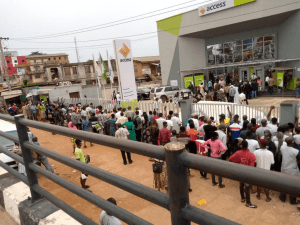
At GTBank’s branch at Idimu, a horde of customers could be seen besieging the entrance into the banking hall. It was the same at the bank’s branch at Masha, in Surulere, where customers were literarily struggling with each other to make their way. It was even worse at the ATM terminals, where several customers stood in long queues to withdraw money.
But the state commissioner for Information and Strategy, Gbenga Omotosho, says government would not be applying force to get the citizens comply with the compulsory wearing of face masks and other directives, including the social distancing protocol and 60 percent maximum loading of commercial buses.
“We’re not applying force because we’re in a democracy. We don’t even have the capacity for that. We’ve been reaching out to our traditional and religious leaders to help us talk to their subjects.

“We’ve also met with the leadership of transportation unions and they have agreed to cooperate with the government. We would continue to use persuasion,” said Omotosho, during a live interview on ‘Morning Crossfire’ monitored on Nigeria Info (99.3) radio station on Monday.
In almost all branches of the different commercial banks visited, disgruntled customers were seen in queues with civil security personnel and police operatives attached the banks battling to control the crowd.
Some of the anxious customers, BusinessDay discovered, arrived their banks as early as 7:30 even when the subsisting guidelines in Lagos allow banks to open their offices to the public from 9am.
It was noticed that the social distancing protocol was not observed in most of the bank branches monitored, as the customers glued in the queues, just as many were without facemasks.
Also, some of the yellow commercial buses did not comply with the directive to limit their capacity to 60 percent. A number of them sighted on Funsho Williams Avenue (formerly known as Western Avenue) in Surulere and elsewhere in the state metropolis carried more than eight passengers.
At Oyingbo Market in Lagos Mainland local government, our correspondent ran into an intimidating crowd of buyers and sellers many of whom wore no face masks and seemed to care less about the social distancing protocol.
Speaking this development in a telephone interview with BusinessDay, Yomi Farounbi, a former chairman of Ikeja branch of the Nigerian Bar Association (NBA), described the decision to ease the lockdown as ill-advised.
According to Farounbi, the government failed the people by allowing itself to be stampeded into relaxing the lockdown when the coronavirus cases are on the rise.
Noting that application of force in a democracy may not be ideal, the legal practitioner advised the government to re-lock the country until the pandemic curve is seen flattening
“This is when you know serious leaders. Government allowed itself to be stampeded to relax the lockdown. They ought to have put their foot down and insisted on not easing the lockdown. In fact, relaxing the lockdown is the worst thing to have happened to this country,” said Farounbi.