



Did the suspended governor of the Central Bank of Nigeria, Sanusi Lamido Sanusi, threat to have the country’s top bankers open their books to trace the movement of miss¬ing oil billions ultimately lead to his downfall?
Even in a coun¬try where un¬told oil wealth disappears into the pockets of the elite, the oil corruption scheme he was investigat¬ing seemed outsize — and he threatened to lay it bare at a meeting with Nigeria’s top bankers.
The rabble-rouser was none other than the governor of the country’s central bank. Weeks later, however, he was out, fired by Nigeria’s president in an episode that has shaken the Nigerian economy, filled newspapers and airwaves here, and even inspired a rare street demonstration.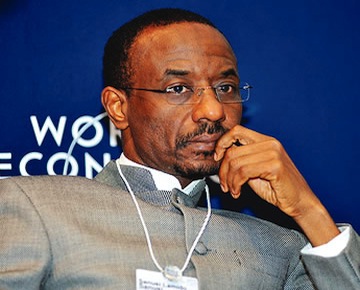

The bankers were going to have to open their books, the governor, Lamido Sa¬nusi, warned them at the recent meeting. He wanted to see where the money was going — $20 billion from oil sales that, mysteriously, was not making its way to the treasury, in a country that could soon be declared
Africa’s biggest economy and already attracts the most direct foreign investment on the continent, according to the United Nations.
But his suspicions were cutting too close, Sanusi said — too close to an oil-politics nexus that both feeds the political establishment in Nigeria, in his view and that of analysts, and deprives the country of vital revenue.
Lamido Sanusi, the oust¬ed head of Nigeria’s central bank, had been investigat¬ing the cause of the missing oil funds.
The charge of missing oil money is not new in Nigeria. In recent years, government commissions, parliamentary inquiries and civil society groups have all pointed to se¬rious shortfalls in the disburse¬ment of oil revenues. Their findings have been ignored.

This time, the accusations appear not to be going away: Never before has an official at Sanusi’s level made them.
In interviews here, Sa¬nusi gave a detailed account of the events that he said led to his ouster on February 20, a dismissal that continues to depress the country’s currency and frighten in¬vestors. He said his warning to the bankers had been reported straight back to the threatened seat of power in the country’s capital, Abuja.
It was too much, he said. With his accusations, which outside analysts consider credible, the soft-spoken, bow-tied central banker ap¬peared to have penetrated to the heart of the country’s en¬trenched corruption problem.
In 2009, Sanusi took aim
at Nigeria’s failing bank¬ing sector, shutting down fraudulent banks, uncov¬ering theft that led to an unprecedented conviction, and earning trust in inter¬national financial markets.
He was named central bank governor of the year by The Banker magazine in 2011, and is a suited-up member of his country’s establishment, as an heir to the position of emir in the ancient northern city of Kano, one of Nigeria’s highest-status designations.
But then he began tak¬ing on the government oil agency, which determines whether oil-dependent Ni¬geria rises or falls. Specifical¬ly, he accused the Nigerian National Petroleum Corpo¬ration (NNPC) — the agency that buys, sells,regulates and produces the country’s oil — of not turning over earnings to the country’s central bank. The country is Africa’s largest oil exporter, oil prices were steady or ris¬ing, yet Nigeria’s financial reserves were falling. It was a mystery. The money was missing.
Sanusi said he feared an eventual collapse of Nige¬ria’s currency.
Backed by calculations, he presented his findings to a Nigerian Senate committee early in February. “A sub¬stantial amount of money has gone,” Sanusi said in an interview at the mansion reserved for the country’s central banker, which he will soon have to leave. “I wasn’t just talking about numbers. I showed it was a scam.”
At a time when political energy in Africa’s most popu¬lous country is focused on next year’s elections — and staying in power is costly for a governing party that functions as a patronage machine — Sanusi knew exactly which interests he had menaced, he said. He had been warned to “cool down.”
“By making NNPC an issue now, the source of mon¬ey for financing elections is threatened,” Sanusi said, re-ferring to the petroleum cor¬poration.
“If this is stopped, there will be no money to finance the elections.”
On the other hand, if it was not stopped, the risk to Nigeria’s economy was grave, the central banker suggested. “It was critical that we stop this haemor¬rhage,” he said. “Otherwise, we can’t maintain stabil¬ity. Reserves had gone way down. We would watch the naira collapse,” he said of the nation’s currency.
Alarmed, Sanusi said, he went in front of Nigeria’s top banking heads for a semi-monthly meeting on February 11 and “threatened to open the books of the bankers, to trace the money.” He suspected some were laundering stolen oil money.
“Some of them were not giving information about their accounts,” the central banker said. “I told them I would order a special ex¬amination.”
One of the bankers at the meeting said, referring to the Central Bank of Nigeria, “He made it clear to them that the CBN would need to unravel what was going on, and they should cooperate.”
Many of the bankers became angry. “One of us said, ‘What next?’ “ a sec¬ond banker said. “There was a general heaviness. He spoke tough.” Both bankers requested anonymity.
Panicked, several of the bankers went straight to the government, Sanusi said. Two of the bankers — he would not identify them — “went and reported to the petroleum minister,” he said. And at that moment, his days were numbered.
“The strategy of the gov¬ernment was to discredit the messenger,” he said. The Nigerian president “doesn’t want me to bring out any more information that would get them into trouble.”
Sanusi’s account is “un¬true,” a spokesman for Presi¬dent Goodluck Jonathan said.
“Mr. Sanusi has been making all kinds of claims to project himself as a vic¬tim,” the spokesman, Reuben¬
Abati, said in an email, accusing the former bank governor of “financial reck¬lessness, abuse of mandate, incompetence and criminal acts of negligence.”
Sanusi has not been charged with any crimes, and the most Jonathan held him responsible for in a se¬ries of counteraccusations that emerged after the bank governor raised an alarm over the oil money was hav¬ing perhaps “side-stepped civil-service rules.”
Outside analysts appear to be in large agreement that Sanusi’s claim of vast miss¬ing oil revenues is plausible.
Nigeria’s state oil sales “feature undue complexity, extensive discretion and well-documented flaws,” Revenue Watch, a group focused on natural-resource management, wrote in an examination of the cen¬tral banker’s declarations. “In such a system, the line between mismanagement and corruption is difficult to draw, as shortcomings in process often benefit specific private interests.”
One such “shortcoming” was laid bare by Sanusi last month to the parliamentary committee: a phony subsidy on kerosene that he deter¬mined to be a racket, costing the Nigerian treasury bil¬lions of dollars and greatly benefiting what he called a “syndicate” of marketers and unknown others.
Sanusi showed that any official subsidy on kerosene had long since been abol¬ished, that the petroleum corporation was nonetheless selling kerosene to market¬ers at less than a third of its purchase price on the inter¬national market and that the Nigerian marketers were then selling kerosene to the public at prices 300 percent to 500 percent above what they had paid for it.
“It’s just a big scam,” Sanusi said in the interview. “The amount is shared by a cabal.”
Though his official term would have ended in June anyway, Sanusi said, he is challenging his removal in court. In a judiciary that is only lightly insulated from political pressure, the out¬come is uncertain,
though perhaps not with the wider public. One of the bankers at the February 11 meeting said: “For me per¬sonally, I don’t think there’s anything wrong with the position he has taken. We are Nigerians. We owe it to this country that things are run properly.”
One of Nigeria’s leading activists, Tunde Bakare, a founder of the pro-democracy organisation Save Nigeria Group, said: “This is going to be tried in the court of public opinion. We can’t wish this matter away. $20 billion is not going to go away overnight.”
Culled from New York Times




