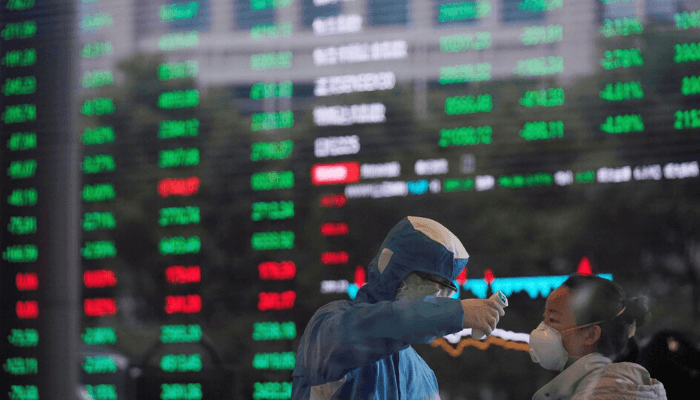
Global stocks fell sharply on Wednesday, as new figures showed US economic activity had plunged and further signs of trouble were found in Wall Street earnings.
The S&P 500 and Dow Jones both fell 2.3 per cent at the opening bell in New York, while the tech-heavy Nasdaq was 1.9 per cent lower, after data illustrated the scale of the economic slump in the US.
Industrial output fell by the most in more than 70 years in March while retail sales posted a record 8.7 per cent drop. A gauge of business activity in New York state also plunged to a record low in April.
European stocks slipped following a downbeat session in Asia, leaving the Stoxx 600 index on course to end a five-session winning streak. London’s FTSE 100 fell 3 per cent, while the CAC 40 in Paris was 3.2 per cent lower and Frankfurt’s Dax was down 3.5 per cent.
European and US stock markets are trading more than 20 per cent above mid-March lows on optimism that the rate of Covid-19 infections is peaking. But this quarter’s corporate results season looks set to test the strength of the rebound, as they shed light on the impact of the lockdowns that have stifled economies.

Goldman Sachs, Citigroup and Bank of America on Wednesday all prepared for more pain among their clients by setting aside billions of dollars to cover loan losses as they reported first-quarter numbers.
Wall Street analysts forecast an 8 per cent decline in S&P 500 profits this year, which would mark the biggest fall since 2009, in the depths of the financial crisis.
Strategists at Barclays said “dire” results in Europe should not be a shock to markets, but could offer a “reality check” following the recent swing higher.
“Sharp downgrades lie ahead and unusually vague guidance due to the fluid situation won’t improve visibility,” the bank’s European equity strategists wrote in a note to clients on Wednesday. “Yet with central banks ‘all in’, unprecedented government bailouts and signs of a slowing outbreak, a second-half recovery seems more likely than not.”
Analysts expect 20 per cent falls in profit for the Stoxx Europe 600 this year, according to FactSet data.

The dollar rose, piling pressure on to emerging market currencies. The South African rand lost nearly 3 per cent of its value, while the Turkish lira slipped 1.3 per cent.
“The market mood has soured in the blink of an eye,” said Mark McCormick, global head of FX strategy at TD Securities.
A sharp fall in the price of oil also weighed on shares, after a new forecast for global crude demand estimated it would plunge even if lockdowns and travel bans were lifted.
Oil majors including Total, BP and Shell each fell around 5 per cent, while Brent crude was down 4.5 per cent to $28.25 per barrel.
Asia-Pacific stocks fell following further indications the pandemic was set to hit the global economy hard, with the IMF warning of the biggest worldwide slowdown since the 1930s.
“The publication of the IMF’s spring forecast has rather put the dampeners on the brightening market mood,” said Société Générale strategist Kit Juckes.
Sentiment was also dented by President Donald Trump’s announcement that the US would suspend funding to the World Health Organization, accusing it of “severely mismanaging” its response to the crisis.
In China, a brief boost to investor sentiment — spurred by its central bank’s decision on Wednesday to cut a key lending rate — quickly faded.
The CSI 300 of Shanghai and Shenzhen-listed stocks fell 0.7 per cent after the People’s Bank of China cut its one-year medium-term lending facility by 0.2 percentage points to 2.95 per cent, the lowest level since its introduction in 2014.
Markets might still be too optimistic about the recovery in China
Nomura
Michelle Lam, Greater China economist at Société Générale, noted significant monetary support from the US Federal Reserve had given Beijing more breathing room to loosen its own policy.
But analysts at Nomura said markets “might still be too optimistic about the recovery in China”, as the country faces the dual challenges of falling external demand and the possibility of a second wave of coronavirus cases that could once again disrupt the economy.
Japan’s benchmark Topix index closed flat, while Australia’s S&P/ASX 200 fell 0.4 per cent and Hong Kong’s Hang Seng shed 1.2 per cent.
The 10-year US Treasury yield, which falls as bond prices rise, was down 0.08 percentage points at 0.66 per cent as investors sought safer assets.