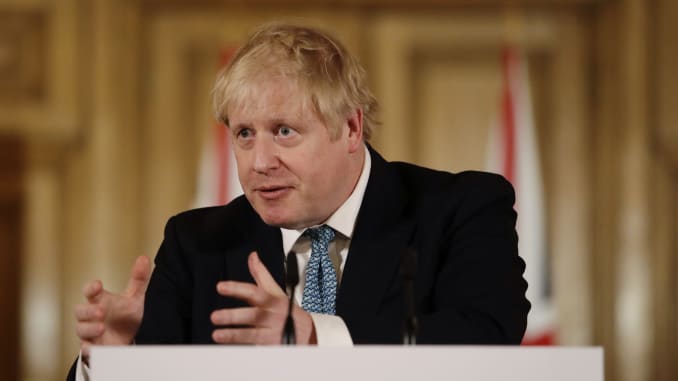
Boris Johnson, the British Prime Minister, was diagnosed to have contracted the dreaded COVID-19 disease recently, and was subsequently taken not to see an obscenely expensive private doctor in Harley Street but to a government funded, National Health Scheme (NHS) hospital, just like any other British subject. Neither was he ushered into a VIP room at the hospital once he recovered enough to be discharged from the Intensive Care Unit.
Information from all available news sources tell us he was moved to one of the general wards. There are several lessons one can learn from the whole Boris Johnson COVID-19 saga.
First, is that the whole country was informed of the nature of his ailment from the get go and since then, the government apparatus has deemed it fit, to give the nation daily briefings regarding the state of his health. No unnecessary shrouding of anything in secrecy, since once he assumed public office, he automatically became public property. How can the public, who pay his salary and his subsequent medical bill, through the payment of their taxes, be kept in the dark about his medical condition? That just wouldn’t make any sense, and the robust democratic institutions operating in that system certainly wouldn’t permit it either. Juxtapose that to what transpired with our President who was at a point, out of the country on medical leave, for about three months. Till date, the only thing we have is a story about an ear problem.
Read also: UK’s high Coronavirus toll means battle continues after Boris Johnson’s recovery

Second lesson is from a comment Pastor E. A. Adeboye once made, while making reference to the scriptures, when he said that only a fool would listen to someone who doesn’t practice what he or she preaches. And let me assure you of something, Nigerians are not fools.
Last and certainly not least, is the simple fact that one cannot be motivated to correct a reality that one doesn’t face. How can we expect any of our nation’s institutions to function well when government officials don’t even use them? All three of these lessons point to factors which often determine whether a system will work or not. That’s why, with apologies to no one, I doff my hat to the Governor of Kaduna State, Nasir El Rufai, who walked his talk by enrolling his son at a public school. Some like to call this gesture a mere gimmick but I beg to disagree. In my opinion, to toy with his son’s future, if he doesn’t have sufficient faith in the quality of education his son would receive, would be too expensive a gimmick. I believe, the Governor by this singular act, demonstrates his desire to toe the path of good leadership, seldom seen in these parts of the world, by abiding by Paul Wellstone’s guiding principle to, “Never separate the life you live from the words you speak”. Good on him.
We will as a people do well to learn to make the connection between choices and consequences. Because we’re responsible for the choices we make, we cannot deny responsibility for their consequences also. A leader who refuses to hold himself to the same standards he holds others, is preparing the grounds for chaos and excellence can never be found there. It’s worthy to note that such conduct is not only reprehensible but it also breaches most rules on good moral conduct. The irrefutable fact that Kaduna State is one of the best governed states in the country did not happen arbitrarily, it’s the result of making the right choices. Until our thinking changes, we will be living in a fool’s paradise to believe our results will magically change. The world over, good leaders have always recorded enduring success by inspiring their people to change. The operative word here is “inspire”.
Of course, it would betray an embarrassing level of ignorance on my part, should I ascribe all the credit to Boris Johnson, for doing the right thing though. Leading a nation where democratic ideals such as equity and justice are part and parcel of their social fabric, and strong institutions hold sway over strong men, such decisions had long been taken away from any of their leader’s hands.
As Edmund Burke once said, “Society is indeed a contract…it becomes a partnership not only between those who are living, but between those who are living, those who are dead, and those who are to be born.” So, for those who still wonder if we owe future generations any duty, there’s your answer right there. What we do now will not only determine our future but theirs too.

The UK has some flagship institutions/policies which represent their values and ideology as a people. Their liberal welfarism sprouts from a belief that all citizens, no matter their economic status, are entitled to enjoy at the very least, the most basic provisions for a meaningful life; some of such institutions is the NHS, established after the Second World War, to cater for all British citizens, no matter their colour or religious belief. Free housing, free schooling and the job seeker’s allowance, popularly known as the “dole” are others. Though he utterly despised the notion of welfarism and hardly forgo any opportunity to criticize it, Lee Kuan Yew, the indefatigable father of modern Singapore, nevertheless remarked in his usual didactic manner that, “The key to peace and harmony in society is a sense of fair play, that everyone has a share in the fruits of our progress”.
I think it would be fitting for me to end with a quote by Ernest Fitzgerald which says, “It is not by accident that the happiest people are those who make a conscious effort to live useful lives. Their happiness, of course, is not a shallow exhilaration where life is one continuous intoxicating party. Rather, their happiness is a deep sense of inner peace that comes when they believe their lives have meaning and that they are making a difference for good in the world.”
Changing the nation…one mind at a time.
DAPO AKANDE