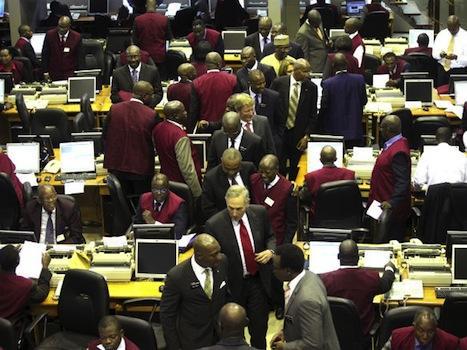
Nigerian stocks saw their second-biggest decline in the year on Monday, set to match the longest bearish-run in 2020, as the coronavirus outbreak continues to put a question mark on economic outlook after pushing oil price to a year low.
The All-Share Index fell 1.53 percent to push the market, already at year-low, further down, with consumer goods stocks (down -5.19 percent) noting their worst performance in over a year.
“The day’s performance shows that investor sentiment for risky assets is still weak,” said Gbolahan Ologunro, analyst at CSL-Stockbrokers. “That will likely persist. In the short term, less risky assets will gain.”
PZ, Unilever, Nestle, and Wapco all shed 10 percent in the day while the other top losers declined by at least 9 percent.

The stock market has now lost 3.82 percent in 2020 and has had seven straight days of decline.
Analysts say investors are still looking out for information whether a vaccine has been discovered to put a halt to the spread across major nations of the world.
So far, about 90,000 cases of the coronavirus disease have been reported around the world with death toll at 3,075, according to Singapore-based Channel News Asia.
While there has been no reported death in Nigeria given efforts by the government to keep the virus at bay by tracing the 100 persons who had contact with the index case, there isn’t much the country can do to stop the oil price decline that tests its key budget assumptions and the resolve of the central bank.
On the bright side, oil prices on Monday jumped by 5.17 percent to $52.24 as at 17:04 GMT+1 on expectations that OPEC will balance the oil market with a larger-than-expected production cut at its meeting later this week.
But a production cut will prop up oil price at the expense of Nigeria’s oil production target for the year.
The head of Middle East North Africa research at Japan’s largest bank, MUFG, forecasts a 1.2 million barrels a day production cut but warns that a lower cut by OPEC would worsen the oil market.

Meanwhile, global ratings agency S&P on Monday became the third of such to downgrade Nigeria’s creditworthiness over mounting external vulnerabilities from the downturn in oil price.
For the stock market, analysts at Afrinvest say the market presents opportunity for bargain hunting although the bearish sentiment would be sustained in the near term.
Investor sentiment as measured by market breadth (advance/decline ratio) rose to 0.4x from the 0.1x recorded in the previous trading session as nine stocks advanced relative to the 24 that declined, analysts at the investment bank noted in a report to clients.
The best performers in the day were LAWUNION (+10.0 percent), HONYFLOUR (+9.3 percent) and UPDCREIT (+8.1 percent), while UNILEVER (-10.0 percent), WAPCO (-10.0 percent) and NESTLE (-10.0 percent) led the laggards.
SEGUN ADAMS