Wall Street fell sharply in opening trading, extending a global wave of selling as the coronavirus that originated in China spread far beyond the country’s borders.
The S&P 500 dropped 2.7 per cent shortly after the opening bell and the tech-heavy Nasdaq benchmark lost 3.2 per cent, the worst showing since August for each benchmark. The Dow Jones Industrial Average was 2.8 per cent lower, shedding about 850 points after the opening bell.
The sell-off was led by microprocessor groups like Advanced Micro Devices, where supply chain concerns continue to weight, and travel companies like American Airlines and Norwegian Cruise Line.
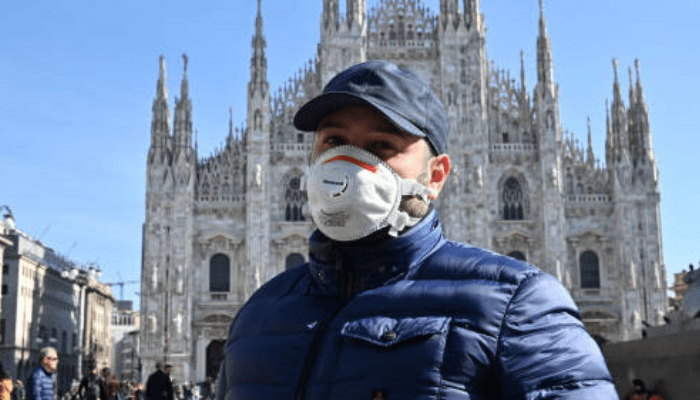
The global drop in equities comes after Italy imposed a quarantine across at least 10 towns in an effort to contain the biggest outbreak of the virus outside Asia, with 219 confirmed infections and five deaths.
South Korean authorities reported 231 new cases on Monday, bringing the total number to 833 with seven related fatalities. The government added it had put 7,000 troops under quarantine after 11 had tested positive for the virus.

Iran said there had been 12 deaths and 61 confirmed coronavirus cases in the country, a sharp rise from eight fatalities and 43 infected patients it had reported a day earlier. Turkey closed its borders with Iran, and Iraq, Afghanistan, Armenia and Pakistan have imposed restrictions on border crossings and trade.
Italian stocks led the global declines, with the country’s FTSE Mib index of shares dropping 5.6 per cent, the largest decline since 2016. The continent-wide Stoxx 600 tumbled 4.2 per cent, while the UK’s FTSE 100 dropped by 3.7 per cent, in its largest slide since 2015. Shares in European airline easyJet fell 16 per cent, while Ryanair slid 13 per cent.
The drops echoed falls in several major Asian markets. Seoul’s Kospi fell 3.9 per cent, its worst day since late 2018, after South Korea on Sunday raised its infectious disease alert to its highest level.
“Markets [are] likely to show extreme caution in the face of [the] global spread of the coronavirus,” said Robert Carnell, chief Asia-Pacific economist at ING. “This is no longer solely an Asia issue.”
Despite the outbreak in Italy, EU authorities said they had no plans to suspend travel across the 26-country Schengen area of visa-free travel.

“We need to take this situation extremely seriously — but we must not give in to panic and of course to disinformation,” Stella Kyriakides, EU health commissioner, told reporters in Brussels.
Bruce Aylward, head of the World Health Organization team of foreign experts in China, praised the country’s response to the health crisis, telling a press briefing in Beijing authorities had implemented “the only successful measures we have seen”. He added that the turning point in Wuhan, the centre of the outbreak, had been reached with more people leaving the hospital than going in.
Mr Aylward also stressed the need to restart China’s economy, echoing calls by the President Xi Jinping for business to resume.
Worries about the impact of coronavirus in stunting global economic growth have had a negative effect on commodities.
The price of Brent crude, the global oil marker, fell 3.6 per cent to $56.36 a barrel.
The debt of energy companies has also been hit particularly hard, reeling from the fall in oil prices and continued low natural gas prices in the US. BlackRock iShares high-yield bond exchange-traded fund dropped 0.6 per cent ahead of the market open in the US.
China’s extended lunar new year holiday officially ended on February 10, but consumption of commodities such as coal for power generation was far below normal levels, analysts have noted. Steel inventories are at five-year highs because of a lack of demand, according to Mysteel, a consultancy.
“The coronavirus outbreak is starting to rattle asset markets and should keep weighing on commodities’ demand,” said Aakash Doshi, head of commodities research in North America at Citigroup. “If virus risks keep spreading outside of China, causing broader downturns in equities and [corporate bond] markets, commodities’ prices should face further short-term headwinds.”
Central banks could provide one source of support. Over the weekend, Haruhiko Kuroda, Bank of Japan governor, said he was monitoring the impact of the virus and was “well prepared” to act to bolster the economy. US Treasury Secretary Steven Mnuchin said central banks would look into possible responses if needed. Analysts at Rabobank said the European Central Bank would “have” to present a monetary policy response.
China’s extended lunar new year holiday officially ended on February 10, but consumption of commodities such as coal for power generation was far below normal levels, analysts have noted. Steel inventories are at five-year highs because of a lack of demand, according to Mysteel, a consultancy.
At a State Council briefing, senior economic and financial officials estimated that more than 70 per cent of large manufacturers had reopened in most industrial areas, but admitted that smaller and medium-sized companies were struggling, with less than 30 per cent resuming operations.
“Consumption hasn’t disappeared; it has just been postponed,” said Cong Liang at the National Development and Reform Commission. The officials did not promise any large stimulus measures beyond Rmb300bn ($42.6bn) in previously announced central bank loans for struggling companies