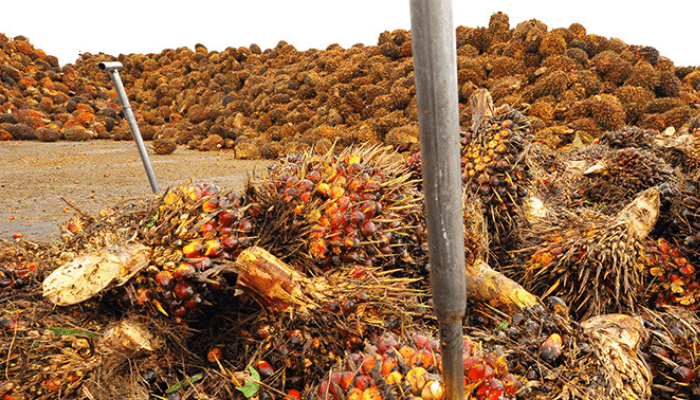
The ongoing border closure by the Federal Government has trigged a higher demand for palm oil in the country, farmers say.
Since the shutdown of the country’s land borders in August 2019, farmers and processors of palm oil have seen increased demand for their products.
Also, importers of crude palm oil who usually import to neighbouring West African countries owing to lower tariffs and bring it into the country through the land borders under the ECOWAS Trade Liberalisation Scheme (ETLS) are now compelled to import directly into the country, experts say.
“The border closure has impacted the palm oil industry positively. Demand from farmers and processors as increased as they are now getting orders from those that ordinarily would not buy from them,” said Fatai Afolabi, executive secretary, Plantation Owners Forum of Nigeria (POFON).

“It has also increased revenue for the government as some manufacturers who import CPO to Ivory Coast and others to bring into the country because of lower tariffs are now importing directly into Nigeria,” he said.
The country’s 2019 import data from Malaysia also confirms Afolabi’s statement, as imports for the period have risen by 18.4 percent from 2019 from 242, 388 metric tons (MT) in 2018 to 286,964 MT in 2019, according to the Malaysian Palm Oil Council (MPOC).
While imports from data from Benin, Ghana, Ivory Coast, and Togo all decrease by 50, 36, 74 and 39.3 percent respectively, the data shows.
“The border closure has reduced smuggling of refined vegetable oil by 80 percent, though very little still come in,” Henry Olatujoye, president, Palm Producers Association of Nigeria.
“Demand for palm oil since the closure has increased tremendously as manufacturers who use it as a by-product for production are now sourcing locally,” Olatujoye said.

To protect the country’s palm oil industry and spur the industry growth, the Nigerian government had imposed a 35percent tariff (10 percent duty and 25 percent levy) on palm oil imports into the country.
Crude palm oil is also listed on the 41 items restricted from forex access.
Presco and Okomu’s – Nigeria’s two largest oil palm producers recorded a revenue surge in the last two quarters of 2019 when the border closure policy came into effect.
According to the numbers released by Presco and Okomu, combined sales revenue nearly doubled to N11.8 billion in the third quarter of the year, from N7.7 billion in the preceding quarter.
Findings from the Q3 financial results of listed firms show that Okomu Palm Oil revenue increased massively year-on-year by 89.9 percent to N7.0 billion in Q3 2019 from N3.7 billion in Q3 2018.
Presco’s revenue increased marginally by 4.3 percent to N4.8 billion in Q3 2019 from N4.6 billion in 2018.
“In the first two quarters, we had a lot of problems in having to sell our products locally,” Graham Hefer, managing director of Okomu Oil Palm, said while reacting to third-quarter results.
Hefer said that after the Nigerian government shut its land borders, the impediments to sales faded off as there was a loosening of grip by illegal imports, creating an opportunity for the company to market its products more easily.
Last year, the Nigerian government also announced the provision of financial support to the palm oil industry.
Nigeria’s apex bank says it has disbursed over N30 billion to the oil palm sector, which has mainly been to support the big players.
But currently, modalities are ongoing to also support smallholder palm oil farmers who produce 80 percent of the country’s total production.
“We are still working on the modality to provide support to smallholder palm oil farmers with the Central Bank,” said Hilary Uche Igwe, national president, Oil Palm Growers Association.
“The association was asked by the Central Bank to work on the numbers of hectare and the list of farmers under our umbrella,” Igwe said.