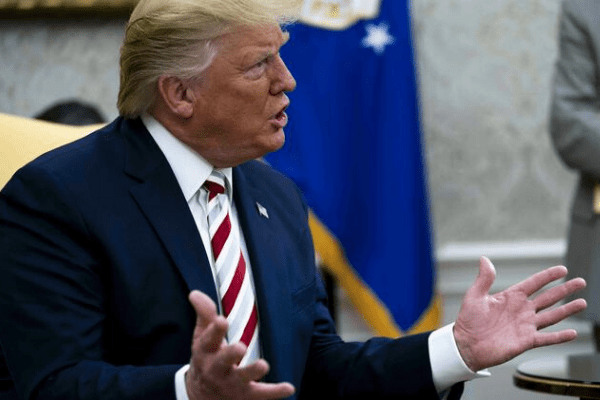
Though the odds may be stacked in his favour, United States President Donald Trump will next month face the Senate which will hold a trial on whether or not to convict and remove him from office.
The 45th president of the United States was impeached on Wednesday by the House of Representatives on charges of abuse of power and obstruction of Congress.
Trump has demanded an immediate impeachment trial in the Senate, amid an impasse among Democrats and Republicans over when it may start, with Democrats arguing the Republican-controlled Senate is refusing witnesses and will not hold a fair trial.
“If further momentum builds behind the Democrats’ efforts, the health of the US economy will become even more critical,” Nicholas Spiro, a partner at Lauressa Advisory, said.

The dramatic increase in US political risk injects yet more uncertainty into an already perilous global economic and policymaking environment.
While the communiqué issued at the end of the IMF and the World Bank’s annual meetings in October agreed that the global economy is not slipping into recession as many have forecast, the trade war with China, rising tensions in the Middle East and fears over the health of the global economy have unsettled markets recently, and led the US central bank, the Federal Reserve, to maintain low interest rates.
The US Fed tends to hold off on raising interest rates if it reckons the economy is decelerating. While higher rates push up borrowing costs for companies and consumers in the US, they hold capital inflow and cheap cost of borrowing opportunities for an emerging economy like Nigeria.
“A lower rate by the Fed simply means the possibility of increased FPI flows into emerging markets. Nigeria’s money market instrument remains a big attraction for foreign investors, thus Nigeria may see more inflows into that space,” Ayorinde Akinloye, a consumer goods analyst at Lagos-based CSL Stockbrokers, said.
However, data by the National Bureau of Statistics (NBS) showed capital inflow into Nigeria declined in Q3 2019 by 7.8 percent to $5.37 billion, from $5.82 billion in Q2 2019. Both Foreign Direct Investment (FDI) and Foreign Portfolio Investment (FPI) saw a drop in inflows by 10 percent and 30 percent, respectively.

Read also: Update: US House of Reps impeaches President Trump
The result from a recent CEO survey by a US-based CEO-focused publisher showed that the current situation in the US is not only delaying investments, it is also endangering an otherwise stellar climate for business, and that if Washington doesn’t straighten up soon, the economy could take a severe downturn.
“Widely varying signals from the US administration on approach to trade and tariffs (are) crippling business confidence and ability to plan,” said Tim Zimmerman, president and CEO of Mitchell Metal Products, who is among the surveyed CEOs forecasting declines in both revenues and profits over the coming year.
Speaking on the US-China trade war and the global economy, Bismarck Rewane, CEO, Lagos-based Financial Derivatives Company, said Nigeria should be concerned about how as a country it is going to be more competitive going forward.
“There is a risk if things go out of control; we could end up in a global recession, not a global financial crisis, in which we are also going to suffer as commodity prices will come down,” he said.
Akpan Ekpo, a former director-general, West African Institute of Financial and Economic Management and professor of Economics and Public Policy, University of Uyo, said “slow growth in the US will lead to slow global growth rate, and once the global growth rate slows down or is sluggish, it will affect Nigeria’s growth performance”.
According to data by the US Economic Bureau of Analysis, the US economy reported 3.1 percent growth in the first quarter of 2019 but slowed to 2.1 percent in the second quarter. This is significantly less than the 5.5 percent achieved in the second quarter of 2014 during the Barack Obama presidency.
While it seems unlikely that Trump will be impeached by the Senate going by the fact that the Republicans – Trump’s party – hold the Senate majority and two-thirds of senators would need to vote for removal, the impeachment by the House of Representative creates a permanent black mark on Trump’s political legacy that he shares with only two past presidents, Andrew Johnson and Bill Clinton.
Trump has argued that his corporation tax cuts along with his US-focused policies, his clampdown on bureaucracy and his promises of infrastructure investment have helped the US financial markets, especially the Dow Jones Industrial Average, which follows the shares of 30 major US companies.
However, in recent months, the index has been highly volatile, reflecting worries about the trade confrontation with China, and a gloomier outlook for the global economy.
Omotola Abimbola, research analyst at Lagos-based Chapel Hill, said for now the market is not really paying attention to the impeachment news as it is just political news.
“In the event that Trump is impeached by the Senate, there will be a negative reaction from the global market because in the last few years, he has actually enacted some policies that impacted on the market,” Abimbola said.
Trading at the stock market remained bearish, Friday, as the Nigerian Stock Exchange (NSE) All-Share Index (ASI) fell further to close lower at 26,526.35, 0.22 percent decline from Thursday trade of 26,584.45.