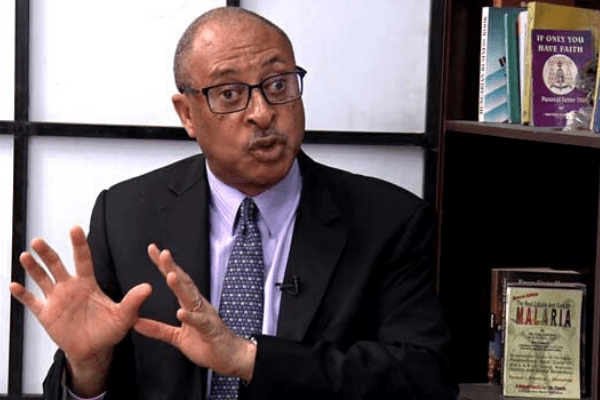
Pat Utomi, a leading economist, has identified weak property right as one of the biggest threat to inflow of capital and foreign direct investment (FDI) into Nigeria’s economy.
Speaking on Wednesday in Abuja at the Day two of the ongoing National Transportation Summit organised by the Chartered Institute of Transport Administration Nigeria (CIoTA), Utomi said that investors do not go to countries where property rights are threatened.
“In Nigeria, Governor’s are revoking C-of-O that were approved by their predecessors. We are talking of properties that people have invested billions of Naira to build. Government revoke them due to political considerations. Investors don’t come to such countries,” he said.
According to him, Nigeria is presently losing relevance to smaller African countries due to the lack of efficient transport infrastructures.
“Africa will not make the progress that it’s destined to make unless Nigeria leads the flying geese. What transformed the South-East Asia economy? It was Singapore that began to get it right, and others looked across the border and joined in the development stride. Before you knew it, Malaysia, Thailand and others had their economy transformed,” he said.
Utomi, who noted that Nigeria is central to African development, said its unfortunate that Nigeria has not done something right in the transport sector such that small countries are beginning to lead the way on the continent.
Citing example, he said that he was in Addis Ababa last week, and saw that they have functional Light rail there. “The road network in Addis Ababa is flourishing, and not the place we used to struggle to go to in the 70’s. We need to see a lot of investment to come to Nigeria’s transport infrastructure.
Emmanuel Iheanacho, a former minister of interior, blamed the problems in Apapa port to lack of adequate capacity to handle the volume of cargoes coming to the port.
“On Creek Road in Apapa, there are numerous obsolete buildings that the government could buy, demolish and convert those areas into marshalling areas for cargoes. What we advocate is dynamism,” he said.
According to him, Apapa problem has gone beyond deploying the military to clear the roads, because Apapa requires expansion and redesigning of the port infrastructure and access roads to the hinterland in line with the volume of trade.
Earlier, Innocent Ogwude a former Acting Vice-Chancellor of the Federal University of Technology, Owerri, who presented a paper titled, ‘Urban Transportation: Access and Mobility for Sustainable Development,’ blamed vehicular congestion on Nigerian roads to narrow roads, inadequate land usage and pattern of city structures.
“Nigeria has low vehicular ownership and thus, vehicular congestion ought not to have occurred in Nigeria until the year 2025. For now, Nigeria’s transportation mode is vehicle dominated, and there is a need for careful planning of urban transportation,” he said.
Ogwude said vehicle ownership in Nigeria is about 0.6 percent, adding that Nigeria is expected to reach a saturation level for vehicle ownership in 2025 when ownership of vehicles will get to 0.73 percent.