|
Getting your Trinity Audio player ready...
|
For the time being, big banks dividend health score- a proprietary model of profitability, cash flow leverage metrics- should assure investors that there is no dividend cut in the horizon.
They have been rewarding shareholders from distributable profit even during volatile market conditions or economic downturns.
Bank stocks provide investors with good source of income as evidenced in a high dividend yield, which means investors are getting high cash benefits from investing in the shares.
High dividend yield provides a buying opportunity for investors in a time of falling yields on fixed income securities, as market participants search for alpha.

The average dividend yield of the five largest banks is 9 percent, according to BusinessDay calculations.
At 14.85 percent, Zenith Bank has the highest yield among the largest companies in Nigeria. GTBnk and United Bank for Africa (UBA)’s yield of 9.70 and 11.41 beat the industry average.
The high dividend yield of these stocks is not because of profit growth alone but declining share price in recent past.
Since 2017, stocks of the largest lenders have gone nowhere in tandem with a sluggish economy, while investors have continued to dump shares as government policies have failed to reinvigorate their appetite.
The banking index has declined 8 percent YTD.

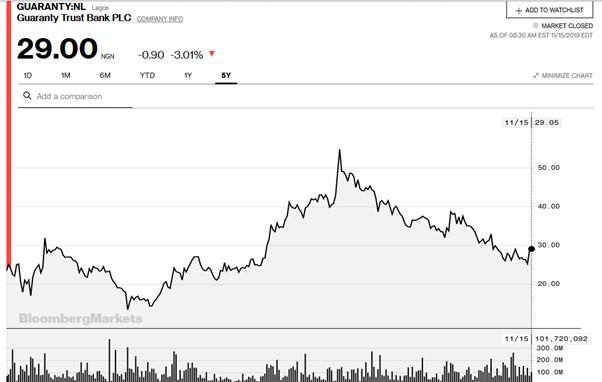
Guaranty Trust Bank (GTBank) was trading at N54.71 as of Jauuary 19 2019, but it closed at N29 as on Friday in Lagos. Zenith Bank traded at N33 as of January 19, 2018, but it closed trading at N18.85 as of close of trading in Lagos.
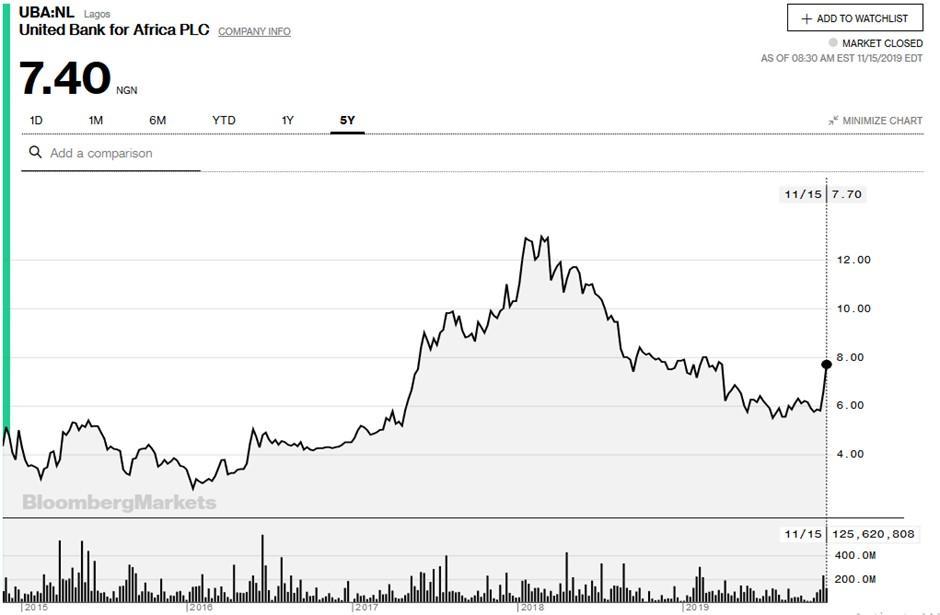
Access Bank’s shares hit an all-time high of N13.30 as of March 2, 2018, but it traded at N10.50 on Friday. UBA traded N12.45 as of March 2, 2018, but closed at N7.40 Friday.
“Bank stocks have liquidity, and you can easily get willing buyers compared to other sectors,” said Yinka Ademuwagun , research analyst at United Capital PlC.
The five largest banks have paid a combined interim dividend of N43.30 billion for the 2019 financial year. Also, they paid a total dividend of N191.06 in 2018, a slight increase from the previous year.
Banks are cautious of amount they pay to their owners out of distributable profit as they must maintain capital buffers to fend off macroeconomic headwinds.
Investment in electronic banking, a reduction in impairment charges, and investment in government securities, are the major drivers of profit in the last four years.
The cumulative net income of GTBank, Zenith Bank, Access bank, UBA, and FBN Holdings increased by 14.65 percent to N521.91 billion in September 2019 from N455.95 billion the previous year.
However, the new directive by regulator that lenders should maintain a minimum Loans to Deposits ratio (LDR) of 65 percent by December 2019 could result in deteriorating assets quality, a double whammy for an industry recovering from a sudden crash in crude oil price that prevented valued customers from servicing interest on money borrowed.
Analysts expect a rally in banks stocks as the continuous drop in treasury bills (T-bills) would force investors to find high yielding assets.
A move by the central bank to limit participation in high yielding OMO bills sent real returns on treasury bills below zero, forcing domestic investors to seek out equities.
“The money market returns would also reflect the current rates in the medium term and new inflows and matured investments will be invested at current rates in the money market fund, which will drag down the performance of the fund,” Managing Director, Afrinvest Securities Limited, Mr Ayodeji Ebo
The Nigerian Stock Exchange All Share Index (NSEASI) gained 2 percent last week touching at a psychological point of 26,851.58 points, but it has a year to date of (-14.57 percent).
BALA AUGIE