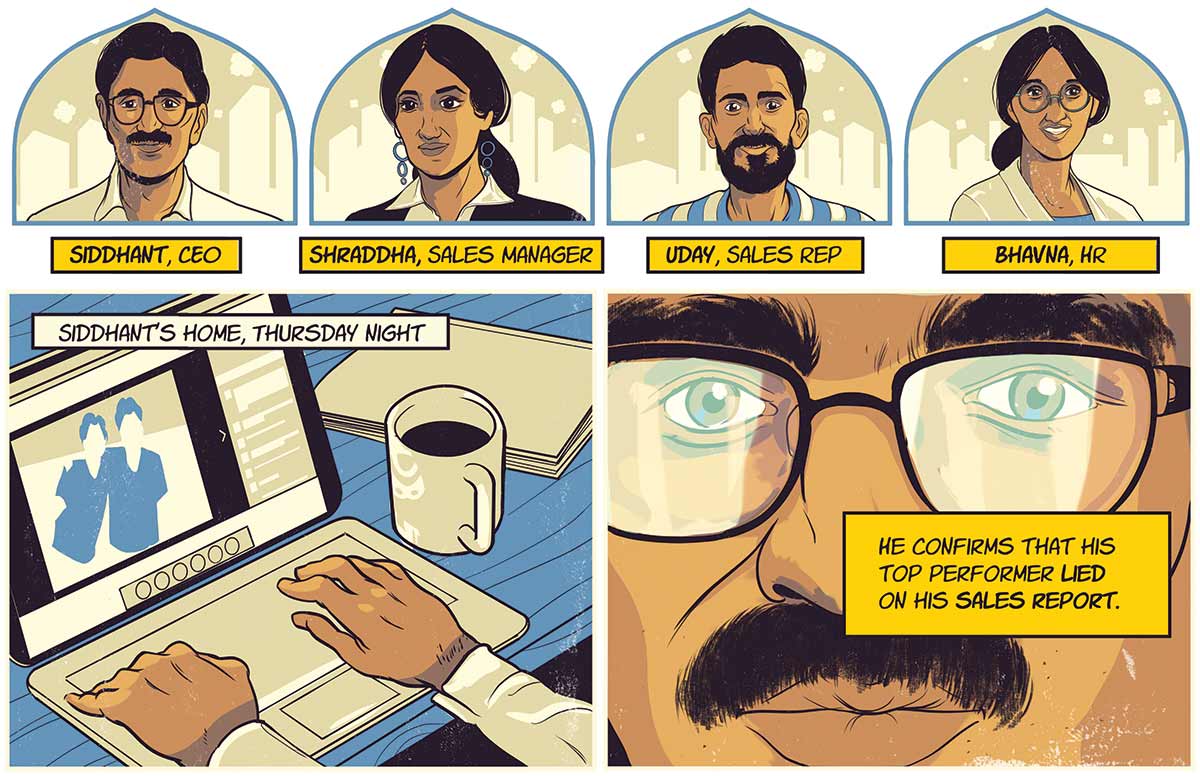
As CEO of one of the largest pharmaceutical-marketing firms in Western India, he didn’t have time for social media. But right now, he needed to log on.
He searched for the doctor’s name — Parasaran Srinivasan — and recognized the first picture that popped up. Just as he’d thought, they’d gone to university together in Mumbai.
Looking at his old classmate’s page, he groaned. The pictures of Parasaran at a recent World Cup party confirmed that one of Novacib Labs’ top salespeople had falsified his sales report. Now he had to decide what to do about it.
NOVACIB HQ, THAT MORNING

SURPRISING NEWS
Everyone at Novacib knew Siddhant hated getting emails with that little red exclamation mark. So when he saw both the red mark and the word “URGENT” in his inbox, his stomach dropped. The email was from Shraddha Pillai, Novacib’s regional sales manager in the Mumbai office. She’d kept her message short:
“Need your advice on a potential ethical breach.”
Siddhant canceled his next meeting and called her mobile.
“Tell me what’s going on,” he said when she picked up.

“I’m afraid we have an issue with one of our sales reports,” Shraddha said carefully.
“What kind of issue?”
“It seems that Uday may have intentionally falsified some information about his customer calls.”
“Uday?” Siddhant made no attempt to hide his surprise. Uday Madhav was one of Novacib’s best salespeople. He routinely exceeded his targets by 10% to 20% and had earned the company’s top commission prize three times in the past five years. And he was a generous colleague. He often took new salespeople under his wing, sharing sales tactics and handing off easy customers.
There was no doubt that the company’s targets were ambitious. Sales reps were required to meet with a minimum of 10 physicians and four retail pharmacies a day, allocating that time according to the potential of the target: 50% to platinum-class customers, 30% to gold and 20% to silver. The regional sales managers worked closely with the reps to coach and support them — but Uday rarely needed Shraddha’s help. In fact, he often served as a mentor to his more junior colleagues.
“Could there be some take?” Siddhant asked.
“It’s possible. But I know how seriously you take ethical issues. I
Smiswanted to bring this to your attention right away.”
Five years earlier, when Siddhant had taken the helm at Novacib Labs, its founder and outgoing CEO had given him a mandate: Grow the company by 40% and ensure that it remains the market leader. New competitors were popping up every day, vying to capitalize on the explosive growth in the Indian pharma industry. Siddhant knew that to accomplish his goals, he needed to be laser-focused on strategy. And by all accounts, he’d been successful. During his tenure, the company’s portfolio had grown from 22 brands to 46, and from 10 sales territories to most of Western India.
That success, he believed, rested on Novacib’s new positioning — to customers and employees — as “the ethical pharmaceutical-marketing company.” Amid growing concerns that similar firms were bribing customers or overstating products’ benefits, this stance distinguished Novacib. Siddhant and his leadership team had even changed the firm’s tagline from “Health for everyone” to “Health with integrity.” Behaving ethically became part of Novacib’s story, and all employees were encouraged to share it, especially during sales calls. And the tagline was more than a marketing slogan to Siddhant. He’d always prided himself on leading a principled life
Shraddha was absolutely right that he would be concerned about false reports. To protect its reputation, Novacib had a zero-tolerance policy for ethics violations. But would sacking Uday really be in the best interest of the firm, Siddhant couldn’t help but wonder? He had always made or exceeded his numbers — and boosted the performance of his colleagues as well.
“Siddhant?” Shraddha asked. “I’m still here,” he said. “Tell me exactly what happened.”
‘SOMETHING DOESN’T FEEL RIGHT’
Shraddha recounted what she’d discovered the evening before.
“I was leaving the office last night,” she began, “when I got a text from Uday that said, Baby still sick. Need to give wife a reprieve. I’ll make up the visits next week. Of course, I felt for him. I’d been in his shoes. The baby is just a few weeks old, and neither he nor his wife have slept much. He’s still been hitting his quotas, but he looks exhausted.
“I decided to stay at the office to finish up my reports in case I had to cover his sales calls. And as I was looking over his activity, one date stood out: June 21. That was the day Argentina lost to Croatia in the World Cup.
“I remember it well, because I had followed the match online. Dates don’t typically stick in my mind, but that day was depressingly memorable, not just because my team lost but also because I watched the game by myself. My family — like most of Mumbai — had skipped work to watch together. I hadn’t wanted to get behind, so I spent the day alone in the office.
“I had spoken with Uday the morning of the game, and he mentioned that he was going to watch it. And yet his daily report listed the names of three doctors that he supposedly saw that afternoon. I texted him about the discrepancy — something like Sorry to bother you with baby sick. Can you resend your activity report for the week of June 18? Ten minutes later he emailed me the same information,. so I texted again: Are you sure that’s accurate? He sent back a thumbs-up emoji.”
She paused. “Go on,” Siddhant said grimly.
“I’m not in the habit of tracking our salespeople’s whereabouts, especially in the case of Uday, who has always been a star performer. Normally, I’d give him the benefit of the doubt, but something didn’t feel right. I looked him up on Twitter and scrolled back to his tweets from June 21. He’d clearly been watching the game — at home. Then I tried one of the doctors on Uday’s report. Same thing: He’d been watching the game, too, not meeting with Uday. That’s when I started to panic.”
Siddhant was starting to panic as well. Trust was essential to the company’s mission, and Uday’s actions were exactly the kind of thing that could undercut Novacib’s culture and reputation and breed resentment among employees. Siddhant recognized that Novacib was bound to encounter less-than-honest salespeople, but he was still having trouble believing that Uday would be the one to get into trouble first. At the same time, there was no denying his outsize contribution to the success of the firm — and how hard it would be to replace him.
Shocked and angry, Siddhant wondered to himself, How could Uday have done this?
NOVACIB HQ, FRIDAY MORNING
NOW WHAT?
The next day, Siddhant met with Bhavna Batra, Novacib’s human resources director, in his office. They dialed in Shraddha on speakerphone.
“This is bad,” Siddhant began. “Last night, I confirmed another doctor listed on the report whom Uday couldn’t have met with that afternoon.”
“Shraddha and I had a conference call with him after she spoke with you,” Bhavna said. “We asked him about the report, and he said he had met with the doctors he listed — but not on June 21. He all but admitted that he lied. I’m not seeing any option other than letting him go.”
“I don’t understand why he didn’t tell anyone he was struggling,” said Siddhant. “He’s the first one to help his colleagues out; people would have jumped at the chance to return the favor.”
“It’s definitely out of character for him,” Shraddha. “That’s why I feel strongly that we should issue a warning — especially with his being a new father. After all, he did meet with everyone he said he had. He wasn’t fabricating that.”
“But he was altering the dates to meet his daily targets,” Bhavna countered, leaning toward the speakerphone. “That’s a serious breach, and we have to consider the broader impact of merely giving him a slap on the wrist.”
She looked up at Siddhant. “When you brought me in after the rebranding, you asked me to help you build a culture of ethics and honesty. I’d be failing at my job if I advised you to let a transgression like this go. I recognize the value of Uday to our team, but our motto isn’t ‘Health with occasional integrity.’ We have to always do the right thing.”
“I agree,” Siddhant said. “Integrity is our promise to every employee and every customer we interact with. If our people knew we tolerated this behavior after all the ethics training we’ve put them through, we’d look like hypocrites. We’d be hypocrites. And if this ever got out to our customers or the press, it could destroy our reputation.”
“But how are we going to look to the rest of the team when we sack their beloved colleague with a newborn at home?” Shraddha asked. “And he’s such a strong performer! Think of the revenue hit we’d take. Are people actually going to care about three names listed for the wrong day on one weekly report? It’s not as if those call targets are tied to his compensation.”
“It’s the principle of the thing,” Bhavna retorted. “And how do we know if this is the first time he’s fudged his reports? How can we trust him going forward? Are you going to check with his customers every week to confirm his reports?”
Shraddha was silent on the line. Siddhant closed his eyes briefly. He knew she was right that the company would suffer if they fired Uday. He brought in over $250,000 a year, and he had built strong customer relationships that Novacib stood to lose if they sacked him. But Siddhant couldn’t shake his disappointment in Uday. Bhavna broke the silence.
“You’ve addressed this issue repeatedly in our sales off-sites,” she said. “You’ve stated in no uncertain terms that you’d rather salespeople not meet their targets than fake their numbers. If you don’t take action, you’ll damage your credibility. I know it’s painful, but I think it’s time to put your money where your mouth is.”
NOVACIB HQ, FRIDAY TERNOON
A SECOND CHANCE?
“Thank you so much for the baby gift. Did you get the thankyou note my wife sent?” Uday’s voice sounded tentative on the phone, the small talk forced.
Siddhant had dreaded making the call, but before he reached a decision, he wanted to talk with Uday himself.
“I did. Listen, Uday, I don’t want to make this any more awkward than it needs to be. I just want to hear your side of the story.”
Uday repeated what he’d told Shraddha: that he had met with those doctors, just on different dates. That he shouldn’t have submitted the false report. “I made a big mistake, and I’m sorry. I was feeling the pressure with the new baby. I knew I wasn’t going to hit my targets, and I didn’t want to disappoint anyone.”
Siddhant hated to hear Uday sound so dejected. But part of him still felt betrayed. He reminded himself that Uday could easily find another job, especially since Novacib had no intention of going public with the circumstances if they let him go. But Uday would be devastated nonetheless. “We need accurate data to grow this business, and we’ve been very clear about our ethics policy,” Siddhant said. “I wish you’d talked to Shraddha about the pressure.”
“I know, and I’d understand if you have to make an example of me. But please believe me that it has never happened before and won’t happen again. Don’t people deserve a second chance?”