



Negative perceptions, often arising from unfounded reports of social and political situations in African countries are blocking foreign direct investments into the region, Aliko Dangote, president of the Dangote Group has said.
The implications, he indicated, were a cramping of these economies and the job opportunities envisaged.
Speaking at the ongoing World Economic Forum in Davos Switzerland yesterday, Dangote said governments of African countries needed to make deliberate efforts to correct these distortions, in order to widen the channels of investment flow.
Speaking during a live telecast of a business platform “Africa’s Next Billion”, alongside other leaders, including Nigeria’s President Goodluck Jonathan and Ghana’s John Mahama, Dangote said the wrong perception of the security and political situation in Africa had made investors, especially from the West, to lose sight of the potentials in the continent, and African countries had also done little or nothing to remedy the ugly situation.

Explaining that the situation in Africa was not as bad as was being painted, the businesman said corporate investors did not check what Africa was truly about, but based their judgments on what they read in newspapers, which was often incorrect. 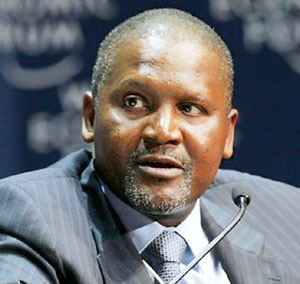
“For instance, foreign investors wait for elections to be concluded. After then, they try to check the stability of the government of the day, for at least two years, but by then, its more difficult to take any decision because the tenure of the government is coming to an end. By so doing, foreign investors are scared of incoming or incumbent governments and the cycle keeps going on,” Dangote said.
“But then, I don’t think there is anything to be afraid of because no government is against business, every government is pro-business. Most business risks are perceived, not actual risks,” he stated.
He lamented that Africa was not good at telling its own stories, which meant that people often relied on stories they heard from others, to make their decisions, and most times those stories were not true. “People always underestimate Africa,” he said.
He added: “As at today, an American has more access to Africa than myself, taking visa issues into consideration. I would require 38 visas to visit 38 African countries outside of ECOWAS.

“The government needs to make a policy where we don’t supply/export raw materials alone; we want to be involved. We want those factories to be set up and produce here, run it for us for about 4-5 years, then we can take over production ourselves. Majority of our raw materials have been exported, processed abroad and brought back with at least 10 percent higher than the original cost.”
He said that entrepreneurship entails being able to take calculated risks, strong business stamina and a large appetite for work and success, adding that Africa has what it takes for people to do business and succeed.
“In Nigeria, we have one of the most attractive investment policies through framework that the government has put in place to help businesses succeed. If I dreamt five years ago that I would invest in agriculture, I would write it off as bad dream or nightmare, but today, we’re investing $2.3 billion in agriculture, $2 billion in sugar, and $300 million in rice,” he said.
“In agriculture, we’re going to create 180,000 jobs in the next four years in Nigeria. African governments need to invest in infrastructure, education, economic stability,” he added.




