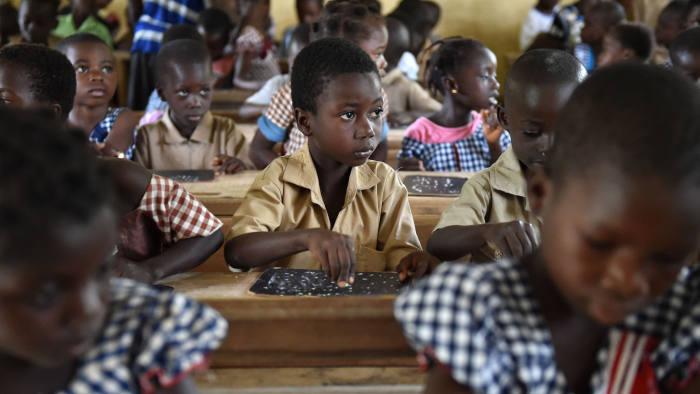
More than half of tenyear olds in poorer countries and nearly 90 per cent of those in Sub-saharan Africa lack basic reading skills, the World Bank said as it unveiled a new initiative to halve “learning poverty” over the coming decade.
In an effort to boost education spending and to increase its effectiveness, the agency released data showing wide divergence in the ability of children to read and understand a basic text.
An estimated 265m children around the world are not even studying in school, the analysis suggests, while a high proportion of those attending classes are failing to benefit because of poor quality teaching, absent or unsuitable materials or other impediments.
Jaime Saavedra, global education director at the World Bank, said: “This is a critical issue. All kids should be able to read. If not, their future is at risk. A lot of children are in school but are getting a low quality education.”

The initiative comes at a time when investing in “human capital” — or education and health — is seen as essential in boosting economic and social development and achieving the UN’S Sustainable Development Goal targets for 2030.
Read also: Nigeria seeks $3bn facility from World Bank for power sector development
The World Bank last year set up a “human capital index” to track progress and is helping co-ordinate a network of finance ministers alongside their counterparts in education and health to encourage countries to invest more of their own resources in social development.
Measures it says are required include meritocratic recruitment, improved teacher training coaching in schools, wider provision of textbooks, detailed lesson plans and improved systems for tracking students’ progress.
Julia Gillard, chair of the Global Partnership for Education which has raised $2.5bn over the past few months for education funding in lower income countries to support national plans, said: “We need an integrated approach. Data has to drive policy to assess improvements and we must focus on the most marginalised.”