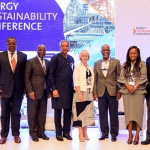
First WATT Renewables has emerged winners of the 4th West African Forum for Climate and Clean Energy Financing (WAFCCEF) contest, held recently in Abidjan and co-organised by the African Development Bank.
Young Nigerian entrepreneurs, Sherisse Alexander and Oluwole Ewéje, presented the project. Based in Canada, First WATT Renewables runs its project through an ‘SPV’, or ‘Special Purpose Vehicle’ set up to isolate financial risk, with a ‘take-or-pay’ model, that is an indexed electricity-purchase agreement in dollars.
Energy is provided as a service to the buyer, who makes flat-rate monthly payments. According to its initiators, the project eases the transition towards
Another award-winning project, Sweep Ghana, transforms energy-rich waste, including 20 percent of Accra’s household waste, to produce 15 megawatts (MW) of electricity for the national grid. A third winning company, Dutch & Co, helps to bridge the gap between supply and demand for electricity in Africa. It reduces demand by installing low-energy LED lighting and increases supply using solar PV.

Read also: ‘Industrialists should embrace solar energy to ease power problems’
“The candidates and their coaches had work to do. There were projects at different stages of maturity. But for us, the question was this: Which project has the best chance of securing funding straight away? There were many really appealing projects, different types of technology in different countries, and we had to make a choice,” explained the jury as it delivered its verdict. Eight projects were submitted, from Côte d’Ivoire, Ghana, Togo, Cameroon and Nigeria.
“WAFCCEF plays a crucial role in developing the next generation of clean energy entrepreneurs on the continent and serves as a link with investment initiatives by the African Development Bank and other financial institutions” said Daniel Schroth, acting director of the Bank’s renewable energy and energy efficiency department. “We have previously supported other WAFCCEF winners through the Sustainable Energy Fund for Africa (SEFA) and we hope to be able to select some additional projects for the Bank’s pipeline.”
Launched in 2013 by the Private Financing Advisory Network (PFAN), the WAFCCEF contest is organised by a partnership of the African Development Bank, the ECOWAS Centre for Renewable Energy and Energy Efficiency, (ECREEE), the ECOWAS Bank for Investment and Development and the African Biofuel and Renewable Energy Company (ABREC).
The PFAN network consists of more than 150 experts in climate funding and clean energy from around the world. The programme is hosted by the United Nations Industrial Development Organization (UNIDO) and the Renewable Energy and Energy Efficiency Partnership (REEEP) in Vienna. It is also supported by the governments of Australia, Japan, Norway, Sweden and the USA, and by the Kigali Cooling Efficiency Program (K-CEP).

“I was very impressed by the quality of the projects submitted. I was also pleased with the positive reactions of the investors attending the event, demonstrating the added value of the PFAN approach to the development and financing of clean energy and climate projects,” said Albert Boateng, PFAN coordinator for West Africa.
The first WAFCCEF was won by the SMEFUNDS (‘Small and Medium Entrepreneurship Fundamentals – Green Energy & Biofuels’), a Nigerian start-up behind the first production installation for cooking fuels in the form of a bio-ethanol gel made from plant waste. In 2014, this company received a $580,000 grant from SEFA to finance technical studies, legal and financial advisory services and a full environmental and social impact assessment.