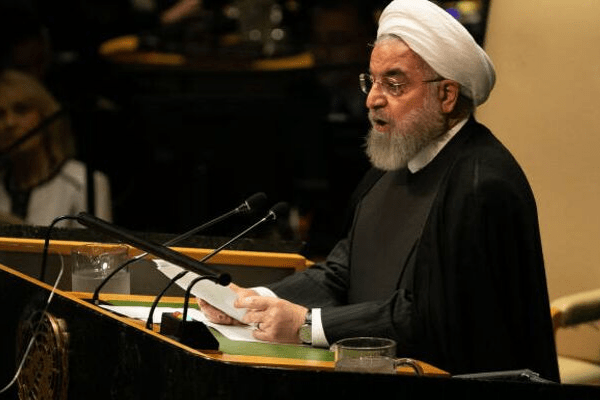
Iran’s president Hassan Rouhani said on Wednesday that the Islamic republic believed the path was open for negotiations with major powers over its nuclear activities and regional policies.
A French initiative to update the 2015 nuclear deal — in crisis since US president Donald Trump abandoned it last year — could provide an acceptable base to restart talks, he said, provided that the US showed that it was willing to “move toward” the lifting of sanctions.
Iran has long made softening of US sanctions a prerequisite for talks over the nuclear deal. Mr Rouhani, who was in New York with other world leaders for the UN General Assembly last week, refused to take part in a direct telephone conversation with Mr Trump over a secure line arranged by France, with the Iranian side blaming the US administration’s refusal to ease economic sanctions for its decision.
Read also: Iran set to release British tanker

But Iran’s president did not insist on this precondition for talks on Wednesday, instead clarifying that Tehran was positive about an initiative by French president Emmanuel Macron to grant Iran a $15bn credit line to enter into comprehensive negotiations with the US and other key powers.
“It is not over and the path [to negotiations] is not closed while Europeans and others are still making efforts,” Mr Rouhani said in the cabinet meeting that was broadcast live on the state television. “I told the French president that the outlines of his initiative are acceptable to us but not the phrases. He said those could be amended in a meeting of foreign ministers.”
Mr Rouhani defended his decision not to negotiate with Mr Trump in New York and said that it was a “smart move not to be fooled by private messages” of the US president. The White House “blocked” negotiations by sending contradictory messages in private and public, he said.
“I told our European friends that ‘shall we believe you that the US is ready [to lift sanctions] or shall we believe the US president who repeated twice in public speeches that sanctions would be further strengthened?’” he said. “How could we be confident [about the outcome]? At least they [the US] should admit their path [of sanctions] has been wrong.”