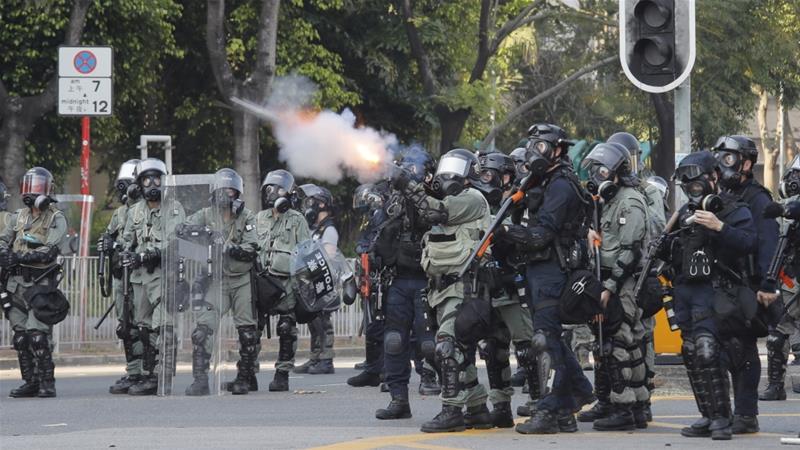
Hong Kong police shot a protester as violent clashes erupted across the Asian financial hub on Tuesday, sullying China’s attempts to project a strong and unified image to the world on the 70th anniversary of Communist party rule.
Video footage showed a police officer shooting the 18-year-old in the chest with a pistol at point blank range — the first time anyone has been shot in four months of often violent demonstrations in the city — during a running battle between police and protesters. The man, who was identified as a high school student, was taken to hospital, where staff said his condition was critical.
Hong Kong police commissioner Stephen Lo said at a late night press conference that the officer who fired the shot acted in a “sensible and lawful” manner because he was facing a life-threatening situation. He added that protester had been placed under arrest for assaulting a police officer. Mr Lo added that 25 police had been injured.
The shooting came on one of the most violent days yet in the wave of protests that have hit the territory, which returned to Beijing’s rule in 1997, with clashes still under way late on Tuesday evening. Financial Times journalists witnessed another protester being beaten unconscious by police in a separate clash. The city’s Hospital Authority said it had treated 66 people aged 11 to 75 years old, including two who were in critical condition.

Read Also: MUFG set to halve workforce in Hong Kong and Singapore
Authorities also released photographs of a police officer who had been attacked with a corrosive liquid, the skin on his chest and arms covered in welts.
“I’m ready to die for the movement, I’m not afraid,” said a 15-year-old student who gave his name as Xiu. “If my death would mean Hong Kong got freedom and genuine democracy, then it would be worth it.”
Hong Kong began the day in lockdown, with almost 30 shopping malls and a number of metro stations closed on what is normally a busy public holiday. The measures highlight the significant economic cost the protests have caused the city since they began four months ago.
“The so-called National Day is a day for mourning. We are mourning those who sacrificed for democracy in China . . . it’s 70 years of suppression,” said Lee Cheuk-yan, a former legislator and democracy activist, marching in one of the city’s biggest shopping districts that is usually flooded with mainland Chinese tourists.

But as crowds of demonstrators fought police, threw petrol bombs and smashed public property in Hong Kong, Beijing staged its biggest ever military parade in a move intended to project an aura of confidence and power to its people and to the wider world.
“Unity is iron, unity is steel, unity is strength,” said Xi Jinping, China’s president, in a speech delivered to a huge banquet on the eve of the national day celebrations in Beijing that was attended by Carrie Lam, Hong Kong’s beleaguered chief executive.
The parade unveiled startling advances in China’s weapons arsenal, including the Dongfeng 41 missile, which analysts said was capable of hitting any target in the US, carrying up to 10 nuclear warheads and travelling at 25 times the speed of sound. An estimated 15,000 troops, 160 warplanes and 580 tanks also took part in the parade.