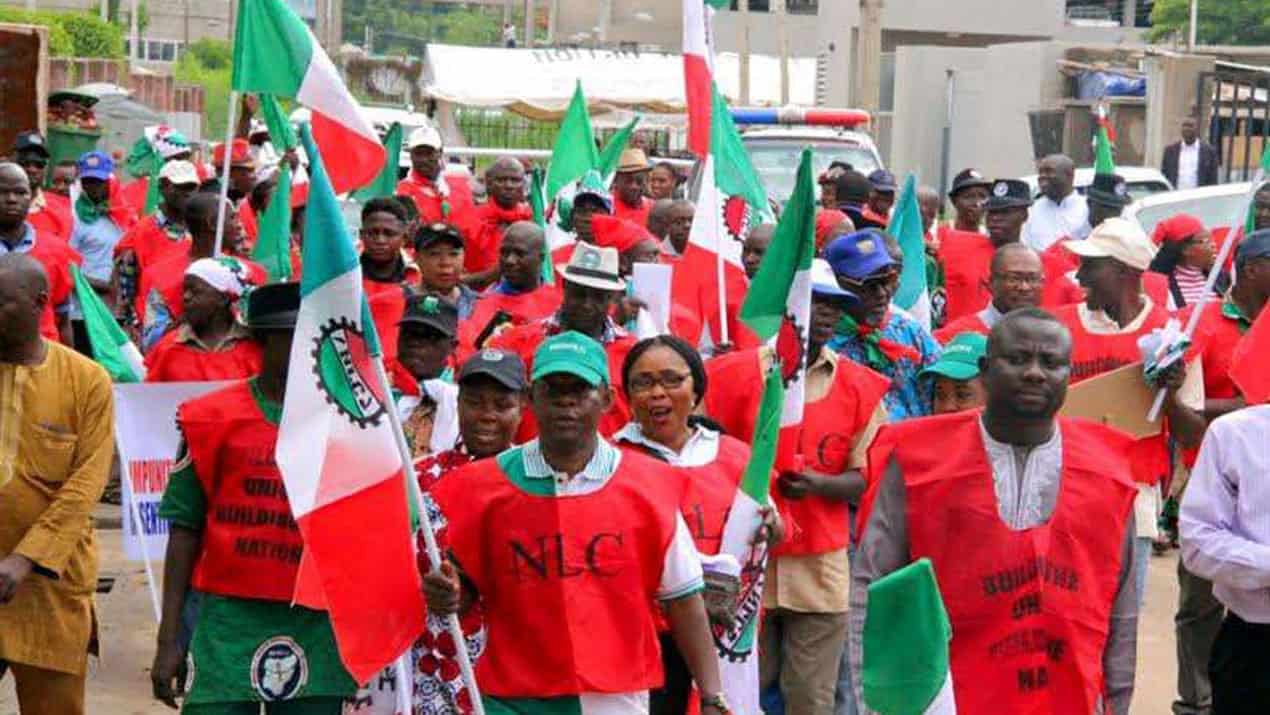
The Federal Government has again assured the Labour Movement in the country that it is working arduously to address the controversy surrounding the consequential adjustment of new minimum wage even as it urged the labour movement to work with the government to sort the matter out.
Minister Labour and Employment, Chris Ngige, gave this assurance when he received in audience the leadership of the Nigerian Labour Congress (NLC), led by its President Ayuba Waba, which paid him a courtesy visit in Abuja on Thursday.
Ngige also said the government has commenced paying the new wage from Levels 1 to 6 workers.
Negotiations between the Nigerian Government and the Joint National Public Service Negotiating Council (JNPSNC) over relativity and consequential adjustment for the implementation of the new N30, 000 minimum wage, had ended in a deadlock as both representatives failed to reach an agreement as labour unions recently threatened industrial action.

Since the new minimum wage bill was signed into law by President Muhammadu Buhari on April 18, 2019, there have been prolonged deliberations as the issue of relativity/consequential adjustment of salaries still persisted. Both negotiating sides will meet again on Friday, September 27.
Ngige noted during Thursday meeting with labour leaders that the government is doing its best saying “this issue of the minimum wage will be sorted out and I am very hopeful it will be done as soon as possible. It is unfortunate that the negotiation was deadlock from grade level 15 to 17 and the issue became on what percentage or scale that they should use. The most important thing is that we are going to discuss and negotiate it.
“Government is not averse to consequential movement, what we are saying is that we should try for all parties to agree that the economy is in doldrums and that the economy has some troubles and therefore we have to cut our coat according to our cloth.”
Earlier during the meeting with the Minister, NLC President Ayuba Waba, lamented that the minimum wage has remained a very thorny issue for both the labour unions and the Nigerian workers.
“Few days ago both NLC and TUC received a formal report in written by the Joint Public Service Negotiating Council informing us that negotiations have broken down and they want our quick intervention and part of the intervention we can make is that we have enough empirical data to guide the government and the committee to be able to sort out this issue in very quick succession.

“Yes there are challenges in the economy but if you look the condition of workers from when the last minimum wage was increased to where we are today, a lot of factors have affected their purchasing power which we have shared in our tripartite negotiating process, which led to the increased of the 30,000 minimum wage.
“Our plea is that while we will be meeting with the government on Friday this process can be fast tracked so that the entire work force can benefit from it,” he said.
The Acting Chairman, of the Trade Union Side (TUS) which is negotiating on behalf of the labour unions, Anchaver Simon, and Secretary, Alade Lawal, had said in a statement that efforts by the unions to persuade government to implement the new minimum wage with appropriate consequential adjustment had proved abortive.
The recent deadlock occurred during negotiation on September 16, which was chaired by the former head of civil service, Winifred Oyo-Ita. The federal government shifted from its earlier position of 9.5% to 11% for grade levels 7 to 14 and 6.5 % from 5.5% for levels 15 to 17.
The labour leaders, however, insisted that government should adjust the salaries of workers on grade levels 07 to 14 by 30% and those on levels 15 to 17 by 25%, having stepped down to 29% from 30% for grade levels 7 to 14 and 24 to 25 per cent for levels 15 to 17.
Innocent Odoh, Abuja