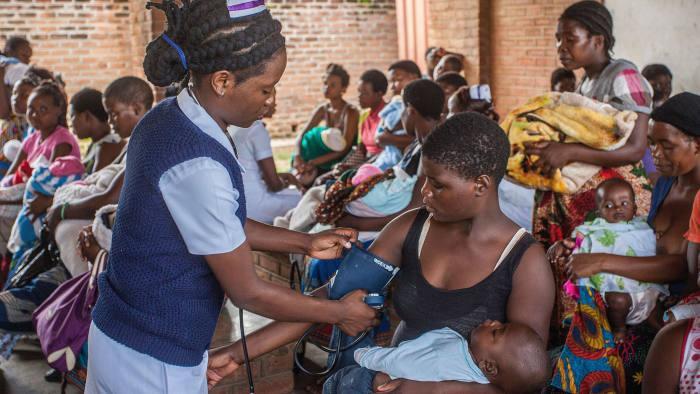
Malawi has a population of over 18m. Some 40 per cent of its adults have mobile phones. But this apparent mark of modernity belies profound problems of health and poverty. About 9 per cent of adults are infected with HIV. Yet the country has fewer than 300 doctors, putting it at the bottom of global rankings.
The precise figures, from the latest World Health Organization global health report, may fluctuate, but there is little doubt about the amplitude of the problem: the country has extremely scant, unevenly spread healthcare coverage. Few train locally and many of those who become doctors emigrate or abandon their profession.
The story of its poor provision is emblematic of a far wider concern across Africa, as debate grows about the needs and difficulties of providing universal health coverage. The country’s more recent encouraging experience highlights efforts taken to tackle the problem: a lack of medical training.
“It’s been tough financially, but I felt that I owed the college for what it had spent on me,” says Mwapasa Mipando, the first Malawian trained in human physiology, who went on to study and work in England and South Africa but has since returned to run the College of Medicine in Blantyre. “When you see the impact, going into the districts to find people you have trained, it’s very fulfilling.”

Read also: Nigeria needs 303000 doctors to meet WHO standard
Cultural and historical factors help explain slow progress in Malawi. Hastings Banda, the country’s former president who maintained a repressive one-party regime for nearly 30 years after independence in 1964, was a symbol of the ambivalence: he trained, settled and practised for many years as a doctor in the UK.
“He refused to start a medical school in Malawi when he came back,” says Dr Mipando, whose college was only created in 1991, almost three decades after Banda came to power. “He didn’t want half-baked training. He wanted doctors who could meet the standards in the UK. But it’s chicken and egg: if you produce doctors for the UK, they can easily stay there to work.” Economic factors also played a large role in pushing students abroad. In the latter part of the 20th century, medical infrastructure was undermined as former colonial powers withdrew across much of Africa. Insecurity and economic instability locally combined with austerity measures encouraged by international financial institutions.
While squeezed budgets and scant investment restricted local training and development, many promising students interested in medicine headed abroad to study instead. Better educational facilities, pay and prospects lured them to Europe, North America and Australia. Then, the development of personal ties once they had settled down made it difficult for many to return.
At the same time, there has been a growing “pull” from the UK and other richer nations for doctors and nurses from Africa, as their own health systems have struggled to train and retain sufficient local healthcare workers while demand from ageing populations continues to rise.

“There’s a huge drain of resources from the continent. The disease and social challenges outweigh what they can provide in Africa,” says Dorcas Gwata, who left her native Zimbabwe as a teenager to help her sister in Edinburgh in Scotland, before training as a nurse and then in public health in London. “We need to stop recruiting from low income countries. We are taking from Africa their greatest assets.”
She now works with organisations including the Tropical Health and Education Trust, which promotes “reverse innovation” that encourages professionals from the UK’S National Health Service to take up placements in Africa.
While leaders often speak out about the importance of healthcare, she says, few have met their pledges in the African Union’s the Abuja declaration in 2001 to invest 15 per cent of their budgets in health. By contrast, they and many others in the continent’s elite “spend an unimaginable amount accessing treatment abroad for themselves. That sets a precedent”.
While much of the medical “brain drain” has been into richer countries, there are other important regional and internal flows. South Africa draws off medical students and recruits from its poorer neighbours. In Malawi itself, private healthcare centres and non-governmental organisations lure staff from the public sector into higher paid and often administrative roles.
Africa needs an estimated additional 6m healthcare workers to reach the aim of universal coverage by 2030. As its population rises, the pressures will only grow.
“You will need a lot more midwives to deliver babies in rural areas,” says Patrick Dunne, chair of Education Sub Saharan Africa (Essa), a charity supporting tertiary education on the continent and modelling future faculty needs. “What will happen otherwise to infant and maternal mortality?”
Tackling the problem depends in part on securing more public funding for medical education and paying for staff in the sector.
Yet frequent strikes among health workers in poorer countries highlight frustrations over low salaries, delayed payments and overwork, as well as scant prospects of promotion. “We have to look at the package on offer. The problem will only be overcome by greater education linked to employment,” says James Campbell, director, health workforce, at the World Health Organization. He cautions that private medical training institutes are pushing students to seek employment outside the public sector, doing little to help meet greatest local need.