
|
Getting your Trinity Audio player ready...
|
The Advertising Practitioners Council of Nigeria (APCON) recently moved to sanction a small business which it claimed violated its rules that requires members to submit all advert materials for vetting before publishing.
However, going by the pronouncements in two separate judgments in the Court of Appeal, APCON’s violation notice is an overreach of its powers.
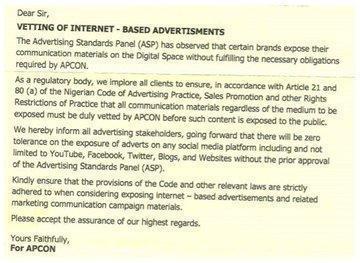
In a 3 September letter addressed to an online fashion firm, and signed by the Acting Registrar, Ijedi Iyoha, APCON said: “all communication materials regardless of the medium” needed to go through it before it is released to the public. Its guideline also requires the owners of the advert materials to pay a minimum vetting fee of N25,000 per material.
“We hereby inform all advertising stakeholders, going forward that there will be zero tolerance on the exposure of adverts on any social media platform including and not limited to YouTube, Facebook, Twitter, Blogs, and Websites without the prior approval of the Advertising Standards Panel (ASP).

APCON is the statutory body that has the mandate to monitor and ensure ethical advertising practice of its members in Nigeria. The body was established by the Advertising Practitioners Act No. 55 of 1988, as amended by Act No. 93 of 1992 and Act No.116 of 1993 (now Advertising Practitioners Registration Act Cap A7 of 2004).
Iyoha, the Acting Registrar claims that by virtue of Article 21 and 80 (a) of the Nigerian Code of Advertising Practice, Sales Promotion and Other Rights Restrictions of Practice, APCON is legally mandated to cover all areas of advertising, including online adverts.
This is not the first time the body is issuing a notice of violation to a business entity. In 2014, APCON found itself in court over claims that its Act empowers to regulate advertising in Nigeria was not limited to its members.
The body had contended that it is empowered to regulate advertisements in general and that any person or entity who publishes or procures the publication of an advertisement within the meaning of the Act and the Code is advertiser and is therefore within the remit of its regulatory powers.

In a July 2018 judgment, in the case of MIC Royal Limited v. APCON (Suit No. CA/L/1140/2016, the petitioner had asked the court to consider the applicability and scope of the Act to persons/entities who are not members of the advertising profession.
According to a report from Banwo & Ighodalo, a legal institution, MIC, without recourse to APCON, procured the placement of an advertisement in the Punch Newspaper of May 29, 2014. Following this development, APCON, via a Violation Notice, imposed a penalty of N500, 000 (Five Hundred Thousand Naira) on MIC Royal for procuring the advertisement without its approval. MIC, meanwhile, had irrefutable evidence that it is a limited liability company engaged in the business of funeral homes, carpentry, joinery trade and manufacturing.
The Court of Appeal returned the judgment in MIC’ favor, as it held that APCON’s powers did not extend to persons who are not advertising practitioners. The Court of Appeal ultimately invalidated the Violation Notice issued to MIC.
Similarly, The Registered Trustees of International Covenant Ministerial Council – Ors. in the case APCON v. RTICM, sought the intervention of the Court of Appeals after the advertisement body directed the council to submit their advertisement for vetting prior to publication.
Like the MIC’s case, the Court of Appeal also held that RTICM are not advertising practitioners as projected by the APCON Act hence were not subject to it.
“Apart from the fact that they don’t even have jurisdiction over media served on a foreign tech platform to a global audience, isn’t this like ICAN trying to vet my book-keeping as a non-member?” Samuel Laolu, co-founder of SureGifts said on Twitter.
“Before you know it, the Computer Society of Nigeria too will ask to vet every line of code for N1,000 before you push.”
He recommended that rather than the rent-seeking approach, APCON could evolve its platform to make it attractive for digital marketers to become members then it can start to regulate them.
Sim Shagaya, former co-founder of eCommerce platform said the APCON move was anti-economic growth, anti-employment and not enforceable.
“It makes no sense,” he said. “A platform like Jiji, which is serving a good purpose and is purely online ads cannot function.”