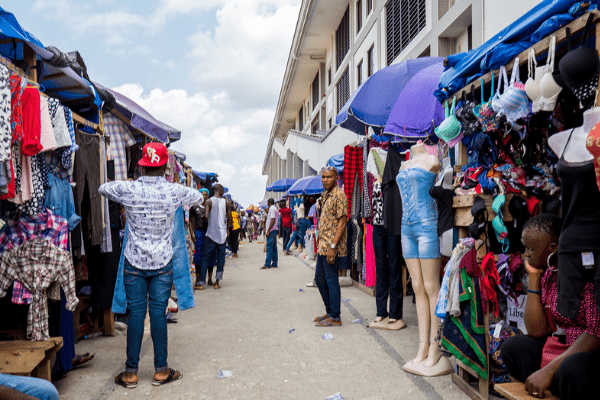
Yaba market, one of the most popular markets in Lagos, was thronged with shoppers who were bargaining with retailers, as commercial activities intensified.
The night air that sent a predawn chill and the current post-recession sluggish growth couldn’t hold back Nigerians from participating actively in the cash economy.
Interestingly, many local cloth sellers have embraced street trading mostly at nights to display their wares for buyers.
A fashion survey by Ajua,formerly Msurvey, Africa’s first integrated customer experience company, show that 70.4percent of respondents bought their clothes from a retail store while 15.0percent made use of both the online and retail platforms, with online platform lagging behind at a meager 10 percent.

Result from the survey shows 79.3 percent of respondents majorly in their 20s bought new clothes, with 20.7 percent not buying in the last 12months.
The effect of a shrinking wallet has seen consumers adjust their spending, while smaller brands continue to cannibalise sales of the big players.
Price continues to play a key role among consumers with the lowest price points prospering.
Result from the survey shows that 52.2 percent of respondents spent between N5,000 to N10,000, 17.4 percent spent between N10,000-N20,000, 8.4 percent spent N25,000 and above within the last 12 months.
According to the survey, despite the government’s increasing awareness on the need to patronize local materials, Nigerians still have a burning appetite for foreign branded clothes. Results from the survey show that 57.1 percent purchased foreign designers, with 28.6percent purchasing local designers while 14.3 percent bought both foreign and local designers within the last 12 months.

Within this period, 53.3 percent of the clothes bought were ready-made, while 26.7 are sown, with 20percent been both ready-made and sewn. 46.7percent of the clothes bought were casual wears, with 26.7 percent formal clothes.
In a recent consumer report by Coronation Merchant Bank, there is an ongoing intense battle between smaller& unlisted brands and big listed brands in the consumer goods sector.
According to the report titled ‘ Power to the Price Points,’ the last recession almost certainly left many people poorer than before. And the current economic recovery is so slow that doubt that incomes, in inflation-adjusted terms, are rebounding, although the upcoming implementation of the N30,000 per month ($83) minimum wage at the national level is likely to have a positive effect.
“Nigeria is generating more people, more households and more consumers, on the other hand, it does not look like they are getting any richer,” the report said.
Inflation pressure, devaluation of the currency, and hike in fuel price has subdued consumer spending, while over 50 percent of a population of 200 million live on less than $1.98 a day. Little wonder unemployment rate is at an all-time high of 23 percent.
Nigeria’s economy has been growing sluggishly since the country exited a recession in 2016, but analysts see an improvement in economic activities if the government implement structural reforms.
According to a recent report by the National Bureau of Statistics ( NBS), Nigeria’s gross domestic product (GDP) expanded by 1.94 percent in the second quarter of (Q2-2019), from the revised first quarter (Q1-2019) print of 2.10 percent.
The trade sector which comprises of whole and retail trade contracted by 0.25 percent in the second quarter (Q2) of 2019, after recording three positive growth rates since the third quarter of (Q3 2018).