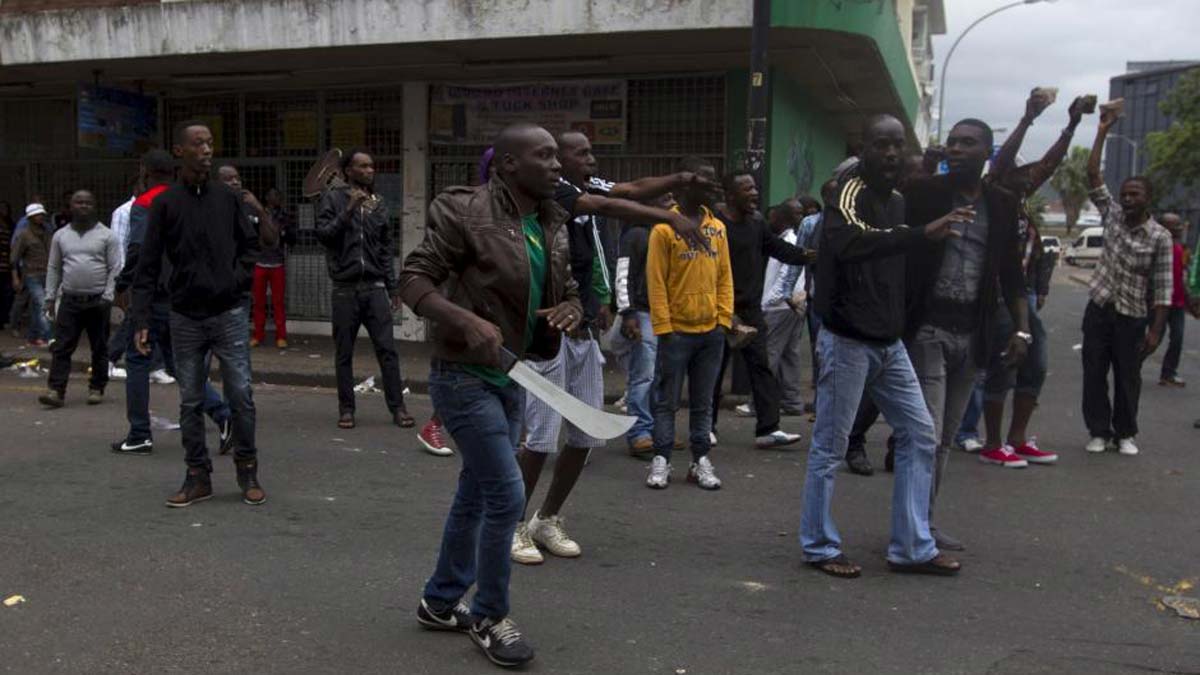
Abdication of responsibilities by leaders in both Nigeria and SA in the first week of September led to the street driving the narratives of their relationships. Mobs took over the major cities of SA in xenophobic attacks on fellow Africans. In Lagos, Ibadan and other places, mobs similarly engaged in an orgy of destruction of South African malls and businesses in Nigeria.
Political and community leaders egged on the mobs of SA as they attacked their fellow Africans arousing outrage across the continent. In a reprise of previous incidents, the assailants accused their fellow Africans of either taking up their jobs or responsibility for crimes. They implied that their police and security systems had caved to the vendors of drugs on the streets of Johannesburg, Cape Town, Durban and Pretoria.
The police in SA stood aside as mobs attacked black non-citizens from countries such as Zimbabwe, Zambia, Kenya, Rwanda, Ghana, and Nigeria. It soon became clear that they were following an official script as Bongani Michael Mkongi, the Deputy Minister of Police Affairs argued the imperative of foreigners leaving SASA for its indigenes. Worse, video evidence shows Cyril Ramaphosa, president of SA making similar statements during a campaign rally.
Xenophobia has been recurrent in post-apartheid SA. Studies by the Human Sciences Research Council identified at least four broad causes. They are the relative deprivation due to intense competition for jobs, commodities, and housing; group processes including conditioning of citizens to think of the other as an enemy; SA’s exceptionalism or a feeling of superiority in relation to other Africans; and nationalism that excludes other Africans.

Poor service delivery and an increase in the number of foreigners from two million to four million over a ten-year period also contributed.
A report from the International Organisation for Migration stated that, “Local leadership could be illegitimate and often violent when emerging from either a political vacuum or fierce competition.” It also added that, “such leaders enhanced their authority by reinforcing resentment towards foreigners.”
Geoffrey Onyeama, minister for foreign affairs had to counter vigorously the verbal assault of a South African minister who pointedly accused Nigerians of contributing to the crime situation in their country.
The real challenge in all these is the failure of leadership in setting agenda, drive and manage the narrative, and redirect it from violence.
In Nigeria, tardiness in responding to the reports from SA by the federal government created a gap that allowed the street to take over. Citizen anger kept rising for days as reports of the violence came over on social media. The federal government did nothing.

The sequence of events also points to the failure of security intelligence. Weeks before the vandalisation of Shoprite stores, a team claiming to represent the National Association of Nigerian Students had blocked a Shoprite store in Ota, Ogun State. They prevented entry and exit. They came to register the displeasure and annoyance of Nigerians over the attacks on fellow citizens out in SA. This was a clear signal, but was ignored.
Worse off, there was inadequate response when the reprisal happened.
More significantly, the violence on the streets illuminates the dangers of mobocracy. The tenor of public discourse lately has promoted mob action as both deterrent and punishment for failures of public officials. It is a wrong and dangerous prescription.
BusinessDay cautions against the advocacy for mobocracy even by members of the elite. The reference to the Nuremberg treatment as a typical jocular shorthand Nigerian-style must stop.
No society progresses with rule by the street. Evident in the Lekki area of Lagos, the mob attacked some citizens for the offence of driving SUVs. They assumed they must be public officials or one of those who have enriched themselves from the public till.
Leaders in the private and public sectors must rise and take concerted action to change the tenor and direction of discourse against mobocracy.
Mobocracy is a clear and present danger to our democracy. Cut it off now.