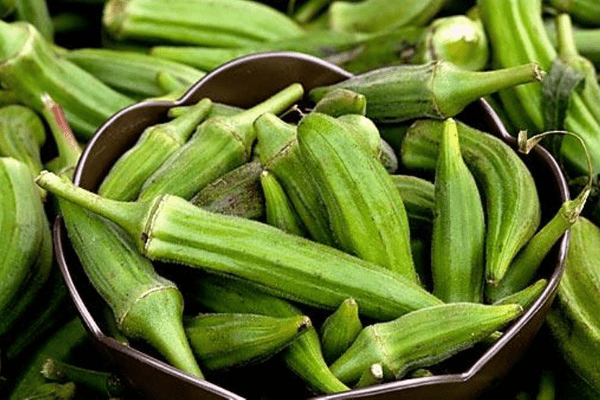
Seafood Okra or fishermen soup is probably the next big cuisine that Nigerians are increasingly craving on the dinning list of hotels. Accompanied by fresh sea fishes, crabs, crayfish and other complementary ingredients, the soup is just one of the many ways Nigerians utilise okra, contributing to a $2.38 billion market.
The commodity which is practically a staple food across the east, south, southwest and northern areas of the country not only has a nationwide market for its production, there are also expatriate communities to be served locally through hotels with international franchise, supermarkets or open market.
Opposite the Indian Language School in Ilupeju, a part of Lagos dominated by Indians, a grocery store thrives in the sale various kinds of vegetables including okra.
Going into okra production might not be a mishit for a commodity investor and the success rate could even be higher than envisaged should a producer target specific markets for supply and produces in accordance with the recommended specifications, says Detoun Abbi-Olaniyan, chief executive officer, Maidville Consulting Ltd., an agriculture consultancy firm.

Out of a total global production estimated at 8.9 million tonnes (10.68bn), Nigeria’s output make up 22.5 percent valued at $2.38 billion. Globally, Nigeria is the second largest producer after India’s production volume of 5.51 million tonnes. Other contenders are Sudan, Mali, Pakistan and Ivory Coast.
With a potential output estimated at approximately five million tonnes, Nigeria can shore up production by upgrading the system of production from subsistence farming, as widely being practiced to large commercial scale farming, a Financial Derivatives Company (FDC) commodity report for September suggests. This presents an opportunity for okra producers to bridge that gap.
“As an investor, who do you want to produce for? When do you want to produce? Can you find a sustainable market? What volume does your market require from you? Is it weekly, bi-weekly or monthly?” asks Abbi-Olaniyan.
Apart from the primary market for okra, there is also the secondary market which is the processed okra. The commodity can be dried, milled into powder and applied to form a cooking constituent.
Besides that, okra seeds can serve as a source of non-caffeinated coffee when it is dried and milled. It is nutritional and good as medicine.

Giving growing nuggets, Maidville Consulting Ltd. advised that producers target months like December, January, February and March using an all-year growth plan anchored by irrigation systems. These are seasons when okra gets very expensive and might in fact, be scarce because many farmers struggle to grow out of the rainy season on lack of irrigation system.
For instance, Thistleberry Natural Farms grow the local variety and Lady’s Finger, another variety, to serve both Nigerian community and expatriate communities including Indians, Lebanese, Europeans or Americans eating okra.
A 2010 study of the profitability of okra in a local government in Ebonyi state showed that the average revenue from okra production in the area is N 61,507.89 per hectare while the total cost is N25, 726.18 per hectare, which gives rise to N 35,781.71 profit per hectare. This indicates that the enterprise is profitable and can serve as an additional source of revenue for households in the area. It also shows that there is a high demand for okra since it is the major component of most soup in the area.