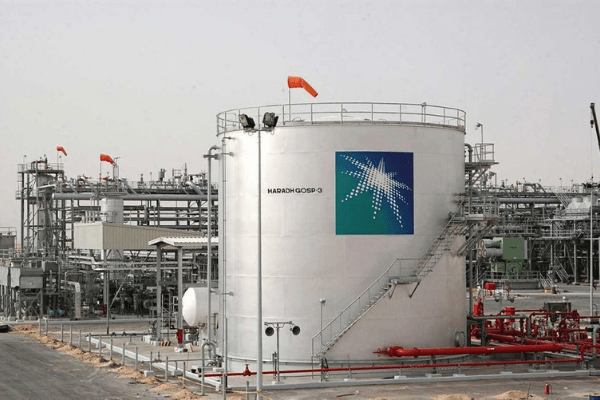
Saudi Arabia which has twenty times the foreign currency reserves of Nigeria is remarkably showing more urgency in tackling the negative economic fallout from tumbling oil prices by embarking on structural reforms even as Nigeria dithers.
Initial preparations for an IPO, long touted as the world’s biggest, were handled by Saudi Aramco but ground to a halt last year amid concerns about legal risks and doubts over whether it would achieve the $2tn valuation sought by the crown prince.
Preparations for the IPO of Saudi Arabian Oil Co., known as Saudi Aramco, are being revived as government officials hope to capitalize on the positive international reaction to the state-owned company’s debut bond sale in April, which raised $12 billion, people close to the talks said.
Saudi officials also believe pressure on the country following the murder of dissident journalist Jamal Khashoggi in the Saudi consulate in Istanbul is easing, according to people familiar with the matter.

Also, Saudi Aramco announced Energy minister Khalid-Al Falih have being succeeded as chairman of the state-owned oil company by Yasir Al Rumayyan, head of Saudi Arabia’s Public Investment Fund, the huge sovereign wealth fund central to Bin Salman’s Vision 2030 to diversify Saudi Arabia’s economy.
Leadership changes at Aramco were a “necessary step” towards the IPO, said Olivier Jakob, managing director at consultant Petromatrix told Bloomberg.
Al-Falih had “never been enthusiastic about an IPO for Aramco,” a senior Organization of the Petroleum Exporting Countries (OPEC) source said.
Yet, as Prince Mohammed seeks to give the initial public offering new momentum, Rumayyan faces an uncertain backdrop for oil demand, fragile stock markets and deepening worries that Saudi Aramco will be used as a cash cow by the government.
The planned IPO date has been pushed back from an initial plan to launch in 2018 as Saudi Arabia has been waiting for optimum conditions to list amid an uncertain oil price environment. It is now mooted for 2020 or 2021.

The Saudi’s who like Nigeria, rely on oil sales to fund more than 70 percent of government spending, have cut fuel subsidies, moved quickly to woo investors to play a bigger role in the economy and introduce sales taxes on consumer goods.
Nigeria’s plans to reform its corrupt national oil company, the Nigerian National Petroleum Corporation (NNPC) through a new oil bill are however stuck between the executive and legislature.
In 2016, Muhammadu Buhari administration announced in far away Abu Dhabi, United Arab Emirate (UAE), that Nigeria has plans to sell key oil assets to the public.
Then minister of state petroleum resources Ibe Kachikwu said the action will be the country’s first Initial Public Offering (IPO) of assets owned by its national oil company, scheduled for a major reforms and is expected to happen in 2018.
Nine months after the deadline the plan still looks more like dream and not close to being a certainty as NNPC still struggles with rot, lost investment, corruption and controversies.
Despite the demand side management moves by the CBN, Nigeria’s foreign exchange reserves still plummeted by five percent year on year to $43.5 billion as at 2 September 2019 from $45.6 billion a year ago.
Saudi-Arabia by comparison has $512.5 billion of foreign currency reserves.
The plunge in oil prices, from $110 a barrel in 2014 to less than $60 today has pushed most oil producers to enact reforms to help cushion the shock.
In Nigeria however, government’s unorthodox policies such as cutting interest rates amid creeping inflation, maintaining subsidies and pegging the naira, despite the collapse in oil prices which threaten to increase economic distortions.
Nigerian unemployment jumped rate of 23.1 percent means 20.9 million people are out job. The economy expanded by just 1.94percent in the second quarter of 2019, less than the population growth rate and implying negative per capita income expansion, even as inflation remains high at 11.08 percent.
The decision might be tough, but for Nigeria, a listed NNPC will not only drive huge capital accumulation in Nigeria it also means Nigeria is going for market forces to determine oil production, retail price for products and proper deregulation of the oil sector.
Auditing and preparing NNPC books for IPO also implies revealing the total and current disclosure of reserves capacity, total revenue, profitability, taxes, and other key metrics which are needed in modelling the profitability of NNPC Plc and potential dividend it could pay to investors.
Listed NNPC will lift out a Nigeria’s oil sector largely in recession and also uplift Nigeria’s oil and gas reserves which have remained stagnant or dwindling, while oil production is on a decline.
Listed NNPC means huge gas reserves estimated at 182 trillion cubic feet (TCF) could help feed power generation for energy-starved Nigeria, largely remain undeveloped 20 plus years after being discovered due to NNPCs inability to either fund the CapEx needed to develop the fields or let go of the fields for private oil firms to develop.
The decision of NNPC to list is not a new development as other state-owned oil companies like Brazilian State oil company Petrobras which was created in 1953, however, it first sold shares to the public in December 1957 and is listed on the Ibovespa or Brazilian stock market.