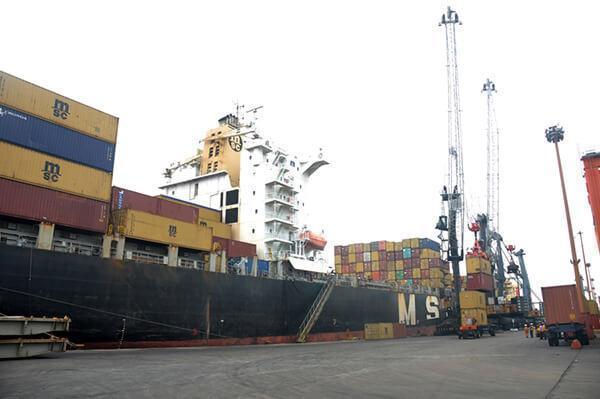
Two years after the acting president Yemi Osinbajo signed Executive Order on Ease of Doing Business, which mandates government agencies and service providers involved in cargo clearance at seaports, to commence 24-hours operation, importers are still paying dearly for delay in taking delivery of their consignments due to the failure of the ports to operate round-the-clock.
According to the Order, government agencies especially the Nigeria Customs Service (NCS), and port service providers must be on ground 24-hours to carry out cargo examinations in order to fast track cargo delivery and reduce the cost of doing business for importers and manufacturers that depend on the ports for the importation of their critical inputs.
By operating 24-hours, the ports can eliminate delays and cost associated with non-clearing of cargo on weekends and public holidays, prune down the avoidable cost importers pay as demurrage and storage charges, to shipping companies and terminal operators for not taking delivery of their consignment as and when due, which is estimated at N1trillion annually.
A recent visit to Apapa and Tin-Can Island Ports revealed that, two years after the order, the Customs has failed to operate 24-hours as it continued to operate within 9am to 5pm resumption and closing time with exception of weekends and public holidays.

Also, Customs, which is the lead agency in charge of cargo clearance at ports, which in the wake of the order, came up with a roaster for its officers to do 12-hourly shifts has reverted to the normal business hours.
However, the marine side of port operations that involves discharging of vessels is the only aspect of the port operation that work round-the-clock while examination of cargo by agencies, payment of duties and cargo release, only works within the business hours.
“24-hours service is no longer obtainable in nation’s seaports and it failed because government failed to put implementation structure in place,” said Tony Anakebe, managing director, Gold-Link Investment Ltd, in a telephone interview with BusinessDay.
Anakebe, who stated that cargo examination starts from 10am or 11am and ends around 3pm but in some cases it may stretch to 5pm for few agents that came late, said that scanning machines that are used to fast track cargo examination are no longer functional.
“At 5pm, officials of Nigeria Customs and other agencies will shut down operations for the day.

Though, we, the port users empathise with the officers because it is risky to be around the port at night given the security situation in the country. There is no motorable access road in and out of the ports and Customs officers are going through hell due to the road issue,” he said.
According to him, going to Tin-Can Island Port to take delivery of consignment had become a hard nut to crack that is why many of these officers are losing their lives.
“In terms of cargo release, agents who have completed their documentation processes with Customs during business hours can go to the port at night to load the container on the truck and exit the port at night because the releasing officer must have given the green light to terminal operator to allow the goods to go out at any time of the day,” he said.
He however said that only Customs officers that man the port gates work round-the-clock while the residence officers work within the business hours.
BusinessDay finding show this was not the first time the government is attempting to implement 24-hours operation as the past administration of President Goodluck Jonathan introduced 24-hour operation as directed by then Minister of Finance, Ngozi Okonjo-Iweala, but the well-conceived policy failed due to poor implementation structure.
Emma Nwabunwanne, a Lagos-based importer, who said that 24-hours port operation, goes beyond an executive order, said the Federal Government needs to put structures on ground to ensure round-the-clock power supply at the ports so that there would be proper illumination of the port and its environment.
He pointed out that government needs to improve on the security system within and around the port by ensuring that security cameras are installed to monitor movement of persons and cargoes in and out of the ports.
“People are being robbed by hoodlums especially around the Apapa and Tin-Can axis at night. This is why clearing agents are also not coming forward at night to take delivery. Therefore, security officials such as officers of the Nigerian Police Force and others must be on ground to monitor activities around the ports,” he said.
Uche Ejesieme, public relations officers of Tin-Can Island Customs Command told our correspondent that Customs officers are always on ground 24/7 to gate out already examined cargoes.
“Our Customs Processing Centre (CPC) cannot work on Saturday and Sunday but every other job especially for those whose cargoes have been examined and want to take delivery, 24-hours is still feasible. May be people expect to come and make online entries at the CPC on weekends and public holidays, that cannot be done because the service providers do not work on weekends,” he said.
BusinessDay check reveals that the CPC is the engine room of the Customs where importers initiate entries through single goods declaration (SGD), and Customs also releases authorised cargoes after payment of duties, and for security reasons such a delicate facility cannot be opened till midnight or even at weekends for fear of being sabotaged or hacked.
Therefore, limiting the time importers and agents undergo cargo clearance at Nigerian ports.
AMAKA ANAGOR-EWUZIE