As Nigeria seeks for ways to diversify its economy and earn foreign exchange, experts say that Hibiscus export could play a vital role in this regard.
Hibiscus is one horticultural crop that is no just earning foreign exchange for Nigeria but also creating wealth for communities.
Hibiscus an important perennial herb is fast booming in the Nigerian market as exporters are now exporting a larger percentage of the crop to Mexico, United States, Europe and Asia.
Agro allied firms such as AgroEknor are making huge investment in the hibiscus value chain in Nigeria owing to the ever increasing global demand for the flower.

Nigeria is the natural habitat for five varieties of hibiscus and among the world’s top producers and supplier of the crop, experts say.
In 2017, Nigeria exported 1,983 containers of hibiscus to Mexico alone, earning $35 million in nine months, according to the Association of Hibiscus Flower Exporters of Nigeria (AHFEN).
Hibiscus scientifically called Hibiscus sabdariffa and commonly known as Roselle, grows in many tropical and sub-tropical countries and is one of highest volume specialty botanical products in international commerce, the Food and Agricultural Organisation (FAO) says in its postharvest report.
The hibiscus plant is drought tolerant, relatively easy to grow, not suitable for mechanised harvest, labour intensive to process, and can be grown as part of multi-cropping system.
Prices and country production volumes are not tracked like a conventional agricultural commodity and this is why the global industry currently does not have adequate data.

The extracts from hibiscus flowers and leaves have many uses and benefits, either medically or in industrial production.
Its antihypertensive and food colouring properties have continued to attract the attention of food and beverage manufacturers and pharmaceutical industry for the commodity globally.
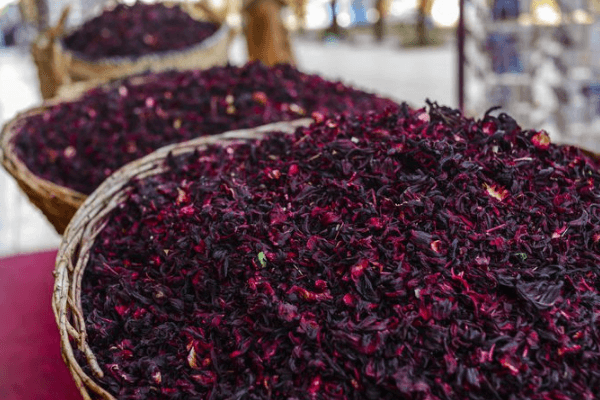
Dry hibiscus flower, locally known as Zobo, can be processed into hot and cold herbal beverages, jellies and confectioneries, among others. The leaves are used extensively for animal fodder and fibre.
Medical experts say consumption of Zobo made from the leaves aids detoxification. It helps reduce high blood pressure, cholesterol levels, as well as blood sugar levels. It also helps in darkening hair colour and slows aging as it contains anti-aging properties.
It induces sleep and has antidepressant properties as well as helping in the treatment of flu.
All these numerous health properties have made it one of the key raw materials in the global confectioneries industry.
“My father takes hibiscus drink daily to control his blood pressure,” Bimbo Ademola, a buyer purchasing the flower at Ketu market in Lagos says.
“The hibiscus flower has been working effectively on my father since he started drinking it. His blood pressure which was high is now normal,” Ademola says.
Hibiscus tea is rich in antioxidants minerals and vitamin C and several studies have found that the tea lowers both systolic and diastolic blood pressure.
The uses of the flower show the huge opportunity in the subsector for potential investors. With strong global population growth, particularly amongst children and young people, consumption of hibiscus products has been on the increase in recent years.
Mexico is the most prominent destination for Nigerian hibiscus – account for 85percent of the exported crop from the country, but in 2015, it improved checks on Nigerian hibiscus exports, alleging adulteration.
Since 2017 Mexico had enforced a ban on Nigeria’s hibiscus export owing to standards and quality issues.
As a result, the country is losing billions of dollars it would have earned from Mexico since it was enforced. This further slowed the traction the crop was gaining in the country.
“A lot of people go into the exporting of hibiscus without actually knowing the nutty gritty of the business and that is what is responsible for the Mexican ban,” Adesanya who was earlier quoted says.
To address the issue of standards, experts say Nigeria needs to set up standard sanitary and phyto-sanitary labs, as well as increase processing to earn more foreign exchange through value adding.
Josephine Okojie