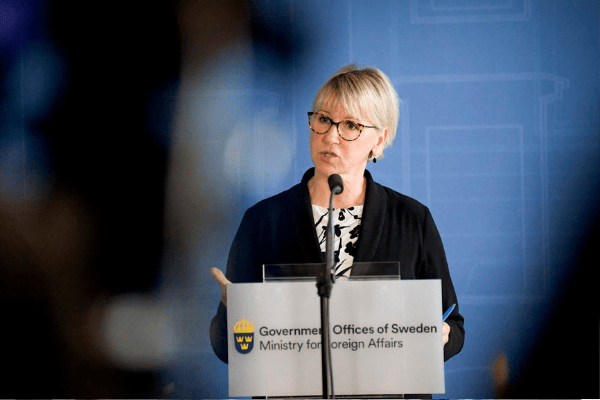
Sweden’s foreign minister has lashed out at the US’S “sad and dangerous” approach to the Arctic, warning of a risk to decades of co-operation with the likes of Russia and China in the far north.
Margot Wallstrom told the Financial Times that US president Donald Trump’s offer to buy the Arctic island of Greenland from Denmark “sounded like a joke” and “was a shock”.
But Sweden’s centre-left foreign minister for the past five years reserved her strongest words for how the US had approached the Arctic Council, the intergovernmental group that discusses regional issues. Diplomats say the council is a rare forum where the west and Russia have engaged with each other since the latter’s annexation of Crimea.
Washington caused consternation in May when for the first time it blocked the council’s traditional joint declaration because of references to climate change.

“I am extremely worried about this. It’s a questioning of science. You have a right to your own opinion, but not to your own facts. This is the case also with the Arctic region. All the rest of the us, we have to stand up for the Arctic region and the Arctic Council and use it in the best possible way,” Ms Wallstrom said.
Diplomats in the Nordic countries have long decried the lack of US interest in the Arctic compared with Russia and China, which have spent years building up their commercial and, for Moscow, military interests in the high north.
But they were bewildered by the tone of a speech to the council by US secretary of state Mike Pompeo in May, where he warned against “aggressive” behaviour by China and Russia in the region.
“That has never been the theme or the task for the Arctic Council to discuss security policy. It is a non-military and sort of peaceful council where other issues are being discussed. They want to turn it into something else,” said Ms Wallstrom.
“We all understand that we are in this together and this is something that will affect us enormously over the years to come. We’ve only seen the start of that. This is sad and dangerous,” she said.

Climate change is opening up the Arctic, bringing the prospect of new shipping routes between Asia and Europe as well as creating mineral and petroleum potential in areas such as Greenland, Alaska and the Russian high north. That has sparked predictions from some of a new “Great Game” in the north.
Ms Wallstrom conceded that there would be “renewed interest from China, from Russia, from the US” but argued that a separate political discussion was needed to “create an international rules-based order also for the Arctic”, probably under the auspices of the UN.