Every month, the Nigerian Stock Exchange polls trading figures from the market operators on their Domestic and Foreign Portfolio Investment flows. Portfolio investment is the purchases of securities and other financial assets by domestic and foreign investors in the domestic economy. Portfolio investments may be held directly by an investor or managed by financial professionals.Equity investments where the owner holds less than 10 per cent of a company’s shares are classified as portfolio investment.
As of 31 July 2019, total transactions at the nation’s bourse decreased significantly by 61.82 per cent from N297.25 billion (about $970.1 million) in June 2019 to N113.47 billion (about $370.4 million) in July 2019.The performance of the current month when compared to the corresponding year-ago performance (July 2018) revealed that total transactions also decreased by 22.31 per cent.
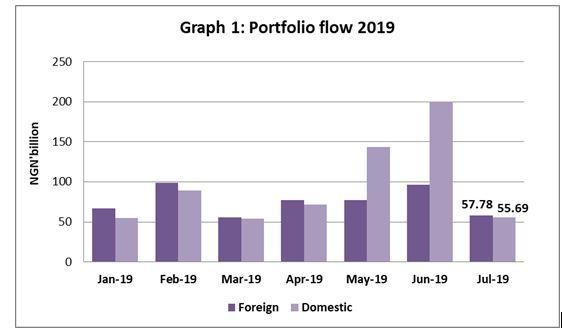
The foreign portfolio which accounts for 50.9 per cent of the total portfolio flow in July 2019 declined by 40.3 per cent from the previous month and 13.6 per cent Year to date; whereas domestic portfolio holdings accounting for 49.1 per cent of the total flow in July declined by 72.2 per cent and increased marginally by 0.8 per cent year to date (YTD). In the month under review, the total value of transactions executed by foreign investors outperformed transactions executed by domestic investors by 2 per cent. This is suggestive of high volatility on the domestic side (see graph 1).

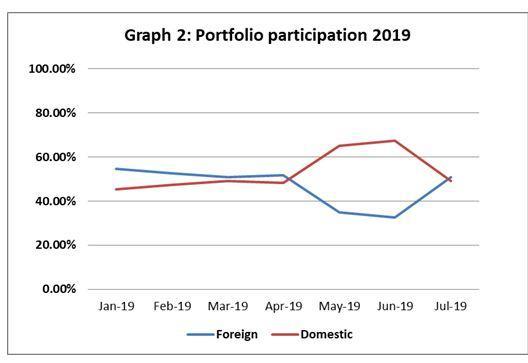
The participation ratio between domestic and foreign portfolio to the total portfolio flow year to date shows an interesting pincers-shaped curve (see graph 2). The pincers curve reveals a trade-off in the participation rate between the foreign and domestic portfolio: as one is rising, the other is falling in almost the same, albeit, opposite pattern. The graphical illustration in figure 2 shows convergence in participation in March through April; and an increasing divergence since then with the highest divergence in June. Convergence may be possible beyond July if the pattern continues as we see in the graph.
Domestic transactions: retail and institutional
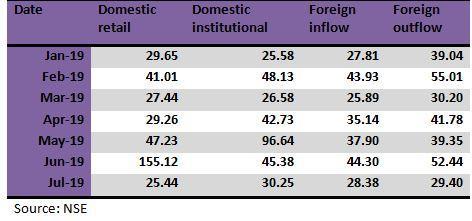
Of the total domestic transactions in the month under review, institutional investments account for 54.3 per cent, while retail accounts for 45.7 per cent. Thisimplies a N4.81 billion difference between the value of transaction executed by Institutional investors and retail investors—a significant difference from the previous month where retail investments exceeded institutional investments by N109.7 billion. A comparison of domestic transactions in the current and prior month (June 2019) revealed that retail transactions decreased by 83.59 per cent from N155.12 billion in June 2019 to N25.44 billion in July 2019. However, the institutional composition of the domestic market reduced by 33.28 per cent from N45.34 billion in June 2019 to N30.25 billion in July 2019.
Table 1: Dissecting domestic and foreign portfolio

Foreign transactions: net flow
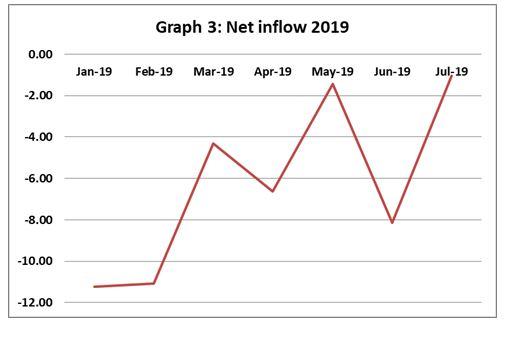
The ratio of inflow and outflow of foreign portfolio in July stands at 49.1 per cent and 51.9 per cent (45.8 per cent and 54.2 per cent in June) respectively. This represents an improvement in net flow (or moderation in negative inflow). The illustration in graph 3 plots the graph of the negative net inflow since January 2019. With the highest net outflow in January, the trend shows an improvement in inflow year to date. The highest outflow since the year was in February and June (N51 and N52 billion respectively), and the highest inflow wasalso in the same months—N43.9 and N44.3 billion respectively.
HISTORICAL ANALYSIS OF DOMESTIC AND FOREIGN TRANSACTIONS
A historical review highlights the performance of the market over the last decade. Over a twelve (12) year period, domestic transactions decreased by 66.7 per cent from N3.56trillion in 2007 to N1.185trillion in 2018 whilst foreign transactions increased by 97.9 per cent from N616 million to N1.219 trillion over the same period. Since after 2008—which had the highest peak— the next peak over a ten-year period was in 2014 before the recession; the domestic transaction was N1.14 trillion while the foreign transaction was N1.54 trillion.
Total foreign transactions accounted for about 51 per cent of the total transactions carried out in 2018, whilst domestic transactions accounted for about 49 per cent of the total transactions in the same period. The actual performance referenced 2019A (2019 Actual) shows that total foreign transactions carried out year till date (YTD) is about N530.56 billion whilst total domestic transactions YTD is about N670.42 billion.
The implication for the economy
The Nigerian economy barely emerged 2015/16 recession in the second quarter of 2017, but the political and economic conditions that followed the electioneering from 2018 through 2019 meantmoderation in growth impetus.The market has consequently followed a downward trend. The China-US trade war and the pessimistic outlook on the global economy stoke the situation more so for small countries. Policymakers must adopt proactive policies, monetary and fiscal, in order to maintain a stable macroeconomic environment conducive for investment, output and employment. A commitment to price stability, favourable policy rate, and unified, stable exchange rate are key indices that enable prediction and forecasting.