|
Getting your Trinity Audio player ready...
|
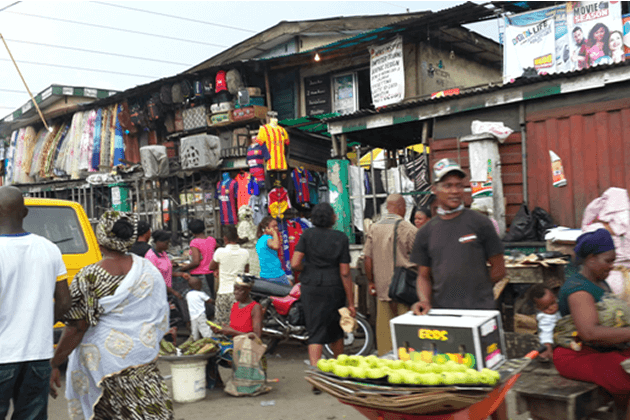
Tola Ige, a trader who deals in food items, has a shop at Tejuosho Mall at Yaba, Lagos but prefers to sell by the roadside where she is sure of greater visibility which most times translates to more sales.
“I have a shop here but I prefer to go outside because I get buyers easily and make more sales unlike my shop,” Ige said. “Also, people feel that it is cheaper to buy outside than inside. Very soon when my rent is due I will just leave here and go the streets that are where the money is.”
Ige is just one out of many traders in Lagos who are opting for the roadside to get better visibility for their products.
Despite the provision of ultramodern markets and malls by the government to evacuate small traders, street markets are growing in leaps and bounds, and they can be found at almost every bus-stop across the length and breadth of Lagos.
The traders are snubbing major malls across the state, from Yaba to Oyingbo, Abule-Egba, Ogba and so on, citing high rental cost and difficulty in getting customers, BusinessDay’s findings show.

Most of the ultramodern malls were established through public-private partnership, with cost of construction rolling into billions. The new Tejuosho shopping complex, which was refurbished in 2017 after a fire accident, gulped N10 billion, some real estate agents told BusinessDay. Over N6 billion went into the newly-built Ogba multipurpose shopping complex which was completed in the second quarter of 2019, but traders around that axis are not showing interest towards the complex.
“Prices are not making it easier for people to get the shops. Usually, the smallest and cheapest shops are within the range of N500,000-N600,000 and the malls are not convenient for consumers. They just want to buy quickly, get out and move on, a real estate expert, who pleaded anonymity, said.
A report by Broll Nigeria Limited, a Lagos-based real estate advisory firm, said existing tenants are fleeing from malls once their tenure expires.
“During the first half of 2019, some existing tenants that have struggled to meet financial obligations in the past have been noted to be exiting malls as their lease tenures expire. This is despite financial concessions and payment plans offered by some landlords,” the report said.
Moyin Adegbite, a petty trader selling soft drinks at Oshodi, said she chose to sell at the roadside because selling fast-moving items like she does needs customers’ attention.

“It doesn’t make sense getting a shop except if I want to sell in bulk. But selling in units, you need to take it close to customers,” said Adegbite.
The thriving street markets point to opportunities that can be leveraged by government, experts told BusinessDay, urging government to create structures to accommodate them.
Abiola Gbemisola, a consumer analyst at Chapel Hill Denham, said people need these markets and that government could create something local in form of a collection of sheds that are not too expensive and also encourage traders to form cooperatives where they could contribute money for stores.
“If you look at traditional setting, when people go to the market to buy things, they like to bend down and select what they want to buy. That is how it has been. The malls are a western thing, not an African thing,” Gbemisola said.
Ayorinde Akinloye, a consumer analyst at CSL Stockbrokers, said the margins at which roadside sellers sell their goods are too small for them to start opening stores and being outside provides accessibility to customers.
“I don’t think we need more malls because they make more products expensive. Anytime you are dealing with consumers when prices increase, they feel uncomfortable. The neighbourhood market is the best option. You can make them standardised, closer to people and put them at strategic locations,” Akinloye said.
“It is not compulsory we become a megacity. Lagos does not have the income capacity to become one. If they want to achieve this, they will just drive prices up and expensive for people. So the neighbourhood market is better because they will still be able to keep cost at reasonable level and make their business profitable,” he said.
Street trading is a big challenge for government, a director in the Lagos State Ministry of Commerce and Industry told BusinessDay, saying the government was doing everything possible to discourage it. He said the challenge with building neighbourhood markets was space.
“If we decide to build sheds, there will be no space and the number of shed to have to accommodate them will be issues we have to deal with,” the director said.
“If you look at the roads and where they sell is on the walkway, no government will want to erect anything in the walkway. The environment of that area will also determine how possible it will be to build sheds. Some of them even if you build market, they don’t want to go there because they know they will make their money by the roadside,” he said.
The director said if there is an area where there is large expense of land where the traders could be taken to away from the roads, then there may be no issue, but maintained that space was the main constraint.
“For example, most banks don’t like street traders on their walkway. So the environment where this will be kept must be important as well. Our planning has been bad from inception. For India and Japan, they have better planning on the onset. They have an industrial master plan which they have accommodated because of their population. But for us, we are not into that,” he said.
The last few years has seen traditional open markets give way for ultramodern markets and malls, forcing displaced traders to do their business on the streets. Most of these traders don’t have enough funds to rent the new malls or secure lock-up shops.
Government might need to change its approach of constructing modern markets, experts say, as the model further compound the woes of small traders who are grappling with sales growth.
Lagos is unarguably the commercial heartbeat of Nigeria, home to several industrialists, businessmen and entrepreneurs. The state, which is the smallest in Nigeria by land area, is the fifth-largest economy in Africa, with a population of 22 million, according to Lagos State Bureau of Statistics.
The vision of the Lagos State Government is to integrate the state into Africa’s model megacity, making it a major financial hub in the continent.
One way to achieve this objective is by creating ultramodern malls to curb street hawking, bringing informal sector players to the formal sector and making the road network more accessible. All these have proved abortive to stop battalion of traders from operating in the street market.
BUNMI BAILEY & ISRAEL ODUBOLA