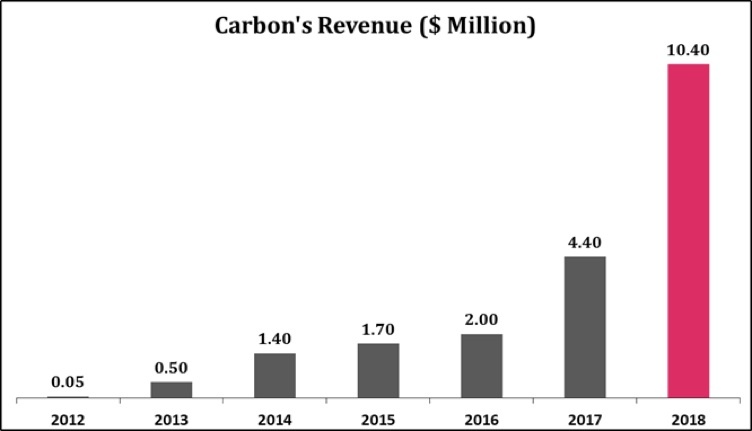
Nigerian financial technology (fintech) company Carbon, formerly known as Paylater, returned to the path of profitability last year after a disappointing 2017 which saw the company lose N111 million despite doubling revenue.
After-tax profit of the financial services startup rose 232 percent to N147 million in the 2018 financial year as against a loss of N111 million recorded a year earlier, thanks largely to gross earnings which grew more than double to hit N3.73 billion from N1.57 billion.
Gross earnings of the digital financial services company did not only balloon in the 2018 financial year, it also reduced its liabilities by more than half in the review period with the key profitability margin returning to the positive territory.
Carbon began operations in 2012 and within the space of six years, it grew revenue steadily, reaching an all-time high of N3.73 billion in full-year 2018. In the same year, loans and advances to customers rose to N2.57 billion from N 1.63 billion.

While some startups are concerned about the negative impact of opening their financials for the public to see, Carbon took the bull by the horns by unveiling its results with an assurance that it would make public subsequent results in a bid to gain client trust, an unusual move in Africa’s fintech space.
“Over the last year, the Paylater app has transformed into a digital financial services platform that now offers bill payments, credit reports, fund transfers and savings products, in addition to loans,” the company said in the released financial results. “The brand Paylater, therefore, is no longer a true reflection of who we are, and our promise to customers.”
Total liabilities of Carbon fell to N1.54 billion from N3.2 billion recorded in the same period of 2017, while shareholders’ equity, which is fund payable to the owners of the business, rose marginally by 0.57 percent to N1.75 billion.
The profit margin of the firm, a key profitability metric that measures how much profit a company generates from every naira of its revenue, stood at 3.94 percent against a loss margin of 7 percent recorded in the previous year.
This clearly shows that for every N100 the company realised as revenue in the review period, it generated N3.94 as profit, indicating an improvement from the loss it recorded from N1.57 billion.

OLUWASEGUN OLAKOYENIKAN