Delayed Response to Change
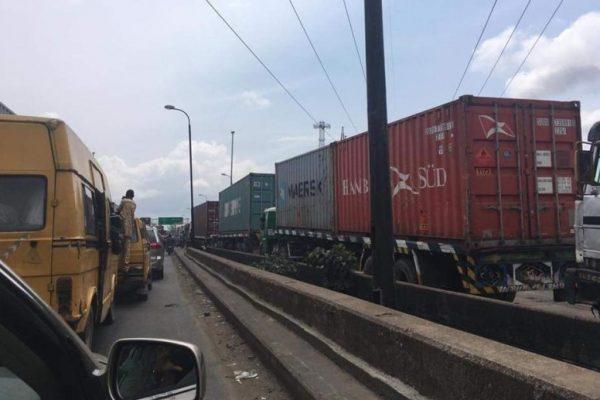
Chris Olakpe, chief executive officer of Lagos State Traffic Management Authority (LASTMA), declared in May that his agency would commence the forceful removal of heavy-duty vehicles blocking Apapa roads. This exercise, known as ‘Operation Totality Enforcement,’ was in response to Vice President Yemi Osinbajo’s on-the-spot inspection of the harrowing Apapa gridlock in April. The inspection, in turn, followed President Muhammadu Buhari’s directive that trucks blocking Apapa roads should vacate within 72 hours.
Through a combination of persuasion and coercion, Olakpe’s patriotic efforts only compounded a hellish situation. The dispersed tanker drivers soon returned to the only place they knew-the same Apapa roads leading into the critical Apapa seaport. We must admit with the best of intentions that Olakpe, Osinbajo and Buhari are treating the symptom while leaving the real sickness intact. Did not the Federal Government years back send in the navy to clear the same Apapa?
“Operation Gbale” was even harsher as it was implemented with kobokos, naval helicopter, gunboat and armed troops, all in the vain bid to scare notorious tanker drivers into taking away their unwanted vehicles. But no sooner than Rear Admiral Ilesanmi Alale, flag Officer Commanding Western Naval Command, withdrew his men having done a good job than those he expelled returned with their sixteen-wheelers to the very spot he expelled them from. Sociologists would call the reaction of the tanker drivers “Return of the Repressed.”

The questions begging for answers include, where were the LASTMA and navy when the gridlock started building up? The lockdown was not spontaneous. It started in the Apapa and Tincan ports before spilling into the streets. Didn’t the regulatory agencies detect that a major crisis was ahead and take pre-emptive measures to avert it?
Tunde Olaosun of Hermonfield Limited is the expert to attempt the questions. He explains how the port concession policy backfired, “The ports at inception was designed as a multi-purpose port intended to be run by one operator, but ever since the concessioning, Apapa now plays host to five terminal operators all of who are sharing one gate.”The gridlock, according to him, was created as empty containers were returned to the ports. Some corrupt concessionaires exploited importers before an unconcerned Federal Government that licensed them.
The Nigerian Port Authority, NPA, responded to the embarrassing situation by hastily putting in place a Standard Operating Procedures (SOP) on Port Truck Clearance that incorporates temporary Manual Call-Up system. But the SOP is obsolete, ineffective and lacking in global best practices. It should have been in place at the point of concession and not after.
Equally so, the LASTMA, navy, Federal Road Safety Corps, FRSC, and Economic and Financial Crimes Commission, EFCC, should have jointly midwifed port concession with the Federal Government. They were only brought in after the harm was done. Apapa roads are unusable today because a fundamental change in port operations was badly and belatedly managed.
Cost implications

Babatunde Ruwase, president of Lagos Chamber of Commerce and Industries (LCCI), said Nigeria was losing N7 trillion yearly to the Apapa gridlock. The loss emanated from demurrage associated with imports, exports, customs duties, maintenance cost of the vehicles and drivers. What about the human cost? The media report that tanker drivers and their assistants eat, bathe and defecate in the open by the roadsides, even in broad daylight. Could such untenable and hazardous environment harm the mental health of Apapa residents and port workers?
In ‘The Never-Ending Congestion at Nigeria’s Largest Port is Starting to Get Very Expensive,’Yomi Kazeen forensically analyses how bureaucracy and corruption combined to kill the Apapa port. Quoting the Dutch maritime intelligence and consulting firm, Dynamar, he claims, “Indeed, it is often far easier to pay middlemen (sometimes in cahoots with customs officials) to clear goods at the port than to go through official processes. The slow-moving nature of the ports’ operations have resulted in perpetual congestion but the inefficiency is coming at a significant price as container traffic to the port has dipped nearly 30percent in the past five years, according to Dynamar.”
Kazeem concluded that Nigeria’s loss was Togo’s gain as the latter reformed its seaport into becoming the West African transit hub. Container traffic to Togo grew three-fold since 2013, the same period that saw Apapa and Tincan portsin decline. The sleaze going on in the NPA and Nigerian Customs was possible because of the antiquated way Nigeria managed it seaports.
One instance of corruption: Chris Osunkwo, managing director of Teams Shipping Company Limited, recently alerted Buhari that Lebanese and Indian middlemen were blocking Nigerians from directly exporting agricultural products. These foreigners formed cabal at the same Apapa and Tincan ports to monopolise exports with the active collaboration of some influential Nigerians. Any Nigerian who exported without passing through them risked incalculable loss, as the cabal would petition the destination country that what was exported was substandard. Since Osunkwo spoke out we have waited to hear that theEFCC, and Department of State Services, DSS, have apprehended these foreigners, to no avail.
What about other ports?
The whole truth is that apart from Apapa and Tincan we have other ports along the coast. They include Gelegele (Edo), Warri and Burutu (Delta), Twon Brass, Akasa and Age (Bayelsa), Port Harcourt, Onne and Bonny (Rivers), Ebughu Fishing Terminal and Ibom Deep Seaport, IDSP, (Akwa Ibom) and Calabar (Cross River). We are seeing an unhealthy business practice where foreign vessels are made to queue for weeks at Apapa and Tincan than be discharged elsewhere.
There is no merit in the claims of Hadiza Bala-Usman, Managing Director of NPA, that ourother ports were not viable. If they suffered “draft limitation” as she said, dredging would give them the right draft depth. If insecurity was their challenge, naval escort would solve that. The charge that communities scared away merchant vessels with levies pales compared with what the same vessels pay to local communities in Casablanca and Bristol.
In the name of making Lagos the hub for West African shipping and mercantilism, other ports are deliberately starved of business. Every conceivable excuse is advanced why the Calabar port cannot be dredged even though an inland port is being built in the north. Buhari is talking about building brand new seaports in Lekki and Badagry to ease the overcrowded Apapa and Tincan, to believe Lagos State Governor Babajide Sanwo-Olu. That is counter-productive considering that Burutu, Age, Gelegele, etc, are grossly underdeveloped and underutilised.
Metaphor for larger Nigeria
Forty-five years to ‘Operation Totality Enforcement,’ Rivers State governor, Commander Alfred Diete-Spiff, sent me to Lagos to negotiate the modernization of his state’s maritime sector. The sector was captured in the post-war Rivers Five-year Development Plan, aligned with the national Five-year Development Plan. As Commander Diete-Spiff’s commissioner for Finance (1969-1974) and joint Commissioner for Economic Development and Reconstruction, and Information (1974-1975), I implemented the plan.
When Lagos said that the Port Harcourt port could not be expanded even by one berth, I unfolded a map of the Onne deep water that Commander Diete-Spiff gave me. As a trained diver, he knew the configurations of every single seaport on the West African coast. I told Lagos to build seaports at Onne since Port Harcourt could not be upgraded.
A skeptical Lagos accepted my proposal before sending divers to Onne, which turned out exactly as the great Commander Diete-Spiff said. That was how the Onne Port Complex, sitting on 2,538.115 hectares, was conceived and built. Marine and vehicular traffics were evenly distributed between Onne and Port Harcourt, saving the Garden City avoidable gridlock; all because a visionary leader was awake to his responsibilities.
Privatisation for privatisation sake makes no sense. There must be demographic, cultural and economic content to it. Imposing a First World economic model on a Third World mindset is to ask for trouble. China privatised and boomed but the Soviet Union did the same and crashed. Deng Xiaoping thoroughly explained to Chinese tanker drivers and port workers what to expect ahead of port concession. He changed the Chinese mindset and his people behaved differently to his utmost satisfaction. But Mikhail Gorbachev privatised under “Glasnost and Perestroika”without first educating his people and lost his country.
Port concession is desirable, as long as we do not limit our definition of “new operators” to the concessionaires. The navy, local communities, tanker drivers, DSS, EFFC and FRSC must be carried along. Secondly, the concessionaires can only develop and operate those ports wrongly written off as unviable and not take over our best ports. The concession programme is a big failure as it only robbed Nigerians what they built over the decades while doing nothing to bring new ports into existence.
Before now, our experts warned the Federal Government that the maritime sector was dying. To bring it back to life four committees of the 2014 National Conference, namely, the (1) Economy, Trade and Investment Committee (2) Public Finance and Revenue Committee (3) Environmental Committee, and (4) Transportation Committee proffered far-reaching solution. Their recommendations would have reformed our ports, opened many interstate trunk roads to the hinterland; in addition to repositioning the sector for massive investment.
Over-concentration of maritime operations in Apapa and Tincan is the sickness. Gridlock, corruption, inefficiency, foreign cabals, etc, are the symptoms. Under such enforced condition, ease of doing business becomes an uphill task. Solution is decentralisation so that the boundless opportunities locked up in Gelegele, Burutu, Warri, Age, etc, can also be unlocked. There is something called wealth of the sea this country is not paying attention to. For instance, as recent as 1964, a Nigerian travelling to London boarded an Elder Dempster boat at Port Harcourt or Apapa. Why can’t we be creative in defining our maritime?
A serious observer, therefore, cannot escape the conclusion that the unwin situation Apapa finds itself today is a true reflection of the larger dysfunctional Nigeria. Political power is so concentrated in Abuja that the constituent units wallow in neglect, underdevelopment and violence. If the Nigerian state wastes time in devolving power, administration and finance through restructuring, the Apapa gridlock could become a national experience.
LAWRENCE BARAEBIBAI EKPEBU