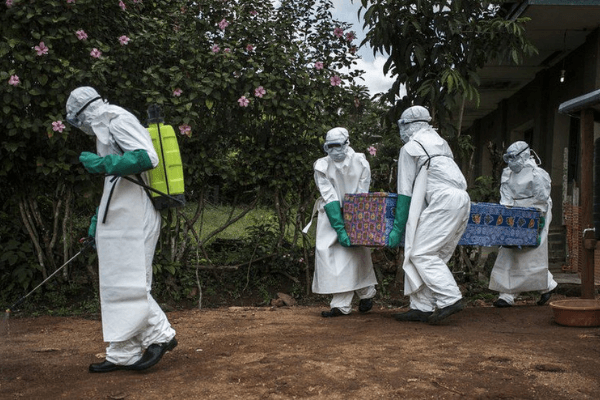
Nigeria’s experience with the last Ebola pandemic could be described as a narrow escape, given the minimal impact it had on lives. Five years down the road, the flu virus is roaring to stage a comeback, with outbreaks already reported in Democratic Republic of Congo (DRC) and Uganda. Unfortunately, Nigeria seems to have abandoned all the precautions it took to stave off the spread.
Nigeria needs to be more proactive in preventing another Ebola epidemic. During the 2014 outbreak, critics cited medical negligence, a relapse to old unsanitary habits by Nigerians and unpreparedness on the part of the health officials as factors that could escalate the attack.
During the epidemic, Nigeria saw the influx of diverse products like hand-washing soaps, gloves, health personnel protective equipment, hand-held infrared thermometers, among others, to help check the virus but appear to have paid off these years.
However, patronage of these products and the use of hand- sanitisers have since declined. There is no more screening of the temperature at the commercial and business places, in Nigeria’s neighbouring countries where people can easily travel by roads, and even at the airports.

The Ebola virus causes an acute, serious illness which is often fatal if untreated; the virus is transmitted to people from wild animals and spreads in the human population through human-to-human transmission.
Records show that forty-two days after the Ebola epidemic ravaged parts of Nigeria in 2014, the country recorded 19 cases which led to 10 deaths. However, WHO declared Nigeria Ebola free in October of the same year.
With this most recent outbreak, the virus finally found its way into Uganda, through a five-year-old boy who had made a cross-border journey to the neighbouring DRC. The little boy died, making it the first case of Ebola reported in the country. Two people have also reportedly died and many have reportedly been infected with the virus, according to a BBC report.
Several of Nigeria’s neighbouring countries have been preparing for months and some health experts in the country are also questioning how the country is preparing for the possibility that infected people might cross into the country.
Experts have advocated a number of approaches that Nigeria can help the country’s preparedness to stop the disease from gaining entrance into the country or combating it.

Oladoyin Odubanjo, chair, Association of Public Health Physicians of Nigeria (APHPN), Lagos Chapter, says that Nigeria’s health sector is characterised by poor outcomes vulnerability to the threat of future epidemics and outbreaks ,which threaten global health security.
According to Odubanjo, Nigeria’s epidemic preparedness and response capacity needs to close gaps by enhancing detection, prevention and management of an outbreak.
“Priority gaps include infrastructure, logistics, technology, human resource and communication,” he said.
History has it that the worst Ebola epidemic ever ended in West Africa just two years ago after killing more than 11,300 people and infecting some 28,600 as it rolled through Guinea, Sierra Leone and Liberia.
The Public Health Physicians added that with the possibility of more outbreaks, applying the lessons learnt and key success factors of the past should be applied in other to prepare the country against another outbreak.
“Nigeria can’t afford to repeat this cycle of uncertainty. Effective surveillance is clearly important, containment, general precautions measure will minimise risk of transmission of the viral disease coming into the county,” he said.
“All we need to do is to practise more universal care precautions at all times generally. People need to practice more hygiene, which is very important and the environment needs to be better,” Odubanjo advised.
In response to the recent outbreak, the World Health Organization, which has twice ruled that Ebola outbreak, has not constituted a global emergency.
Rotimi Arowole, a medical practitioner based in Abuja, said that responding to Ebola requires application of lessons learnt and key success factors of the past
“Nigeria’s top priority is to work alongside with the health workers, government, conduct contact tracing, engage communities with messages on symptoms, prevention and control,” said Arowole.
However, Nigeria is on high alert, and the Nigeria Centre for Disease Control has issued an advisory to help the public prevent an outbreak of Ebola in the country.
“Wash your hands frequently using soap and water – use hand sanitisers when soap and water are not readily available,” the centre said in the latest advisory.
“Avoid direct handling of dead wild animals and physical contact with anyone who has possible symptoms of an infection with an unknown diagnosis, it added.
It also advised health workers to ensure “universal care precautions at all times.”
ANTHONIA OBOKOH