|
Getting your Trinity Audio player ready...
|
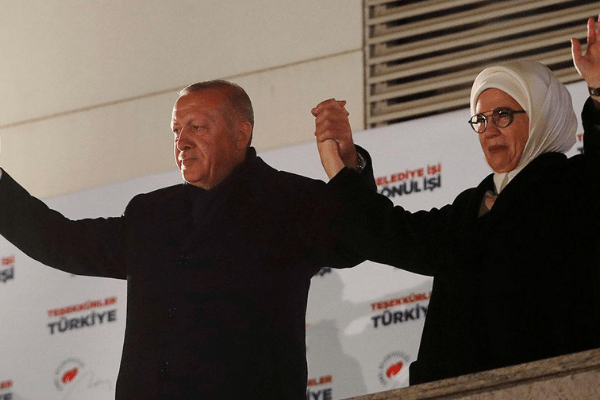
Recep Tayyip Erdogan strived for a reassuring tone when he addressed supporters from the balcony of his ruling party headquarters in the early hours of Monday morning.
But behind the upbeat veneer, the Turkish president was well aware that he had suffered one of the most difficult election results of his 16 years in charge. “If we have deficiencies it is our duty to fix them,” Mr Erdogan told the crowd in a tacit acknowledgement of the losses.
Having lost Ankara, the nation’s capital, and facing a bitter dispute over the result in Istanbul, Mr Erdogan must now add the need to fix his dented support to the array of domestic and international challenges he was already facing.
“It’s a terrible result for Erdogan,” said Berk Esen, an assistant professor of international relations at Ankara’s Bilkent University. “There’s an economic crisis, there’s an international crisis due to an ongoing stand-off with the US. At the same time, there is an electoral defeat that shows his international partners and domestic opponents that’s he’s quite vulnerable.”

Although Mr Erdogan was not a candidate in Sunday’s vote, he fought the campaign for control of Turkey’s 81 provinces as if it were a general election. He sought to distract from complaints about sky-high food prices and rising unemployment by casting the vote as a battle for national survival in the face of external threats. His face was on posters throughout Turkish towns and cities, and he zigzagged his way across the country on a gruelling schedule of campaign rallies.
The Turkish leader fought so hard because he knows from personal experience how victory on a local level can trigger a domino effect. He was elected mayor of Istanbul in 1994 on the back of a wave of support for Islamist politics. Eight years later, the Justice and Development party (AKP) that he founded swept to national power.
No one is predicting Mr Erdogan’s imminent demise. The 65-year-old remains by far and away the country’s most popular politician and has found his way out of tight spots many times. But the loss of Ankara and a string of economic powerhouses along the country’s south coast — including the industrial city of Adana and the tourism hub of Antalya — sent a clear message to the political alliance led by the AKP.
“They survive,” said Asli Aydintasbas, a senior fellow at the European Council on Foreign Relations, a think-tank. “But they don’t have the confidence of voters in big cities, including the best and brightest, the industrial elite and the middle class.”
Winning back those people will be a central focus for Mr Erdogan as he looks ahead to his dream of presiding over celebrations for the centenary of the Turkish republic in 2023.

But first the Turkish president must deal with some more pressing challenges. In the weeks and months ahead, he faces a looming confrontation with Washington over Turkey’s plan to buy an S-400 air defence system from Moscow. He must also find a way out of the deadlock over the future of northern Syria after US president Donald Trump promised to wind down the American presence in the country.
Turkey GDP
The strong showing on Sunday night for a group of ultranationalists who are allied with the AKP could complicate both of those issues. The Nationalist Movement party (MHP) harbours deep suspicions of foreign powers and takes a hardline stance towards Kurdish militants in Syria, potentially limiting Mr Erdogan’s ability to reach a compromise.
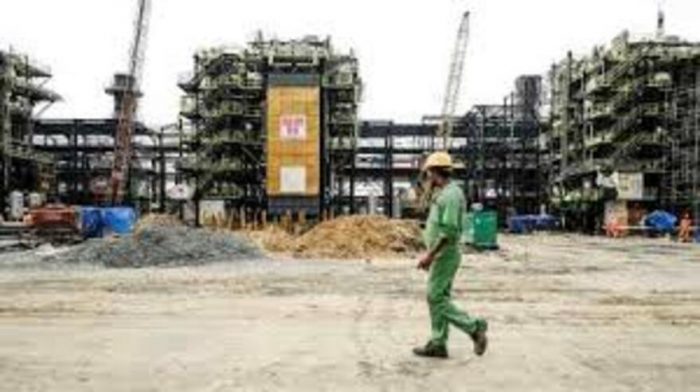
But the most daunting task facing the Turkish president is the urgent need to fix deep-rooted problems in the economy, which were exacerbated after last year’s currency crisis that saw the lira end 2018 almost 30 per cent weaker against the dollar. The lira fell 2.5 per cent to TL5.6939 to the dollar early in the London trading day.
Mr Erdogan moved swiftly on Sunday to reassure investors after a torrid week for Turkish assets in the days before the vote. In a stark contrast with his rhetoric on the campaign trail, when he lambasted foreign speculators and railed against high interest rates, the Turkish president promised to “adhere to the rules of a free-market economy” and focus on boosting technology and exports.
Still, he and his son-in-law, the finance minister Berat Albayrak, will need to rapidly and clearly spell out their plans in detail to regain the trust of investors who were left stunned by the methods used to prop up the lira in the final countdown to the vote.
Some voiced concern prior to the result that a poor outcome for the AKP and its de facto coalition partners could diminish the scope for bold reforms. “The worst outcome [for investors] is if the election shows a further weakening of the AKP coalition, and makes the government more apprehensive,” said Esther Law, a senior investment manager for emerging market debt at Amundi, a fund house.
One outcome of Sunday night’s votes that was met with almost universal relief was Mr Erdogan’s pledge that there would be no more elections until 2023.
After 13 polls in the past 12 years, Turkish voters are exhausted, the country’s western allies are tired of campaign jingoism, and investors are desperate for an end to the pursuit of credit-fuelled growth at the expense of all else. “From now on, we won’t be bound up in constant elections,” Mr Erdogan promised the electorate and his weary party activists. “Now, we are only going to look forward.”